One mushroom, five levers
- VO2max -- your maximum capacity to use oxygen -- is one of the most replicated predictors of a long life. In human trials the fermented Cs-4 strain raised aerobic and metabolic threshold, the point where exertion tips into exhaustion, especially in older and less-trained adults.
Oxygen & VO2max
the longevity biomarker
- Cordyceps is rich in adenosine, the backbone of ATP -- the exact molecule your mitochondria build for energy. In animal work Cs-4 improved steady-state bioenergy status, and cordyceps compounds protect mitochondria from oxidative damage.
Mitochondria & ATP
cellular energy
- After the liver, the heart and brain hold the most mitochondria of any tissue -- a single heart cell can carry thousands. A compound that supports mitochondrial energy is, by definition, most relevant to the organs that run on the most of them.
Heart & brain
your most mito-dense organs
- Cordyceps has been reviewed extensively for immune-modulating activity, and its compound cordycepin acts on inflammatory signalling -- which fits its centuries-old reputation as a tonic you take to rebuild strength when you are run down.
Immune resilience
the run-down tonic
- The pharmacology behind cordyceps' classic 'Yin-nourishing, Yang-invigorating' actions -- stamina, vitality and libido -- has been reviewed through the lens of energy metabolism and cellular support, the same machinery VO2max measures.
Vitality & stamina
the Yang tonic
$36 a month$45, 20% off applied by the link
20% off, applied by the link
Nothing to paste -- the discount rides the link for you.
First-time buyers: checkout uses 2-step verification for fraud protection, so have your phone handy.
We spend enormous energy tracking cholesterol, blood pressure and blood glucose. They matter. But there is a number almost no one measures that may tell us more about how long and how well we live than any of them.
The one biomarker that beats the labs you track.
VO2max: your maximum capacity to use oxygen under load.
In a study of more than 120,000 people, cardiorespiratory fitness tracked with survival so strongly that the lowest-fitness band carried a mortality risk comparable to smoking and diabetes.1 A 46-year follow-up found midlife fitness still predicting survival decades later, and meta-analyses keep ranking it among the strongest, most consistent predictors of all-cause mortality we have.2,3,4,5 It even beats body weight -- fit people carrying extra weight often outlive lean, unfit ones.6 This is not a fringe claim. It is one of the most replicated findings in biology.
The mushroom worth its weight in gold.
Not everyone is up for a regular hell-sprint.
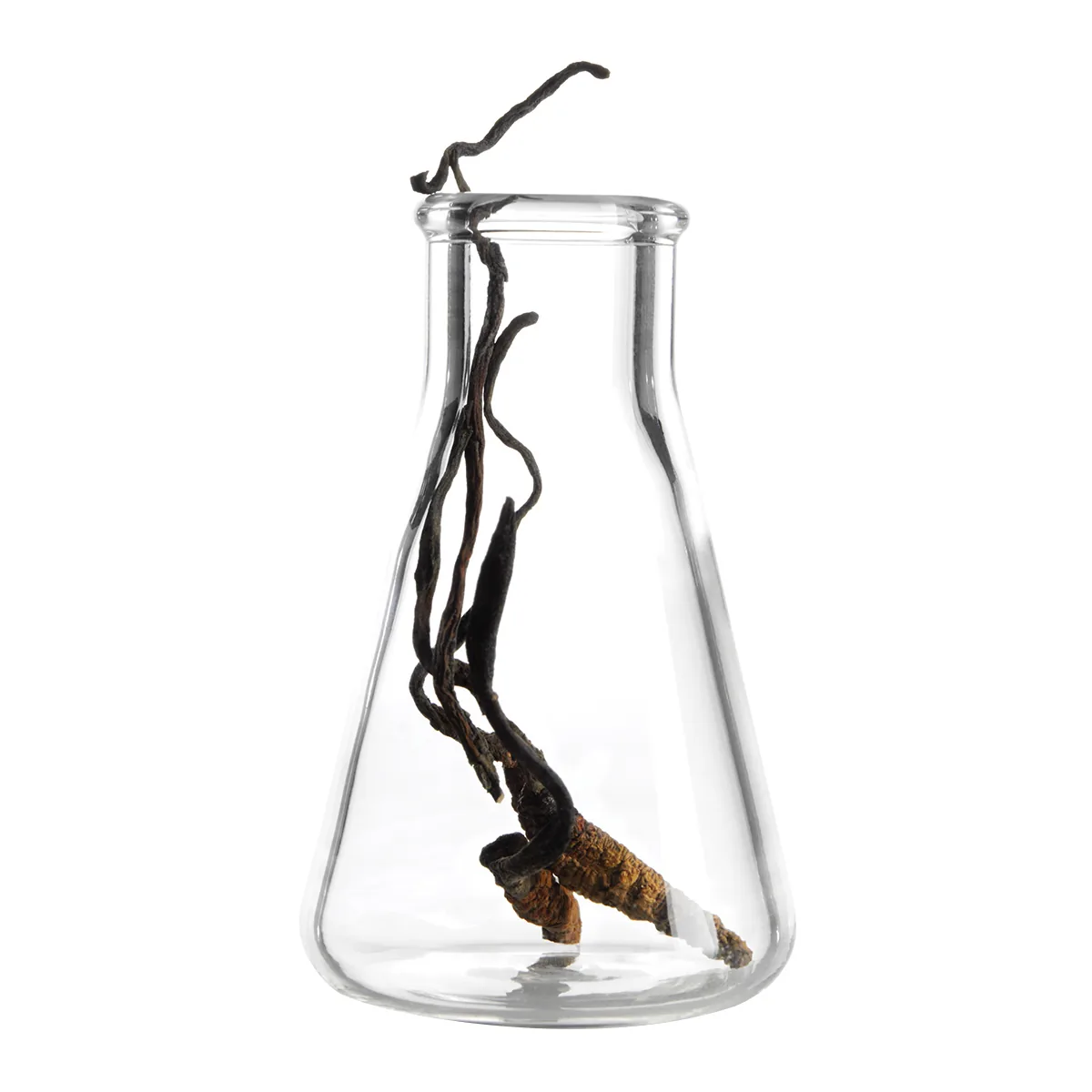
Training is the gold standard for raising VO2max, and nothing replaces movement. But not everyone has the joints, the time, or the appetite to push that hard week after week -- so it helps that there is a second lever on the same machinery. Cordyceps is a fungus that grows at high Himalayan altitude, historically out of a caterpillar buried under the snow. Wild, it was sold by weight against gold. In human trials the standardized fermented strain (Cs-4) raised the aerobic and metabolic threshold and measures of oxygen use, especially in older and less-conditioned adults,7,8,9 and in the lab it raises tolerance to low oxygen by switching on oxygen-sparing pathways12 -- exactly what you would expect from something evolved to survive where the air is thin.
How it works: adenosine, ATP, mitochondria.
A tonic that feeds the engine, not a stimulant that whips it.
Cordyceps is unusually rich in adenosine -- and adenosine is the backbone of ATP, the exact molecule your mitochondria build to power everything you do. In animal work the fermented Cs-4 strain improved steady-state bioenergy status, and cordyceps compounds protect mitochondria from oxidative damage and help preserve healthy mitochondrial dynamics.14,15,16 That is the difference between a stimulant and a tonic: caffeine whips a tired horse, while supporting mitochondrial ATP is closer to feeding it.
Why it reaches the heart and the brain.
The most energy-hungry organs hold the most mitochondria.
Mitochondria are not spread evenly. A single heart muscle cell can carry thousands, and neurons hundreds to thousands each; after the liver, the heart and brain are the most mitochondria-dense tissues in the body. So a compound that supports mitochondrial energy production is, by definition, most relevant to the organs that run on the most mitochondria -- which is why cordyceps has a long reputation as a heart and brain tonic, and why the pharmacology behind its classic vitality actions has been reviewed through exactly this lens.19
More than oxygen: the run-down tonic.
The same organism has a well-studied immune side: cordyceps has been reviewed extensively for immune-modulating activity, and its compound cordycepin acts on inflammatory signalling.17,18 That fits its centuries-old use as something you take to rebuild strength when you are run down -- so the case does not rest on the oxygen story alone.
The honest part: who it helps.
Grounded is the whole point. This is not magic and the evidence is not uniform. In trained young cyclists, one well-run trial found the fermented strain did not improve endurance performance13 -- if your engine is already elite, do not expect a supplement to move it much. The consistent signal is in older and less-trained people,8,9 and in tolerance to hard efforts rather than turning a couch into a marathon.10,11 So the fair claim is simple: if you cannot train like an athlete, this is a legitimately evidence-supported way to nudge the same oxygen-and-energy machinery -- and if you already are one, it may still offer a modest edge.
Grown in water, not picked off a mountain.
Wild cordyceps is one of the most expensive substances on earth. A team of researchers worked out how to grow the active strain in a controlled water fermentation, so you get the standardized Cs-4 profile without paying Himalayan hand-picked prices. That is what CordyMax Cs-4 is: the studied strain, in a consistent, reproducible extract, for about $36 a month -- a genuinely cheap way to support a system that predicts how long and how well you live.
20% off, applied by the link
Nothing to paste -- the discount rides the link for you.
First-time buyers: checkout uses 2-step verification for fraud protection, so have your phone handy.
Who standardized it.
Pharmanex was built by working scientists, not marketers. Its founding-era head of R&D and chief science officer, Michael N. Chang, PhD -- organic chemistry at Brandeis, postdoc at MIT, more than 35 patents and 60 papers, who later co-founded a pharmaceutical company that brought a real antibiotic to market -- set the bar for how its formulas were designed and standardized. That pedigree is why the Cs-4 strain here is a defined, reproducible extract rather than gambling on wild-harvested material.
Take it further
FAQ
What is VO2max and why does it matter so much?
VO2max is the maximum oxygen your body can take in and use when you push hard. It reflects your heart, lungs, blood and mitochondria working together, which is why it predicts all-cause mortality so consistently -- in a 120,000-person treadmill study, low fitness carried risk comparable to smoking and diabetes.
Is VO2max really a better predictor than cholesterol or blood pressure?
Those each measure one system; VO2max measures the whole engine at once. Reviews repeatedly rank cardiorespiratory fitness among the strongest and most consistent predictors of mortality we have, and fit-but-heavier people often outlive lean-but-unfit people.
How do you raise VO2max?
Hard, repeated, higher-intensity exertion is the gold standard. If that isn't realistic for your joints, time or health, supporting the oxygen-and-energy machinery directly is a second lever -- which is where cordyceps comes in.
Does cordyceps actually raise VO2max, or is that hype?
Honestly, it's mixed but real. Human trials of the fermented Cs-4 strain raised aerobic/metabolic threshold and oxygen use, mostly in older and less-trained adults; in elite young athletes one trial found no benefit. So it's a genuine lever for most people, and a modest one for the already-fit.
How does a caterpillar fungus improve oxygen use?
Cordyceps is rich in adenosine, the backbone of ATP -- the exact molecule your mitochondria build for energy. It grows where oxygen is thin (high Himalayan altitude) and switches on oxygen-sparing pathways, so it supports the machinery rather than stimulating like caffeine.
The research
All 19, grouped and numbered. Every marker in the text above jumps to its entry here, linked to the source. This is the same set carried by the deep-dive article. Animal and in-vitro studies are noted in the text where they are cited.
VO2max and how long you live6 studies · 1–6
- 1Association of Cardiorespiratory Fitness With Long-term Mortality Among Adults Undergoing Exercise Treadmill Testing
- 2Midlife Cardiorespiratory Fitness and the Long-Term Risk of Mortality: 46 Years of Follow-Up
- 3Cardiorespiratory fitness as a quantitative predictor of all-cause mortality and cardiovascular events in healthy men and women: a meta-analysis
- 4Impact of Cardiorespiratory Fitness on All-Cause and Disease-Specific Mortality: Advances Since 2009
- 5Cardiorespiratory fitness, body mass index and mortality: a systematic review and meta-analysis
- 6Cardiorespiratory Fitness, BMI, Mortality, and Cardiovascular Disease in Adults with Overweight/Obesity and Type 2 Diabetes
Cordyceps, oxygen and exercise capacity7 studies · 7–13
- 7Cordyceps Cs-4 and exercise metabolic threshold, RCT
- 8Effect of Cs-4 (Cordyceps sinensis) on exercise performance in healthy older subjects: a double-blind, placebo-controlled trial
- 9Randomized double-blind placebo-controlled clinical trial and assessment of fermentation product of Cordyceps sinensis (Cs-4) in enhancing aerobic capacity and respiratory function of the healthy elderly volunteers
- 10Cordyceps militaris improves tolerance to high intensity exercise after acute and chronic supplementation
- 11Cordyceps militaris Improves Tolerance to High-Intensity Exercise After Acute and Chronic Supplementation
- 12Cordyceps sinensis Increases Hypoxia Tolerance by Inducing Heme Oxygenase-1 and Metallothionein via Nrf2 Activation in Human Lung Epithelial Cells
- 13Cordyceps Sinensis (CordyMax Cs-4) supplementation does not improve endurance exercise performance
Cordyceps, mitochondria and ATP3 studies · 14–16
Cordyceps, immunity and inflammation2 studies · 17–18
Traditional actions: vitality and the tonics1 studies · 19–19
Education only. These statements have not been evaluated by the Food and Drug Administration. Nothing here is medical advice, and nothing here diagnoses, treats, cures or prevents any disease.