Five disguises, one signal
Stubborn belly fat
that diet barely moves
Anxious for no reason
worst in the morning
Wired at night, tired all day
the rhythm is flipped
Perimenopause turned up
the same stress hits harder
Weight creeping up
on the same food and effort
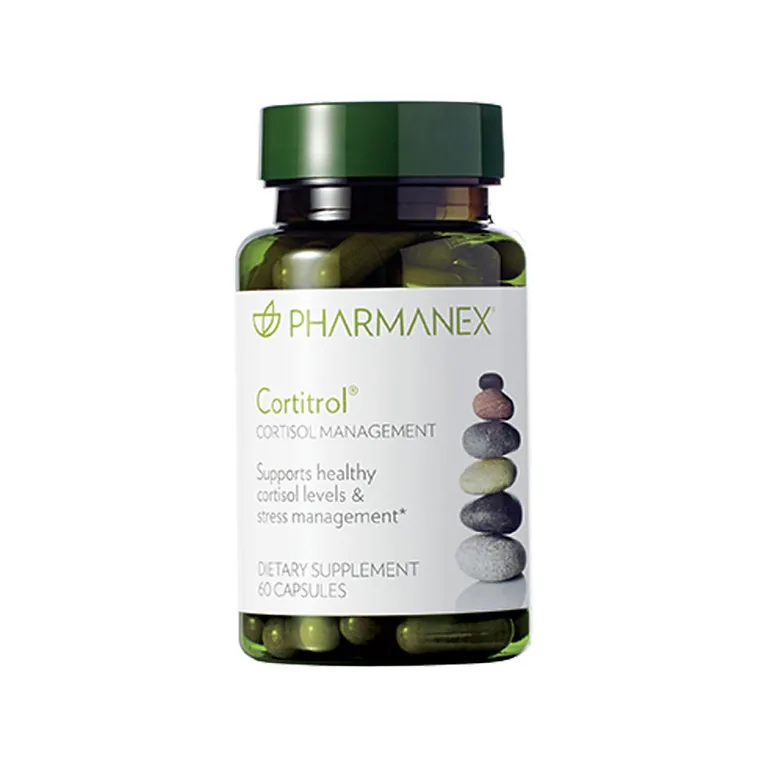
$51 a month$61, 20% off applied by the link · 60 capsules
20% off, applied by the link
Nothing to paste -- the discount rides the link for you.
First-time buyers: checkout uses 2-step verification for fraud protection, so have your phone handy.
You can be doing everything right -- eating clean, walking, sleeping when you can -- and still carry weight around the middle, wake up with your heart going, and feel wired at midnight but flattened by 3pm. It looks like five separate failures of willpower. It is usually one hormone, running on the wrong setting -- and chronic stress, poor sleep and weight are wired into that same axis, each one turning up the others.49,50,51
The belly fat isn't insulin. It's cortisol.
Cortisol activates an enzyme right inside abdominal fat.
Visceral fat -- the deep kind around the organs -- is unusually rich in an enzyme called 11beta-HSD1, which regenerates active cortisol locally, so stress feeds fat exactly where you least want it, and that enzyme is a recognized target in obesity research.1,4 In people, a higher and more reactive cortisol pattern tracks with more central fat, and stress reliably drives "consolatory eating" toward calorie-dense food -- and abdominal obesity itself raises overnight cortisol output, a self-feeding loop measured directly.2,3,5,6,7 That is why the last few inches around the middle resist a diet that works everywhere else: you are dieting against a hormone, not a calorie count.
Anxious for no reason -- worst in the morning.
There's a name for it: the cortisol awakening response.
Cortisol is supposed to surge in the first 30-45 minutes after you wake -- that's the cortisol awakening response, and it is measurable and well characterized -- its parameters map onto how reactive and slow-to-recover your whole stress system is.10,12 When it runs too high, that "anxious the second my eyes open" feeling is the surge, not a character flaw. It is also modifiable: even gut-directed changes have lowered the waking cortisol response and shifted emotional bias in controlled work, and chronic stress leaves a lasting fingerprint you can read in nail and hair cortisol.11,13 Adaptogens like ashwagandha have lowered measured cortisol in stressed adults, one line of evidence that the stress axis is a movable target, not a fixed trait.15,16
Tired all day, wired at night.
One broken rhythm, seen from both ends of the day.
Healthy cortisol is high in the morning and low at night. When that daily curve flattens or flips, you get exhaustion by day and alertness at night -- and salivary cortisol dynamics track directly with sleep quality, and short sleep the night before winds the whole cortisol system tighter the next day.17,20,21 Even a single night of deprivation reshapes the morning surge, and when you eat can shift the rhythm too.19,22 The "tired but wired" state most people describe isn't two problems. It's the same rhythm, off.
Perimenopause turns the volume up.
The same stress lands harder through the transition.
Through the perimenopausal years, stress and cortisol don't just sit beside the hormone shift -- they amplify it. In recent work, menopausal symptoms actually mediated the link between stress and psychological distress, and reviews of perimenopausal nutrition point at the same stress-and-mood axis, and mind-body approaches have measurably eased menopausal sleep, anxiety and low mood.23,24,25,26,27 It helps explain why the same life feels so different from one year to the next.
Weight creeping up on the same food.
Not a new habit -- a hormone quietly moved the setpoint.
Put the pieces together and the slow creep makes sense: a cortisol pattern that favors central fat, plus stress-driven eating, plus a flipped rhythm that steals recovery.3,2 Same food, same effort, different result -- because the hormone underneath changed, not the willpower.
The plants that work the stress pathway.
Here's the second thing worth knowing: certain plant compounds act on the very same stress pathway -- the calming brake in the brain and the body's cortisol handling around stress -- and several have real human trials. Ancient plants, read with modern instruments.
L-theanine, from green tea
The best-supported calming compound in this class: randomized human trials link it to lower stress-related symptoms and better sleep quality, without sedation, and it pairs with GABA for sleep -- and a 2024 meta-analysis of 31 randomized trials backs the calm-focus effect.28,29,30,31,32+3 more
Magnolia bark, standardized to honokiol
Its active compounds, magnolol and honokiol, are positive allosteric modulators of the brain's GABA-A receptors -- the same calming brake, worked gently -- with animal work showing an antidepressant-like effect.36,37
Phosphatidylserine
One of the ingredients most studied for blunting the body's endocrine and psychological response to stress, in trials spanning acute stress, exercise and mood.38,39,40,41
Epimedium
A phytoestrogen-bearing botanical long used in women's formulas, which is part of why this class of blend gets reached for through the menopausal transition, with research on its phytoestrogenic and mood effects.42,43,44,45
Plant sterols
Best known for lowering LDL cholesterol at the gut, and studied for the immune-and-stress side of hard exercise; higher dietary sterol and lignan intake even tracked with lower perceived stress in a recent survey.46,47,48
One evening formula, not five bottles.
You could chase each of these compounds separately. Or take them the way they were formulated to be taken together: Cortitrol is a single evening blend that brings magnolia bark (standardized to honokiol), L-theanine, phosphatidylserine, plant sterols and epimedium into two capsules with dinner -- built to support the body's normal, healthy cortisol rhythm as the day winds down, rather than to sedate you.
The honest read: this is a proprietary blend, so not every per-ingredient amount is published, and the strongest single-compound evidence sits with L-theanine. What it is, is an evidence-based way to support your nervous system's normal downshift through a stressful stretch -- not a lever that lowers a lab value, and not a treatment for any condition.
20% off, applied by the link
Nothing to paste -- the discount rides the link for you.
First-time buyers: checkout uses 2-step verification for fraud protection, so have your phone handy.
Who formulated it.
Pharmanex was built by working scientists, not marketers. Its founding-era head of R&D and chief science officer, Michael N. Chang, PhD -- organic chemistry at Brandeis, postdoc at MIT, more than 35 patents and 60 papers, who later co-founded a pharmaceutical company that brought a real antibiotic to market -- set the bar for how its formulas were designed and standardized.
The wider bench behind the brand includes Lester Packer, PhD, one of the world's foremost antioxidant scientists, 40 years at UC Berkeley, who originated the "network antioxidant" concept. That is the difference between a blend thrown together to ride a trend and one designed by people who spent careers on how plant compounds actually behave in the body.
Taken at night, for a reason.
Because the goal is to support the evening end of the cortisol rhythm -- the downshift that lets you fall and stay asleep -- these compounds are taken with the evening meal, not first thing.17,18,19,20,21+1 more If sleep is your main way in, start with the rhythm itself: our Sleep: The Repair Window piece covers why the timing matters more than most people think.
Take it further
FAQ
How do I know if my belly fat is from cortisol and not diet?
Cortisol-driven fat settles around the middle and resists diet change because cortisol activates an enzyme (11beta-HSD1) that regenerates it right inside abdominal fat. If the weight is central, stress is high, and diet changes barely move it, cortisol is a prime suspect -- the blog covers the research and how to check.
Why do I wake up anxious for no reason?
That is often the cortisol awakening response -- a normal morning cortisol surge that becomes a problem when it runs too high. It is measurable and modifiable; even gut-directed changes have lowered the waking cortisol response in studies. The anxiety is on a curve, not in your head.
Why am I tired all day but wired at night?
Healthy cortisol is high in the morning and low at night. When that curve flattens or inverts, you get exhaustion by day and alertness at night -- salivary cortisol dynamics track directly with sleep quality. It is one broken rhythm seen from both ends of the day.
Does cortisol affect perimenopause?
Yes -- in the perimenopausal years stress and cortisol amplify symptoms rather than sitting beside them, and menopausal symptoms have been shown to mediate the link between stress and distress. It helps explain why the same transition feels very different for different women.
What plants actually lower the stress response?
L-theanine (calming without sedation, with randomized trials), magnolia bark (its compounds act on the brain's GABA-A calming receptors), phosphatidylserine (blunts the cortisol response to stress), and epimedium (a phytoestrogen used in women's formulas). The blog cites the studies for each and explains why they are used together on the HPA axis.
The research
All 51, grouped and numbered. Every marker in the text above jumps to its entry here, linked to the source. This is the same set carried by the deep-dive article.
Cortisol and belly fat9 studies · 1–9
- 1Cortisol metabolism and visceral obesity: role of 11beta-hydroxysteroid dehydrogenase type I enzyme and reduced co-factor NADPH
- 2['Consolatory eating' is not a myth. Stress-induced increased cortisol levels result in leptin-resistant obesity]
- 3Occupational status, cortisol secretory pattern, and visceral obesity in middle-aged men
- 411beta-Hydroxysteroid dehydrogenase type 1 and obesity
- 5Abdominal obesity increases overnight cortisol excretion
- 6Cortisol Stress Reactivity to the Trier Social Stress Test in Obese Adults
- 7The cortisol stress response in youth with overweight and obesity: Influence of psychosocial variables
- 8The weight of stigma: Cortisol reactivity to manipulated weight stigma
- 9A missense mutation in the human melanocortin-4 receptor gene in relation to abdominal obesity and salivary cortisol
Morning anxiety and the cortisol awakening response7 studies · 10–16
- 10Cortisol Awakening Response: Regulation and Functional Significance
- 11Prebiotic intake reduces the waking cortisol response and alters emotional bias in healthy volunteers
- 12Associations of diurnal cortisol parameters with cortisol stress reactivity and recovery: A systematic review and meta-analysis
- 13Human nail cortisol as a retrospective biomarker of chronic stress: A systematic review
- 14Social support and oxytocin interact to suppress cortisol and subjective responses to psychosocial stress
- 15Dual impact of Ashwagandha: Significant cortisol reduction but no effects on perceived stress -- A systematic review and meta-analysis
- 16Effects of Withania somnifera on Cortisol Levels in Stressed Human Subjects: A Systematic Review
Sleep and the daily cortisol rhythm6 studies · 17–22
- 17Salivary cortisol dynamics and their relationship with sleep and mental well-being in adults receiving a phospholipid-based Melissa officinalis supplement: a secondary analysis in a subpopulation
- 18Grounding and cortisol/sleep, pilot study
- 19The cortisol awakening response after sleep deprivation: Is the cortisol awakening response a “response” to awakening or a circadian process?
- 20Nocturnal ghrelin, ACTH, GH and cortisol secretion after sleep deprivation in humans
- 21Hair Cortisol Concentration as a Biomarker of Sleep Quality and Related Disorders
- 22The Window Matters: A Systematic Review of Time Restricted Eating Strategies in Relation to Cortisol and Melatonin Secretion
Perimenopause, stress and cortisol5 studies · 23–27
- 23Heightened menopausal symptoms mediate the associations between stress and depressive symptoms among midlife women
- 24Nutritional Interventions for Perimenopausal Anxiety and Depression Targeting Tryptophan and GABA Pathways: A Narrative Review
- 25Mind-body therapies for sleep disturbances, depression, and anxiety in menopausal women: a systematic review and meta-analysis of randomized controlled trials
- 26Meta-analysis on the efficacy of liver-soothing formulas for perimenopausal anxiety and depression
- 27Effect of vitamin D supplementation on fatigue and mood among perimenopausal women
L-theanine, from green tea8 studies · 28–35
- 28Effects of L-Theanine Administration on Stress-Related Symptoms and Cognitive Functions in Healthy Adults: A Randomized Controlled Trial
- 29A Randomized, Triple-Blind, Placebo-Controlled, Crossover Study to Investigate the Efficacy of a Single Dose of AlphaWave l-Theanine on Stress in a Healthy Adult Population
- 30Effects of combined GABA and L-theanine supplementation on sleep quality: an exploratory study
- 31Safety and Efficacy of AlphaWave l-Theanine Supplementation for 28 Days in Healthy Adults with Moderate Stress: A Randomized, Double-Blind, Placebo-Controlled Trial
- 32Anti-Stress, Behavioural and Magnetoencephalography Effects of an l-Theanine-Based Nutrient Drink: A Randomised, Double-Blind, Placebo-Controlled, Crossover Trial
- 33Cognitive and affective effects of L-theanine: systematic review and meta-analysis of 31 randomized trials
- 34L-theanine consumption on sleep outcomes
- 35Tea or L-theanine on cognition sleep and mood in healthy participants
Magnolia bark (magnolol and honokiol)2 studies · 36–37
Phosphatidylserine and the stress response4 studies · 38–41
- 38Phosphatidic acid and phosphatidylserine complex on endocrine and psychological stress responses
- 39Soy phosphatidylserine/phosphatidic acid complex normalizes HPA reactivity
- 40Phosphatidylserine on endocrine response to moderate-intensity exercise
- 41Phosphatidylserine supplementation on mood and heart rate during acute stress
Epimedium and women's hormones4 studies · 42–45
- 42Epimedium-derived phytoestrogen flavonoids exert beneficial effect on preventing bone loss in late postmenopausal women: a 24-month randomized, double-blind and placebo-controlled trial
- 43Epimedium brevicornum in glucocorticoid-suppressed neuroendocrine-immune function
- 44Neuroprotective effects of icariin in animal models of depression and anxiety: a systematic review of preclinical studies
- 45Icariin attenuates premature ovarian insufficiency via a phytoestrogenic mechanism mediated by the ERβ/SIRT3 pathway
Plant sterols, cholesterol and stress3 studies · 46–48
Chronic stress and the HPA axis3 studies · 49–51
- 49Sleep deprivation potentiates HPA axis stress reactivity in healthy adults
- 50Body Weight Management in Adults Under Chronic Stress Through Treatment With Ashwagandha Root Extract: A Double-Blind, Randomized, Placebo-Controlled Trial
- 51Long-term magnesium supplementation improves glucocorticoid metabolism: A post-hoc analysis of an intervention trial
Education only. These statements have not been evaluated by the Food and Drug Administration. Nothing here is medical advice, and nothing here diagnoses, treats, cures or prevents any disease.