Sources listed
In 1991 a 68-year-old woman named Charlotte Haley sat at her dining-room table and hand-made peach-colored ribbons. Her grandmother, her sister and her daughter had all had breast cancer. She stapled each packet of five to a postcard: the National Cancer Institute's budget is $1.8 billion, only 5 percent goes to prevention, help us wake up America by wearing this ribbon. Her ribbon was about prevention. Self magazine and Estée Lauder wanted it for a breast cancer awareness issue. She said no: too corporate, too commercial. The magazine asked its lawyers what to do. The lawyers said: change the color. Pink tested as soothing. So the ribbon went pink, and the word on it went from prevention to awareness. That is the whole story in one paragraph. A woman asked why only five cents of every cancer dollar went to stopping cancer. A cosmetics company took her symbol, changed its color, dropped her question, and has sold it every October since. My friend Denny put it in three words this week, prevention > awareness, in a reel that opens with who started Awareness Month in the first place. Start there, because it explains everything after it.
Awareness is a product. Prevention is free.
Awareness sells. In 2010 more than 5,000 KFC restaurants went pink and gave 50 cents a bucket to Komen, $4.2 million in all, for a food nobody pretends prevents anything. Estée Lauder has raised over $99 million in the name of breast cancer since 1992 while its own products carried parabens, preservatives that act like estrogen in the body. Breast Cancer Action coined the word for it: pinkwashing. A pink ribbon on a product that contains chemicals linked to the disease it claims to fight. Prevention does not need a box. So let us look at what the ribbon sells, starting with the thing it is built around.
Who started Awareness Month: a chemical company
Denny opened his reel with the part almost nobody knows, and his sources check out. Breast Cancer Awareness Month began in October 1985 as a week-long campaign by the American Cancer Society in partnership with the pharmaceutical arm of Imperial Chemical Industries, a British conglomerate that sold pesticides and drugs out of the same house. ICI's drug business became Zeneca, then AstraZeneca; its agrochemical business became Syngenta. Same company, both sides of the ledger: the chemical and the pill for what the chemical does. Syngenta sells atrazine, the second most used weedkiller in America. In human adrenal cells, atrazine and its cousins induced aromatase, the enzyme that manufactures estrogen, about 2.5-fold (Sanderson, Toxicological Sciences, 2000) [1]. Excess estrogen is the best-established driver of hormone-positive breast cancer. In November 2025 the WHO's cancer agency reclassified atrazine as probably carcinogenic to humans, citing mammary and uterine tumors in rats; the US EPA disputes it. Our library holds women drinking atrazine-contaminated water with lower estrogen and more irregular cycles [2], the review of atrazine's aromatase effect [3], the documents showing Syngenta paid scientists and a television pundit to defend the chemical without disclosing it [4], and the other side: a 2026 modeling paper arguing aromatase induction only appears at 350 to 1,013 times the blood levels reached at regulatory exposure [5]. On the pharmaceutical side, ICI made Nolvadex, better known as tamoxifen, approved in the UK in 1973 and the most successful breast cancer drug ever sold (Jordan, Endocrine-Related Cancer, 2021). Tamoxifen is itself an IARC Group 1 carcinogen: it causes cancer of the uterus. In the trial that established it for early breast cancer, NSABP B-14, 23 of 25 endometrial cancers occurred in the tamoxifen groups and four of those women died of it [6]. The same listing says, in the same breath, that tamoxifen reduces the risk of a second breast cancer, and that is true too. The company that founded Awareness Month sold a probable carcinogen that raises estrogen, and a Group 1 carcinogen that blocks it. Awareness was the business plan.
The mammogram: the numbers from the trials, not the poster
Get screened, says every pink poster. Here is what the trials say when you read them instead. The Cochrane review of screening mammography, the most rigorous independent summary there is: for every 2,000 women invited to screening for 10 years, one avoids dying of breast cancer. Ten healthy women, who would never have been diagnosed without screening, are treated as cancer patients anyway. More than 200 live through a false alarm. The adequately randomized trials found no effect on total cancer deaths or on deaths from any cause, and the screened groups had 31 percent more lumpectomies and mastectomies. The Canadian National Breast Screening Study followed 89,835 women for 25 years: 180 breast cancer deaths with annual mammograms, 171 without. No benefit, and 22 percent of the cancers it found were overdiagnosed, one for every 424 women screened. Our own library holds the overdiagnosis literature: the randomized trials show persistent excess incidence after lead time is accounted for [7]; DCIS, stage zero, is about 20 percent of what screening finds, and only about half of untreated cases ever progress over four decades [8]; in Norway, screened and unscreened women ended up with no significant difference in cumulative incidence [9]. The other side ships too: estimates as low as 1 to 5 percent overdiagnosis from service screening [10], and a Korean cohort where follow-up mammography after a diagnosis cut mortality 28 percent [11]. The argument is about how big the harm is, not whether it exists.
- Start annual mammograms at 40 and your chance of at least one false positive in the first 10 years is 61 percent. Your chance of a false-positive biopsy recommendation is 7 percent (Hubbard, Annals of Internal Medicine, 2011).
- The radiation itself: the modeling study done for the US Preventive Services Task Force projected 15 to 35 deaths per 100,000 women from cancers caused by screening mammography, highest in women with large breasts who need extra views (Miglioretti, 2016).
- The biopsy needle moves cells. In a 1999 series, malignant cells were displaced along the needle track in 32 percent of patients after core biopsy, 42 percent when surgery followed within 15 days. A 2009 systematic review put it at 22 percent, range 2 to 63, and noted local recurrence did not differ from excisional biopsy, which is why the field calls it manageable. Both halves reported. Nobody tells you before the needle goes in, and they will biopsy the same spot again next year.
- So the pipeline is: a test that finds ten harmless lesions for every life it saves, a false-alarm rate most women hit in a decade, a needle that moves cells, a diagnosis, and a woman who is now a patient inside a system that bills by the procedure. That is not prevention. That is intake.
Birth control is on the carcinogen list
This is the one almost no woman has been told. The World Health Organization's cancer agency, IARC, lists combined estrogen-progestogen oral contraceptives as Group 1: carcinogenic to humans. Same group as tobacco smoke and asbestos. Monograph 100A names the cancers: breast, cervix and liver. The same monograph says the pill lowers endometrial and ovarian cancer risk, and we say that too, because the charter of this library is that both directions ship. Then the modern numbers. The Danish national cohort followed 1.8 million women for 10.9 years: current and recent users of hormonal contraception had a 20 percent higher breast cancer risk than never-users, rising with duration, about 13 extra breast cancers per 100,000 women a year (Mørch, New England Journal of Medicine, 2017). A 2023 UK study and meta-analysis found the same 20 to 30 percent increase for progestogen-only methods too, pill, injection, implant and hormonal IUD alike [12]. Cervical cancer: among women carrying HPV, 5 to 9 years on the pill nearly tripled the risk and 10 years or more quadrupled it [13]. Liver: the pill is the recognized cause of hepatocellular adenoma, and some of those turn malignant. And it is not only cancer. In the Danish registries, teenage girls on the combined pill were 1.8 times as likely to start an antidepressant, 2.2 times on progestin-only pills (JAMA Psychiatry, 2016); users had roughly double the rate of a first suicide attempt and three times the rate of completed suicide [14]. Injectable medroxyprogesterone, the Depo shot, carried 5.5 times the odds of a brain meningioma needing surgery after a year or more of use [15]. Our library carries the umbrella review that lists oral contraceptive use among the determinants of breast cancer across 35 meta-analyses [16], the ovarian-cancer review where the pill lowers risk [17], and an Italian cohort where it ran the other way for breast cancer [18]. All of it shown. A Group 1 carcinogen is handed to girls at 15 as routine, for decades, with a pink ribbon on the box, and the word awareness nowhere near it.
The tampon
The ribbon is printed on the box. Here is what is in it. In 2024 researchers at UC Berkeley tested 30 tampons from 14 brands and found 16 metals. Lead was in every single one. Arsenic. Cadmium. Lead ran higher in conventional brands, arsenic higher in organic ones (Shearston, Environment International). A UK test the same year found glyphosate, the weedkiller the WHO calls a probable carcinogen, in a box of tampons at 40 times the legal limit for drinking water. Our library holds the wider picture: a 2024 systematic review of 15 studies found phthalates, parabens, phenols and fragrance chemicals in tampons and pads and called it an often-overlooked route of chemical exposure to reproductive tissue [19]; extracts from 18 tampon brands showed estrogen-mimicking activity in nearly half, organic or not [20]; every one of 16 sanitary pads and 7 panty liners tested in South Africa contained parabens, phthalates and bisphenols [21]; PFAS turned up across 91 personal-hygiene products, and skin absorption from a diaper or a cup exceeded house dust [22]; a 2024 synthesis tied urinary glyphosate to breast cancer risk, endocrine disruption and altered DNA methylation in humans [23]. The tissue these products touch is not skin. It absorbs. Nobody asked you. And some of the proceeds go to the marketing of awareness.
The makeup: she is not enough without it
Then we hand her the makeup, and the message underneath it: you are not enough as you are. Permanent hair dye: 8 percent higher breast cancer risk across 17 studies [24], 18.8 percent across eight case-control studies [25]. Chemical relaxers: nearly double the uterine cancer in the same review [24]; the NIH Sister Study of 33,000 women put the lifetime risk at 4.05 percent for frequent users against 1.64 percent for never-users (JNCI, 2022), and hair products track with ovarian cancer in the same cohort [26], with chemical straighteners and incident uterine cancer in the Sister Study itself [27]. Parabens, the preservative in the lotion and the mascara: two 2025 genetic-causation studies tie methylparaben and n-butylparaben to breast cancer through named signaling pathways [28] [29]. Phthalates, the fragrance carrier: higher urinary levels tracked with breast cancer in Mexican women [30] and in Indian women [31], and a Danish national cohort tied phthalate exposure to breast cancer incidence [32]. The single best argument for prevention is one experiment: in 2023, women simply stopped using daily personal-care products containing parabens and phthalates, and the cancer-associated changes in their own breast tissue reversed [33]. Both directions, as always: antiperspirant studies are inconsistent [34], a 2025 review found no increased breast, ovarian or uterine cancer from relaxers across seven cohorts of Black women [35], and one meta-analysis found no BPA association [36]. The direction of the whole shelf is not in doubt, and the burden of proof was never put on the people selling it.
- And when the makeup is not enough, the body itself. In October 2021 the FDA put a black-box warning on every breast implant sold in the United States: a lymphoma called BIA-ALCL, 573 reports and 33 deaths at that time, plus the fatigue, joint pain, brain fog and memory loss patients call breast implant illness.
- A 10-year study of one implant line found capsular contracture rising about 1 percent a year and a 5.7 percent rupture rate on MRI [78]. A 2026 review lays out the mechanism: chronic foreign-body inflammation, silicone gel bleed, macrophage activation [79].
- Teach a girl she is not enough, sell her the fix, and the fix carries the risk. Every step has a receipt.
The diaper
Her exposure started before she could walk. In 2019 the French safety agency ANSES tested 23 diapers and found about 60 potentially harmful substances: glyphosate, dioxins, furans, PCBs, formaldehyde, PAHs, fragrance chemicals, some above safe limits over a realistic 4,000 diapers in the first three years. It was the first such test by any national safety body in the world. Since then: volatile organic compounds in all 31 US diapers and wipes tested, with benzene in some baby diapers [37]; phthalate levels in diapers tracking phthalate metabolites and a DNA-damage marker in infant urine, with skin absorption estimated at up to 45 percent of total exposure [38]; bisphenols in nearly half of 109 daycare diaper urine samples, with the BPA-free substitutes BPS and BPF found more often than BPA itself [39]; phthalates measured across childhood tracking with earlier puberty and smaller uterine volume at 14 in girls [40].
The vial: known carcinogens, tested by every route except the one they use
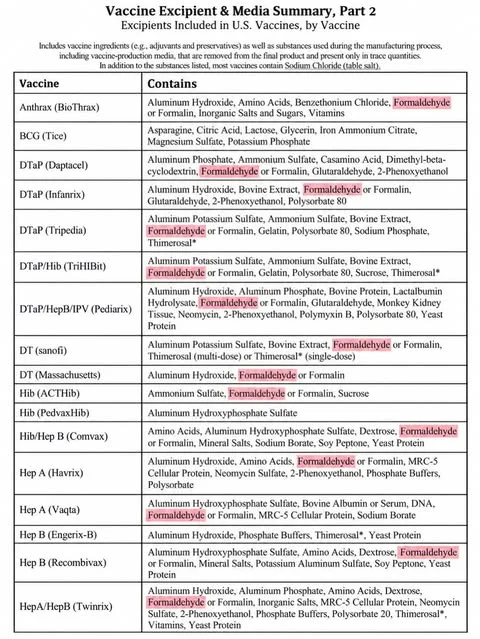
Before she is two she has been injected dozens of times, and the ingredient list is a public document. The CDC's own excipient table lists formaldehyde in 24 products across 14 vaccine families; IARC classifies formaldehyde as carcinogenic to humans [41], and the occupational record is not subtle: myeloid leukemia deaths rose with peak exposure in formaldehyde-industry workers, relative risk 3.46 at the highest level [42], and 3.1 times in embalmers with the longest exposure [43]. Beta-propiolactone, used to inactivate the virus in some influenza and rabies vaccines, has been a laboratory carcinogen since the 1950s. Glutaraldehyde, in several DTaP combinations, has a published genetic-toxicity and carcinogenicity record by inhalation and skin. Thimerosal, ethylmercury, still in multi-dose flu vials, with its own toxicology comparison against methylmercury [44]. Aluminum adjuvants, whose pediatric toxicity mechanisms are argued in the literature [45] and whose comparative safety summary admits the evidence gaps [46]; polysorbate 80, 2-phenoxyethanol, phenol, octoxynol. Every one of those has toxicology by mouth, by skin or by breath. Here is the point Ryan makes, and it is the point of this section: you will not find the injection studies for these chemicals, because they were never run. The only safety assessment of injected residual formaldehyde in infants is a 2013 computer model, not a measurement in a single child [47]. The other direction ships: a UK cohort of 109,863 children found no link between thimerosal and neurodevelopmental disorders [48], and a 2026 review reports injected aluminum is slowly absorbed and cleared with no association found with autism or neurotoxicity [49], while sheep given two adjuvanted doses still carried crystallized aluminum inside macrophages 133 days later [50]. A carcinogen by inhalation, a carcinogen by ingestion, and a shrug by injection is not a safety record. It is an absence of one. Our write-up on where a child meets formaldehyde, with the CDC table page by page, is linked below.
The cleaning cabinet: 2.1 times
The one study that asked the question directly: the Cape Cod Breast Cancer and Environment Study interviewed 787 women with breast cancer and 721 without. Women in the top quarter of cleaning-product use had 2.1 times the breast cancer risk of the bottom quarter; combined air-freshener use, 1.9 times; solid slow-release air fresheners and mold removers stood out [51]. Nobody put it on a box. Women in jobs with high exposure to carcinogens and endocrine disruptors carried 1.42 times the risk across 1,005 cases, and premenopausal risk in automotive plastics was 4.76 times [52]. Immigrant women, who disproportionately clean houses and staff hospitals, face elevated exposure to phthalates, antimicrobials and other mammary-gland toxicants carried in fragrance [53]. Now the ingredients, one at a time.
- Formaldehyde and industrial air toxics: in 53,000 California women, residential exposure to dichloromethane, tetrachloroethylene, trichloroethane and formaldehyde raised breast cancer risk [80]; synthetic air fresheners emit formaldehyde, benzene, toluene and xylene [81]; free formaldehyde was found in 88.6 percent of 35 cosmetics, none labeled [82].
- Benzene: occupational exposure raised breast cancer risk in a 2024 meta-analysis [83] and cervical, ovarian and endometrial cancer in a 2025 one [84].
- Nonylphenol, the breakdown product of common detergent surfactants: promoted breast cancer growth in the laboratory across a 58-study review, with some null studies alongside [85].
- Quaternary ammonium disinfectants, the quats in disinfecting wipes and sprays: cut fertility in mice through both male and female reproductive processes [86], with a 2024 review of their reproductive and developmental toxicity [87].
- Triclosan: linked to lower ovarian reserve [88] and to hormone imbalance in polycystic ovary syndrome [89]. Cadmium: the most consistent endocrine disruptor tied to endometrial cancer across two 2026 reviews [90] [91].
- Talc: the Sister Study, with bias correction, put genital talc at 1.17 to 3.34 times the ovarian cancer hazard (JCO, 2024); the FDA's own adverse-event file holds 4,427 cosmetic-product cancer reports, mostly talc and ovarian cancer [92]; a 2026 meta-analysis finds the case-control studies positive and the cohorts null, so we say that too [93].
- The lungs, for good measure: weekly use of scented, irritant and disinfecting-wipe products tracked with asthma in 41,570 French adults [94]; occupational cleaners carry 50 percent higher asthma and 43 percent higher COPD risk across 21 studies [95].
- Every one of these can carry a pink ribbon in October.
Follow the money, because it does not hide
Nonprofit hospitals are the largest business in most American towns, tax-exempt because they promise charity care. The Lown Institute compared what 2,425 of them saved in tax breaks to what they gave back. Eighty percent gave back less than they saved. The gap: $25.7 billion in one year. A sick woman is revenue. A well woman is not. That is not a conspiracy; it is the billing model, and it is why a ribbon that said prevention had to be repainted. Charlotte Haley's postcard said 5 percent of the cancer budget went to prevention. That was 1991. Ask what the number on this October's pink box is.
B17: the one they buried on purpose
There are books on this and they are hard to find, which is the point: World Without Cancer (G. Edward Griffin, 1974), Alive and Well (Dr. Philip Binzel, 1994, one physician's clinical series), The Cancer Industry (Ralph Moss). The Hunza people of the Karakoram ate apricot kernels as a staple and pressed the oil, and the British physician Sir Robert McCarrison wrote them up in the 1930s as a population without the diseases he saw everywhere else. That is lineage evidence, and in this library lineage is evidence. Then the part that was buried, with names. From 1972 to 1977 Kanematsu Sugiura, a senior scientist at Memorial Sloan-Kettering, ran amygdalin in mice with spontaneous breast tumors and reported that it significantly inhibited lung metastases and slowed the primary tumors. His supervisor's words for why it went unpublished: it would have caused all kind of havoc. The results leaked in 1973. Sloan-Kettering's 1977 press release said laetrile showed no benefit. Ralph Moss, the center's science writer, said publicly that the results were being suppressed, and was fired. That is the institution's own history. What the laboratory says today: amygdalin triggers programmed cell death in triple-negative breast cancer cells (2016), selectively sensitizes breast cancer cells to oxidative stress (2019), cuts adhesion and migration in MDA-MB-231 and MCF-7 lines (2021), and in nanoparticle form shrinks breast tumors and sharpens radiotherapy (2023); Europe PMC holds 71 papers with amygdalin and cancer in the title. Our library holds a 2026 mouse study where an amygdalin nanocomposite reduced tumor volume and improved survival [54] and a rat model where apricot-seed extract and amygdalin reduced tumor markers in chemically induced liver cancer [55].
- Now the other side, because the charter says it ships. The only human trial is Mayo Clinic, 1982, 178 patients: no benefit, and cyanide in the blood at levels approaching lethal (Moertel, New England Journal of Medicine). The Cochrane review found no eligible human studies at all. Our library carries a woman who took amygdalin tablets for cancer and arrived with severe cyanide poisoning [96], and the 1983 finding that high-dose vitamin C decreases the body's detoxification of the cyanide amygdalin releases [97]. Kernels plus a vitamin C megadose makes the poison worse.
- So here is the honest sentence. One human trial in 44 years. A compound with a documented metastasis signal in a Sloan-Kettering lab, a laboratory literature that keeps growing, a lineage behind it, and nobody has funded a second human trial since 1982 because nobody can patent an apricot. That is what buried looks like. It is also why you cannot know whether it works in a person, and why a nurse will tell you the cyanide is real. Both things are true.
Bee venom: 2,400 years of use, 240 cancer papers, zero human trials
Hippocrates recorded bee stings as medicine around 400 BC. Galen wrote about bee venom. Charlemagne and Ivan the Terrible were stung on purpose for gout. Chinese, Korean, Egyptian and Russian traditional medicine all carry it; Philipp Terč published on bee stings and rheumatism in 1888; Korean traditional medicine still runs bee venom acupuncture under 18 clinical guidelines [56]. The laboratory record is not thin: Europe PMC holds 240 papers with bee venom or melittin in the title alongside cancer. In 2003 bee venom inhibited mammary carcinoma cells in the dish and tumor growth in living mice (Toxicon). In 2020 the Harry Perkins Institute tested the venom of 312 honeybees on breast cancer lines: melittin destroyed triple-negative and HER2-enriched cells within 60 minutes at concentrations that left normal cells mostly untouched (npj Precision Oncology). Our library: melittin drives self-destruction in cancer cells while preserving mitochondria in normal cells [57]; a 2024 review found it killed liver, lung, bladder, kidney, prostate and leukemia cells more readily than normal cells [58]; nanocarrier delivery is the active front because raw venom is toxic and allergenic [59] [60]. The other side: the 145-study safety review found adverse events in a median 28.9 percent of patients, and bee venom acupuncture carried 3.6 times the risk of a saline injection [61]. Anaphylaxis is real, and no route or dose for people has been established [58]. Twenty-four centuries of use, a growing literature, and not one human cancer trial. Same shape as B17. Same reason.
Pine needle: the tree of life
In the winter of 1535 Jacques Cartier's crew lay dying of scurvy on the frozen St. Lawrence, 25 already dead. The Iroquois at Stadacona brought boughs of a conifer they called annedda, showed them how to brew the bark and needles, and the crew recovered within days. Cartier named it arbre de vie, the tree of life. Indigenous peoples across the continent drank conifer-needle tea long before anyone wrote it down; in Korea it is solip-cha, a named medicine; Taoist priests drank it for long life, and Chinese texts from the Tang through the Ming carry dozens of pine-needle prescriptions. The laboratory has been catching up: Korean red pine needles were antioxidant, antimutagenic and antitumor in 2006 [62] and protected DNA from oxidative damage in 2009; Scots pine extract and essential oil were selectively toxic to estrogen-insensitive breast cancer cells in 2015 [63], with a 2026 mechanistic follow-up; pine needle essential oil suppressed tumor progression through the AMPK/mTOR pathway in 2018. Pine needles are the richest natural source of shikimic acid, the starting material for Tamiflu. Pine bark has real human trials in our library: 12 weeks of it in postmenopausal women raised antioxidant capacity and lowered oxidative damage against placebo [64], and it lowered an oxidative-stress marker in healthy older adults [65]. Three cautions, because a nurse says them. Pine needles are documented abortifacients in cattle, so the tea is not for pregnancy. One 2019 cell study found shikimic acid promoted estrogen-receptor-positive breast cancer cell proliferation, so the whole tea the lineage tested is not the same thing as an extract. And white pine itself has no cancer study on our shelf; the species in the papers are Korean red pine and Scots pine. That is a gap in our library, not in the tree.
A frog, and the fruit they warn you about
In July 2026 a Japanese team gave mice with colorectal tumors one intravenous dose of Ewingella americana, a bacterium from the gut of the Japanese tree frog. Every tumor disappeared. It beat checkpoint immunotherapy and liposomal doxorubicin head to head, with no damage to healthy tissue (Gut Microbes). Mice. One study. An un-patentable organism that outperformed two billion-dollar drug classes got a week of science-news coverage and nothing on a pink box. Soursop: the fruit's acetogenins shut down mitochondrial complex I in cancer cells and are cytotoxic to multiple cancer lines in the laboratory [66]; the same acetogenins, especially annonacin, are neurotoxins, and heavy consumption is linked to an atypical Parkinson's disease on Guadeloupe. Laboratory benefit, documented human harm at high intake. And the free levers, each with a library row: fibrocystic breast disease responded to molecular iodine in the 1993 Ghent and Eskin series [67] and a 2017 randomized trial of 188 women found a GLA-iodine-selenium formula reduced breast nodularity [68]; light at night tracks with higher breast cancer risk across 19 studies [69] and one hour of summer sun a day with lower risk [70]; sugar-sweetened drinks tracked with higher risk across 27 studies [71]; even one alcoholic drink a day raised breast cancer risk in two large US cohorts [72]; in hormone-positive breast cancer a low-glycemic Mediterranean diet plus a daily brisk walk cut metabolic syndrome by 65 percent [73], and an 8-week whole-food plant-based diet in metastatic disease dropped insulin 33 percent [74]. None of this treats cancer. All of it is prevention. None of it fits in a pink box.
Anemia: the proof they never cared
If you want one number that shows how the system has treated women for decades, it is not a cancer number. 38.6 percent of American girls and young women aged 12 to 21 are iron deficient. That is a 2023 JAMA analysis of national survey data, and 84 percent of them were not anemic, so a standard blood count missed them. They were tired, foggy, cold, losing hair, and told that was being a teenage girl. Correcting low iron stores, even without anemia, improves mood and cognition [75]. Low iron holds thyroid function down on its own, because the thyroid's key enzyme needs iron to work [76]. Nobody put a ribbon on it. There is no awareness month for the most common nutrient deficiency in women on earth, because the fix costs almost nothing and the symptoms get a woman a prescription for an antidepressant instead. The same system that let 4 in 10 girls run on empty is the one telling women they are strong for surviving a cancer that most of the evidence above says was substantially preventable. Strong is what you call someone after you have failed them. We built the Lab Library so you can check this yourself: ferritin, not just hemoglobin, and what normal actually means on a range built from a population that was already deficient.
One more thing about daughters
Every mitochondrion in your body came from your mother. The egg carries them; the sperm's do not survive. The energy factories in your cells are a maternal inheritance, and the library shows what travels with them: in an animal model, a mother's metabolic syndrome programmed mitochondrial dysfunction across three generations through the germline [77]. What we put into a girl, through the diaper, the shot, the pill, the tampon, the makeup, the implant, the cleaning spray, the sugar and the screen at midnight, is not only her exposure. It is her daughter's starting point. That is what Charlotte Haley meant by prevention. That is what the peach ribbon said before the lawyers changed the color.
What to do with this
Prevention > awareness. Five moves, none of them in a box.
- Read your own labs. Ferritin, thyroid, inflammation, hormones. The Lab Library is free and explains each marker in plain English with the studies attached.
- Know what you are being prescribed. Birth control is a Group 1 carcinogen by the WHO's own classification. Ask for the absolute numbers, the non-hormonal alternatives, and read the monograph yourself; it is linked below.
- Clear the cabinet. Fragrance-free, paraben-free, phthalate-free, no quats, no solid air fresheners, and fewer products altogether. The breast-tissue reversal study says the body responds fast.
- Know the screening numbers before you consent. One in 2,000 saved, ten overtreated, 200 false alarms, 61 percent false-positive odds in a decade. Ask for the absolute numbers and the alternatives.
- Fix the free levers first. Sun in the morning, dark at night, a daily walk, less sugar, less alcohol, iodine and iron checked. Then ask what the ribbon bought, and ask the company selling it what is in the box.
Key Takeaways
- The pink ribbon began as Charlotte Haley's peach prevention ribbon in 1991. When she refused Self magazine and Estée Lauder, their lawyers advised a new color. Prevention became awareness, and awareness became a product.
- Breast Cancer Awareness Month was founded in 1985 by the American Cancer Society and Imperial Chemical Industries, whose businesses became AstraZeneca (tamoxifen, an IARC Group 1 carcinogen for the uterus) and Syngenta (atrazine, an aromatase inducer the WHO now calls probably carcinogenic).
- Cochrane's mammography numbers: per 2,000 women screened for 10 years, 1 death avoided, 10 healthy women treated as cancer patients, 200+ false alarms, 31 percent more breast surgery. The 25-year Canadian trial found 180 deaths with screening and 171 without.
- Combined oral contraceptives are IARC Group 1, carcinogenic to humans, for breast, cervix and liver, and protective for ovary and endometrium. The Danish cohort of 1.8 million women put current use at 20 percent higher breast cancer risk; the pill also tracked with antidepressant use, suicide attempts and, for the Depo shot, meningioma.
- Lead was found in 100 percent of 30 tampons tested; parabens, phthalates and bisphenols in every pad in a 2026 study; about 60 harmful substances in diapers in the first national test ever run.
- The vaccine ingredient list is a public document. Formaldehyde, beta-propiolactone, glutaraldehyde and thimerosal each carry toxicology by breath, mouth or skin. Their injection studies do not exist; the only infant assessment of injected formaldehyde is a 2013 computer model.
- Cleaning products doubled breast cancer risk in the one study that asked (2.1x, Cape Cod); benzene, nonylphenol, quats, triclosan, cadmium and talc each carry a women's-cancer or fertility receipt.
- B17, bee venom and pine needle carry lineage, laboratory literature and a suppression record (Sugiura at Sloan-Kettering, 1977), and between them one human trial since 1982. 38.6 percent of girls 12 to 21 are iron deficient, and nobody put a ribbon on that.
Sources
Powered by CellWell.life- 1.Effects of chloro-s-triazine herbicides and metabolites on aromatase activity in various human cell lines a... (2001)
- 2.Menstrual cycle characteristics and reproductive hormone levels in women exposed to atrazine in drinking water (Environmental Research, 2011)
- 3.Curcumin as an antidote to atrazine on estrogen homeostasis and beyond: mechanistic insights from a targete... (Frontiers in endocrinology, 2025)
- 4.Syngenta's Paid Third Party Pundits Spin the (News" on Atrazine." PR Watch, Center for Media and Democracy, Feb, 2012)
- 5.Quantitative in vitro to in vivo extrapolation (QIVIVE) of atrazine's effects on phosphodiesterase and arom... (2026)
- 6.Endometrial cancer in tamoxifen-treated breast cancer patients: findings from the National Surgical Adjuvan... (Journal of the National Cancer Institute, 1994)
- 7.Overdiagnosis and overtreatment of breast cancer: Overdiagnosis in randomised controlled trials of breast c... (Breast Cancer Research, 2005)
- 8.Overdiagnosis and overtreatment of breast cancer: Progression of ductal carcinoma in situ: the pathological... (Breast Cancer Research, 2006)
- 9.Overdiagnosis of breast cancer in the Norwegian Breast Cancer Screening Program estimated by the Norwegian... (BMC Cancer, 2013)
- 10.Overdiagnosis and overtreatment of breast cancer: Overdiagnosis and overtreatment in service screening (Breast Cancer Research, 2005)
- 11.Clinical impact of follow‐up imaging on mortality in Korean breast cancer patients: A national cohort study (Cancer Medicine, 2021)
- 12.Combined and progestagen-only hormonal contraceptives and breast cancer risk: A UK nested case-control stud... (PLoS medicine, 2023)
- 13.Effect of oral contraceptives on risk of cervical cancer in women with human papillomavirus infection: the... (Lancet (London, England), 2002)
- 14.Association of Hormonal Contraception With Suicide Attempts and Suicides (The American journal of psychiatry, 2018)
- 15.Use of progestogens and the risk of intracranial meningioma: national case-control study (BMJ (Clinical research ed.), 2024)
- 16.Breast cancer determinants in low- to upper-middle-income countries: an umbrella review of meta-analyses of... (2025)
- 17.Global epidemiology of ovarian cancer: patterns, trends, and risk factors (Cancer biology & medicine, 2026)
- 18.Real-World Evidence for Breast Cancer Risk Stratification: Insights from the P.I.N.K. Study (2026)
- 19.Chemicals in menstrual products: A systematic review (BJOG : an international journal of obstetrics and gynaecology, 2024)
- 20.Estrogenic activity in tampon products (2026)
- 21.The presence of endocrine disrupting chemicals in sanitary pads: A study done in South Africa (2026)
- 22.Per- and Polyfluoroalkyl Substances in Personal Hygiene Products: The Implications for Human Exposure and E... (Environmental science & technology, 2023)
- 23.Potential Role of Glyphosate, Glyphosate-Based Herbicides, and AMPA in Breast Cancer Development: A Review... (International Journal of Environmental Research and Public Health, 2024)
- 24.A systematic review of association between use of hair products and benign and malignant gynecological cond... (European journal of obstetrics, gynecology, and reproductive biology, 2024)
- 25.Does the Use of Hair Dyes Increase the Risk of Developing Breast Cancer? A Meta-analysis and Review of the... (Anticancer research, 2018)
- 26.Use of hair products in relation to ovarian cancer risk (Carcinogenesis, 2021)
- 27.Use of Straighteners and Other Hair Products and Incident Uterine Cancer (Journal of the National Cancer Institute, 2022)
- 28.Effects of endocrine disrupting chemicals, blood metabolome, and epigenetics on breast cancer risk: A multi... (Ecotoxicology and environmental safety, 2025)
- 29.Combining Mendelian randomization and network toxicology to decipher the causal role and molecular mechanis... (Cancer epidemiology, 2025)
- 30.Exposure to phthalates and breast cancer risk in northern Mexico (Environmental health perspectives, 2010)
- 31.Urinary concentration of endocrine-disrupting phthalates and breast cancer risk in Indian women: A case-con... (Cancer epidemiology, 2022)
- 32.Phthalate Exposure and Breast Cancer Incidence: A Danish Nationwide Cohort Study (Journal of Clinical Oncology, 2019)
- 33.Reduction of daily-use parabens and phthalates reverses accumulation of cancer-associated phenotypes within... (Chemosphere, 2023)
- 34.Correlation between daily life aluminium exposure and breast cancer risk: A systematic review (Journal of trace elements in medicine and biology : organ of the Society for Minerals and Trace Elements (GMS), 2023)
- 35.Systematic Review of the Epidemiology of Hair Relaxer Use and Hormone-Sensitive Reproductive Outcomes Among... (Journal of applied toxicology : JAT, 2025)
- 36.The Association of Bisphenol A and Phthalates with Risk of Breast Cancer: A Meta-Analysis (2021)
- 37.Volatile Organic Compounds in Disposable Diapers and Baby Wipes in the US: A Survey of Products and Health... (2023)
- 38.Infants' Dermal Exposure to Phthalates from Disposable Baby Diapers and Its Association with DNA Oxidative... (2025)
- 39.Exposure to New Emerging Bisphenols Among Young Children in Switzerland (International journal of environmental research and public health, 2020)
- 40.Phthalates exposure and pubertal development in a 15-year follow-up birth cohort study in Taiwan (Frontiers in endocrinology, 2023)
- 41.Meeting report: summary of IARC monographs on formaldehyde, 2-butoxyethanol, and 1-tert-butoxy-2-propanol (2005)
- 42.Mortality from lymphohematopoietic malignancies among workers in formaldehyde industries (Journal of the National Cancer Institute, 2003)
- 43.Mortality from lymphohematopoietic malignancies and brain cancer among embalmers exposed to formaldehyde (2009)
- 44.Toxicity of ethylmercury (and Thimerosal): a comparison with methylmercury (Journal of applied toxicology : JAT, 2013)
- 45.Mechanisms of aluminum adjuvant toxicity and autoimmunity in pediatric populations (Lupus, 2012)
- 46.Comparative Safety of Vaccine Adjuvants: A Summary of Current Evidence and Future Needs (Drug Safety, 2015)
- 47.Pharmacokinetic modeling as an approach to assessing the safety of residual formaldehyde in infant vaccines (Vaccine, 2013)
- 48.Thimerosal exposure in infants and developmental disorders: a retrospective cohort study in the United King... (Pediatrics, 2004)
- 49.The Role and Safety of Aluminum Adjuvants in Childhood Vaccines (Pediatrics, 2026)
- 50.Macrophage-Mediated In Vivo Intracellular Crystallization of Aluminum Oxyhydroxide Adjuvant in Vaccine-Indu... (2026)
- 51.Self-reported chemicals exposure, beliefs about disease causation, and risk of breast cancer in the Cape Co... (Environmental health : a global access science source, 2010)
- 52.Breast cancer risk in relation to occupations with exposure to carcinogens and endocrine disruptors: a Cana... (Environmental Health, 2012)
- 53.Breast cancer-related occupational exposures facing immigrant women (Journal of exposure science & environmental epidemiology, 2026)
- 54.Amygdalin delivery via a hybrid hyaluronic acid–chitosan/carbon–metal oxide nanocomposite: In silico and in... (Oral Oncology, 2026)
- 55.The pharmacological effect of apricot seeds extracts and amygdalin in experimentally induced liver damage a... (Journal of Herbmed Pharmacology, 2020)
- 56.Bee Venom Acupuncture in Traditional Korean Medicine: A Review of Clinical Practice Guidelines (Toxins, 2025)
- 57.Melittin-Induced Modulation of Mitochondrial Physiology: Beyond the Antitumoral Actions (Toxicon, 2025)
- 58.Bee Venom: Composition and Anticancer Properties (Toxins, 2024)
- 59.Nanocarrier-Enabled Melittin Therapy: Mechanistic Advances, Therapeutic Applications, and Translational Cha... (International journal of nanomedicine, 2026)
- 60.Therapeutic Potential and Mechanisms of Bee Venom Therapy: A Comprehensive Review of Apitoxin Applications... (Pharmaceuticals (Basel, Switzerland), 2024)
- 61.Risk associated with bee venom therapy: a systematic review and meta-analysis (PloS one, 2015)
- 62.Antioxidant, antimutagenic, and antitumor effects of pine needles (Pinus densiflora) (2006)
- 63.Selectivity of Pinus sylvestris extract and essential oil to estrogen-insensitive breast cancer cells Pinus... (2015)
- 64.Oligopin® Supplementation Mitigates Oxidative Stress in Postmenopausal Women with Osteopenia: A Randomized,... (Phytomedicine : international journal of phytotherapy and phytopharmacology, 2021)
- 65.Antioxidant Effects of a Polyphenol-Rich Dietary Supplement Incorporating Pinus massoniana Bark Extract in... (Antioxidants (Basel, Switzerland), 2022)
- 66.Review of Phytochemical and Medical Applications of Annona Muricata Fruits (2020)
- 67.Iodine Replacement in Fibrocystic Disease of the Breast (Canadian Journal of Surgery 36(5):453-460, 1993)
- 68.A Randomized Controlled Multicenter Trial of an Investigational Liquid Nutritional Formula in Women with Cy... (Journal of Women s Health, 2017)
- 69.Exposure to Light at Night and Risk of Cancer: A Systematic Review, Meta-Analysis, and Data Synthesis (Cancers, 2024)
- 70.Solar Ultraviolet Radiation and Breast Cancer Risk: A Systematic Review and Meta-Analysis (2020)
- 71.Consumption of Sweet Beverages and Cancer Risk. A Systematic Review and Meta-Analysis of Observational Studies (Nutrients, 2021)
- 72.Light to moderate intake of alcohol, drinking patterns, and risk of cancer: results from two prospective US... (BMJ, 2015)
- 73.The effects of Mediterranean diet, physical activity, and vitamin D on breast cancer recurrence and cardiom... (Journal of Clinical Oncology, 2026)
- 74.A whole-food, plant-based randomized controlled trial in metastatic breast cancer: weight, cardiometabolic,... (Breast cancer research and treatment, 2024)
- 75.Psychiatric and cognitive outcomes of iron supplementation in non-anemic children, adolescents, and menstru... (ScienceDirect, 2025)
- 76.Iron Deficiency, a Risk Factor of Thyroid Disorders in Reproductive-Age and Pregnant Women, systematic revi... (PMC7947868)
- 77.Maternal Metabolic Syndrome Programs Mitochondrial Dysfunction Via Germline Changes across Three Generations (Cell Rep. 16 (, 2016)
- 78.Ten-Year Results From the Natrelle 410 Anatomical Form-Stable Silicone Breast Implant Core Study (Aesthetic Surgery Journal, 2015)
- 79.Breast Implant Illness and Autoimmune/Inflammatory Syndrome Induced by Adjuvants: Mechanistic Rationale and... (2026)
- 80.Exposure to Industrial Air Toxics and Risk of Breast Cancer in California: The Multiethnic Cohort Study (2026)
- 81.Systematic Review on Respiratory Toxicology Caused by Synthetic Air Fresheners (International Journal for Research in Applied Science and Engineering Technology, 2022)
- 82.Determination of free formaldehyde in cosmetics products through derivatization with 2,4-DNPH using an opti... (Acta Chromatographica, 2024)
- 83.Abstract 831: Occupational-related exposure to benzene and risk of breast cancer: Systematic review and met... (Cancer Research, 2024)
- 84.Occupational-Related Exposure to Benzene and Risk of Cervical, Ovarian, and Endometrial Cancers: Systematic... (Cancer Epidemiology, Biomarkers and Prevention, 2025)
- 85.Environmental exposure to nonylphenol and cancer progression Risk-A systematic review (Environmental research, 2020)
- 86.Exposure to common quaternary ammonium disinfectants decreases fertility in mice (Reproductive toxicology (Elmsford, N.Y.), 2014)
- 87.Reproductive & developmental toxicity of quaternary ammonium compounds† (2024)
- 88.Assessment of ovarian dysfunction induced by environmental toxins: a systematic review (2025)
- 89.Association between exposure to endocrine-disrupting chemicals and polycystic ovary syndrome: a systematic... (2026)
- 90.Environmental endocrine disruptors and endometrial cancer risk: a systematic review and meta-analysis of ca... (2026)
- 91.Environmental endocrine disruptors and endometrial cancer: a systematic review of epidemiological studies (2026)
- 92.Cosmetics and Cancer: Adverse Event Reports Submitted to the Food and Drug Administration (JNCI Cancer Spectrum, 2018)
- 93.Talc Exposure and Risk of Ovarian Cancer: A Systematic Review and Meta-Analysis with Limited Evidence on Ce... (2026)
- 94.Household use of green and homemade cleaning products, wipe application mode, and asthma among French adult... (2022)
- 95.Cleaning products and respiratory health outcomes in occupational cleaners: a systematic review and meta-an... (Occupational and environmental medicine, 2021)
- 96.Physician Beware: Severe Cyanide Toxicity from Amygdalin Tablets Ingestion (Case Reports in Emergency Medicine, 2017)
- 97.High-dose ascorbic acid decreases detoxification of cyanide derived from amygdalin (laetrile): studies in g... (Canadian journal of physiology and pharmacology, 1983)
Primary documents and informed-consent resources
Open the original documents. Advocacy resources are included for perspective and are not substitutes for the primary record.
- 1.History of the pink ribbon: Charlotte Haley, the postcard, Self magazine and Estée Lauder, the lawyersCarries the Breast Cancer Action account; bcaction.org itself was unreachable from our machine on 2026-10-11.
- 2.Pinkwashing and KFC 'Buckets for the Cure' (NPR, April 2010)More than 5,000 restaurants, 50 cents a bucket, $4.2 million.
- 3.Breast Cancer Awareness Month: founded October 1985 by the American Cancer Society and the pharmaceutical division of Imperial Chemical Industries (now AstraZeneca)Denny's opening fact. ICI's agrochemical arm became Syngenta in 2000.
- 4.Jordan VC. 50th anniversary of the first clinical trial with ICI 46,474 (tamoxifen): then what happened? Endocr Relat Cancer 2021Nolvadex approved in the UK in 1973; 'enormous medical and financial success'.
- 5.Sanderson JT et al. 2-Chloro-s-triazine herbicides induce aromatase (CYP19) activity in H295R human adrenocortical carcinoma cells. Toxicol Sci 2000Atrazine, simazine and propazine raised aromatase activity about 2.5-fold, dose-dependently.
- 6.IARC Monographs Volume 140 (Lancet Oncology, November 2025): atrazine reclassified as probably carcinogenic to humans, Group 2ALimited evidence in humans, sufficient in animals (mammary and uterine tumors in female rats). The US EPA disputes the finding.
- 7.Fisher B et al. Endometrial cancer in tamoxifen-treated breast cancer patients: findings from NSABP B-14. J Natl Cancer Inst 199423 of 25 endometrial cancers in the tamoxifen groups; four deaths. The authors judged net benefit still outweighed the risk.
- 8.IARC Group 1: tamoxifen, sufficient evidence for endometrial cancer (Monograph 66; Volume 100A)Listed beside its proven reduction of contralateral breast cancer.
- 9.FTC and all 50 states, May 19 2015: four sham cancer charities bilked $187 million; 85 percent went to professional fundraisersCancer Fund of America, Children's Cancer Fund of America, Cancer Support Services, The Breast Cancer Society.
- 10.Hendrix K. 'Peach Corps.' Los Angeles Times, August 20 1992 (the contemporaneous account of Charlotte Haley's card; the Times archive page no longer serves, so the quotation is carried via the pink-ribbon history above)
- 11.Paulsen M. 'The cancer business.' Mother Jones, May 1994'The bottom line is this: there's little profit in preventing breast cancer.'
- 12.Cochrane Review CD001877: Screening for breast cancer with mammography2,000 women / 10 years / 1 death avoided / 10 overdiagnosed / 200+ false positives; lumpectomy and mastectomy RR 1.31.
- 13.Miller AB et al. Twenty five year follow-up of the Canadian National Breast Screening Study. BMJ 2014;348:g36689,835 women; 180 vs 171 breast cancer deaths; 22 percent overdiagnosis.
- 14.Hubbard RA et al. Cumulative probability of false-positive recall or biopsy recommendation after 10 years of screening mammography. Ann Intern Med 201161.3 percent false-positive recall and 7.0 percent false-positive biopsy recommendation with annual screening from 40.
- 15.Miglioretti DL et al. Radiation-induced breast cancer incidence and mortality from digital mammography screening. Ann Intern Med 2016;164:205-214 (USPSTF evidence summary)15 to 35 projected deaths per 100,000 women from screening-induced cancers.
- 16.Needle-tract seeding and tumor-cell displacement after breast core biopsy: Diaz 1999 (32 percent) and Liebens 2009 (22 percent, range 2 to 63) summarizedBoth halves: displacement is measured; local recurrence did not differ from excisional biopsy.
- 17.IARC Monographs Volume 100A: Combined estrogen-progestogen contraceptives, Group 1 carcinogenic to humansBreast, cervix and liver cancer caused; endometrial and ovarian cancer risk reduced. Both directions in the same document.
- 18.Mørch LS et al. Contemporary Hormonal Contraception and the Risk of Breast Cancer. N Engl J Med 2017;377:2228-22391.8 million Danish women; RR 1.20 for current or recent use, rising with duration; about 13 extra cases per 100,000 person-years.
- 19.Fitzpatrick D et al. Combined and progestagen-only hormonal contraceptives and breast cancer risk. PLOS Medicine 202320 to 30 percent relative increase for every hormonal method including progestogen-only pill, injection, implant and IUD.
- 20.Moreno V et al. Effect of oral contraceptives on risk of cervical cancer in women with HPV infection: the IARC multicentric case-control study. Lancet 20025 to 9 years of use OR 2.82; 10 or more years OR 4.03.
- 21.Skovlund CW et al. Association of Hormonal Contraception With Depression. JAMA Psychiatry 2016Adolescents on the combined pill: RR 1.8 for first antidepressant use; 2.2 on progestin-only pills.
- 22.Skovlund CW et al. Association of Hormonal Contraception With Suicide Attempts and Suicides. Am J Psychiatry 2018First suicide attempt RR 1.97; completed suicide RR 3.08 versus never-use.
- 23.Roland N et al. Use of progestogens and the risk of intracranial meningioma: national case-control study. BMJ 2024;384:e078078Injectable medroxyprogesterone acetate OR 5.55 after a year or more of use; 108,366 women.
- 24.Shearston JA et al. Tampons as a source of exposure to metal(loid)s. Environment International 2024 (NIEHS summary)16 metals, 30 tampons, 14 brands; lead in every sample.
- 25.Glyphosate in UK tampons at 40 times the drinking-water limit (PAN UK and the Women's Environmental Network, 2024)0.004 mg/kg in one of 15 boxes tested.
- 26.ANSES (France), January 2019: hazardous substances in disposable baby diapers23 samples, about 60 substances including glyphosate, dioxins, furans, PCBs and formaldehyde; the first national test of its kind.
- 27.Chang CJ et al. Use of Straighteners and Other Hair Products and Incident Uterine Cancer. JNCI 2022 (NIEHS summary)Sister Study, 33,000 women; lifetime risk 1.64 percent never-users vs 4.05 percent frequent users.
- 28.White AJ et al. Use of hair products in relation to ovarian cancer risk. Carcinogenesis 2021Same cohort.
- 29.López-Carrillo L et al. Exposure to phthalates and breast cancer risk in northern Mexico. Environ Health Perspect 2010
- 30.Ahern TP et al. Phthalate Exposure and Breast Cancer Incidence: A Danish Nationwide Cohort Study. J Clin Oncol 2019
- 31.FDA, 27 October 2021: boxed warning on all breast implants573 BIA-ALCL reports, 33 deaths at that date; breast implant illness named in the patient checklist.
- 32.CDC Vaccine Excipient and Media Summary, Part 2 (the ingredient table)The three CDC pages are reproduced in our formaldehyde write-up; the CDC PDF itself blocks automated readers.
- 33.Roe FJC, Salaman MH. Further studies on incomplete carcinogenesis: triethylene melamine, 1,2-benzanthracene and beta-propiolactone as initiators of skin tumour formation in the mouse. Br J Cancer 1955Beta-propiolactone as a laboratory carcinogen, 1955.
- 34.Zeiger E et al. Genetic toxicity and carcinogenicity studies of glutaraldehyde: a review. Mutat Res 2005
- 35.Dórea JG et al. Toxicity of ethylmercury (and Thimerosal): a comparison with methylmercury. J Appl Toxicol 2013
- 36.Tomljenovic L, Shaw CA. Mechanisms of aluminum adjuvant toxicity and autoimmunity in pediatric populations. Lupus 2012One side of the adjuvant argument; the library rows above carry the other.
- 37.Petrovsky N. Comparative Safety of Vaccine Adjuvants: A Summary of Current Evidence and Future Needs. Drug Saf 2015
- 38.Zota AR et al. Self-reported chemicals exposure and risk of breast cancer in the Cape Cod Breast Cancer and Environment Study. Environmental Health 2010;9:40Cleaning products OR 2.1 (95% CI 1.4-3.3); air fresheners OR 1.9 (1.2-3.0). Journal page doi.org/10.1186/1476-069X-9-40.
- 39.Brophy JT et al. Breast cancer risk in relation to occupations with exposure to carcinogens and endocrine disruptors. Environmental Health 2012OR 1.42 overall; premenopausal automotive plastics OR 4.76.
- 40.Occupational exposure to organic solvents and breast cancer risk: systematic review and meta-analysis. Environ Sci Pollut Res 2022
- 41.Melin VE et al. Exposure to common quaternary ammonium disinfectants decreases fertility in mice. Reprod Toxicol 2014With the 2024 Biology of Reproduction review, PMID 38959857.
- 42.O'Brien KM et al. Intimate care products and incidence of hormone-related cancers. J Clin Oncol 2024 (NIEHS summary)Genital talc and ovarian cancer HR 1.17 to 3.34 with bias correction.
- 43.Lown Institute, Fair Share Spending 2025 report80 percent of 2,425 nonprofit hospitals; $25.7 billion fair-share deficit.
- 44.Kanematsu Sugiura, Memorial Sloan-Kettering, and the amygdalin experiments of 1972-1977Lung metastases inhibited in mice; the supervisor's 'all kind of havoc'; the 1973 leak; the 1977 press release; Ralph Moss fired.
- 45.Lee HM, Moon A. Amygdalin Regulates Apoptosis and Adhesion in Hs578T Triple-Negative Breast Cancer Cells. Biomol Ther 2016With PMIDs 30407870 (2019), 32778045 (2021), 37210478 (2023) and reviews 29308747, 31066207, 33924691, 36355478.
- 46.Moertel CG et al. A clinical trial of amygdalin (Laetrile) in the treatment of human cancer. N Engl J Med 1982178 patients; no benefit; blood cyanide approaching lethal levels. The only human trial.
- 47.Cochrane Review CD005476: Laetrile treatment for cancerNo eligible studies; cyanide risk.
- 48.McCarrison's Hunza account, the apricot-kernel staple and Krebs's B17 hypothesis, summarized
- 49.Apitherapy: Hippocrates, Galen, Charlemagne, Ivan the Terrible, Terč 1888, Beck 1935
- 50.Orsolic N et al. Inhibition of mammary carcinoma cell proliferation in vitro and tumor growth in vivo by bee venom. Toxicon 2003
- 51.Duffy C et al. Honeybee venom and melittin suppress growth factor receptor activation in HER2-enriched and triple-negative breast cancer. npj Precision Oncology 2020312 bees; cell death within 60 minutes; normal cells largely spared.
- 52.Jacques Cartier, winter 1535-36, Stadacona, annedda and scurvy
- 53.Pine needle tea across cultures: Indigenous conifer teas, Korean solip-cha, Taoist and Tang-to-Ming prescriptions
- 54.Kwak CS et al. Antioxidant, antimutagenic, and antitumor effects of pine needles (Pinus densiflora). Nutr Cancer 2006With Pinus sylvestris and estrogen-insensitive breast cancer cells, PMID 26664017 (2015), and shikimic acid in ER-positive cells, PMID 31048002 (2019).
- 55.Pine needle abortion in cattle: a review and report of 1973-1984 research (PMID 2643502)The pregnancy caution.
- 56.JAIST, Gut Microbes, July 2026: a frog-gut bacterium cleared colorectal tumors in mice with a single dose (ScienceDaily)100 percent complete response; outperformed checkpoint immunotherapy and liposomal doxorubicin; mice only.
- 57.Annonacin and atypical parkinsonism in Guadeloupe
- 58.Weyand AC et al. Prevalence of Iron Deficiency and Iron-Deficiency Anemia in US Females Aged 12-21 Years. JAMA 2023 (Newswise summary)38.6 percent iron deficient; 83.6 percent of them without anemia.
Related
Want the next one of\u00a0these?
The Signal is one email when there is something genuinely worth your attention -- written the way this post is, in plain language, with the studies behind it. No noise, no selling your address, and nothing to\u00a0buy.
The Signal, and nothing else -- no fixed schedule, only when there is something worth sending. We never sell or share your address, and you can unsubscribe in one click any time.