Sources listed
Two facts. Leukemia is the most common cancer in children. And formaldehyde, a chemical the world's cancer agency says causes cancer in people, is a listed ingredient in many of the vaccines a baby gets in the first months of life. Those two facts are rarely said together. This post says them together, and then asks the obvious question: where is a baby actually meeting formaldehyde? The injections come first, because they come first in a child's life. Then the crib, the clothes, the shampoo, the couch. Then what the studies on both sides say, who paid for them, and what you can do about it. This is education, not medical advice. We will show you the evidence and leave the decision where it belongs.
It starts with the injections
In the United States, a child is now recommended to get at least 84 doses of vaccine in 57 shots by age 18, for 17 diseases. That is the White House's own count for the 2024 schedule, and the government's own health department has said the U.S. recommends more childhood vaccines than any comparable country (both documents are linked below). Most of those shots begin at two months old, and several are given on the same morning. Formaldehyde is in many of them. The CDC publishes a list of what is in every vaccine. On that list, formaldehyde appears in 24 products across 14 kinds of vaccine: the DTaP shots (Daptacel, Infanrix), the five-in-one Pediarix, the polio shot (Ipol), hepatitis A (Havrix, Vaqta), hepatitis B (Recombivax), Hib (ActHIB), the Tdap boosters (Adacel, Boostrix), the flu shots (Fluarix, FluLaval, Fluzone), a meningitis shot (Menactra) and others. The same list shows aluminum, polysorbate 80, glutaraldehyde, 2-phenoxyethanol and, in multi-dose bottles, thimerosal, which is a form of mercury. The CDC pages are below so you can read them yourself. Formaldehyde is there because the makers use it to kill the virus or neutralise the toxin during manufacturing, and some is left behind in the finished shot. How much is left is measured; there is a published lab method for checking it [1]. So the amount going in is a known number. What happens to it inside a baby is the question.
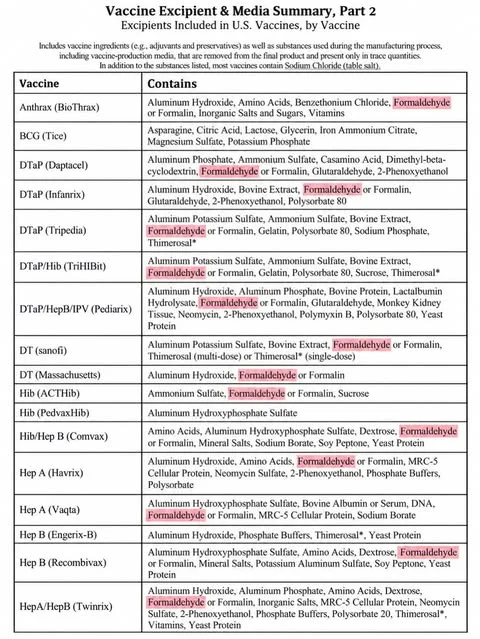
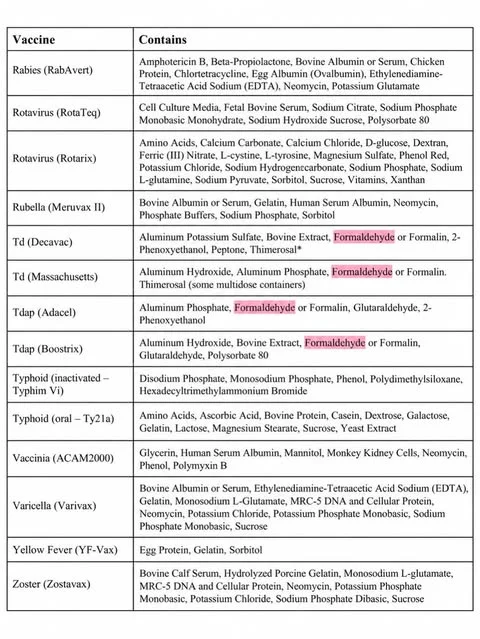
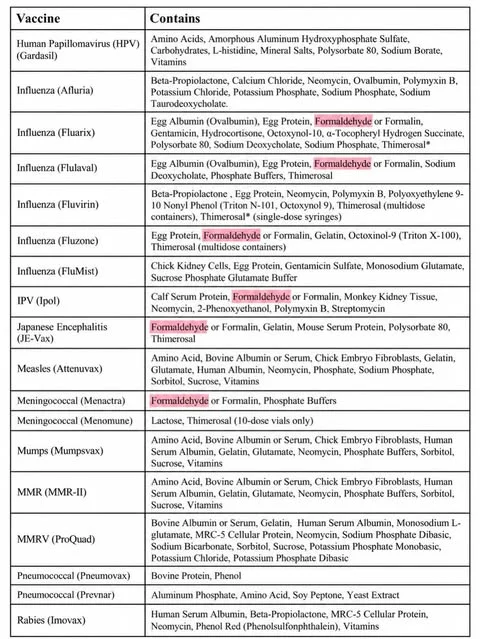
Nobody has checked. Here is exactly what that means
When you ask whether the formaldehyde in a baby's shots is safe, the answer you will be given rests on one paper. In 2013 a group of researchers built a computer model, a set of equations that estimates how a substance moves through a body, and used it to estimate how much formaldehyde would be in a baby's blood after vaccination. The model said the amount would be less than 1% of the formaldehyde the body makes on its own [2]. We report that honestly, and it may be right. But read what it is. It is a calculation. No baby was measured. No baby's blood was tested. No group of children was followed to see what happened. In our index of more than 300,000 studies, we could not find a single study that measured formaldehyde in a child after a vaccine, or one that followed vaccinated children for any outcome tied to it. The closest real experiment is in rats, and it is a breathing study, not an injection study [3]. So when the FDA writes, on its own page, that "there is no evidence linking cancer to infrequent exposure to tiny amounts of formaldehyde via injection as occurs with vaccines," that sentence is true in the narrowest way: there is no evidence because nobody looked. No evidence is not the same as safe. Nobody checking is not the same as nobody finding.
Formaldehyde has a warning for every way into the body except a needle
Every chemical sold in the world comes with a hazard sheet, and the hazard language is standardised. For formaldehyde it reads: toxic if swallowed. Toxic in contact with skin. Toxic if inhaled, and in higher amounts, fatal if inhaled. Causes severe skin burns. May cause an allergic skin reaction. May cause cancer. Suspected of causing genetic defects. The U.S. workplace safety agency, NIOSH, lists its routes of exposure as breathing it and skin or eye contact, names the nose as the cancer site, and sets a ceiling for workplace air of one part in ten million (both documents are linked below). Now notice what is not on that list. There is no warning for injecting it. There never will be, because no safety system anywhere imagines putting formaldehyde under the skin. That is not a clean bill of health. It is a door nobody wrote a warning for because nobody expected anyone to use it. The research follows the same shape. Breathing it has the deepest shelf of studies [4][5]. Skin has its own [6][7]. Swallowing it has its own [8]. Injecting it into a person has the one computer model above. Has it ever been injected into people on purpose? Once, briefly, more than a century ago. In February 1903 a London medical weekly reported a case of childbed fever in which a New York doctor, Charles Burrows of Bellevue Hospital, injected a weak formalin solution and the woman recovered; a handful of others tried it "with varying results," and the journal's own verdict was that "one cannot come to any conclusion on the strength of one or two cases" (the 1903 pages are linked below). The idea died there. Today the only routine, deliberate injection of formaldehyde in all of science is something called the formalin test: researchers inject dilute formalin into the paw of a rat or mouse to cause pain, so that painkillers can be measured against it [9]. It has been done in infant rats [10]. In a laboratory, formaldehyde under the skin is the standard way to reliably hurt an animal.
Why a needle changes everything
This part is basic pharmacology and nobody disputes it. When a medicine is swallowed, your gut and your liver get to it first and destroy part of it before it ever reaches your blood. That is why the pill version of a drug is often several times stronger than the injected version: injected, the whole dose arrives [11][12]. Formaldehyde is an extreme example of this, because your body's defences against it are unusually good at the front door. Breathe it in and it is used up at the lining of your nose; in the rat study, formaldehyde from outside the body showed up in nasal tissue and nowhere else [3]. Swallow it and it meets your liver, which carries an enzyme, a protein tool called ADH5, built for exactly this molecule [13][14]. Those two front doors are why formaldehyde in air and food does its damage at the point of contact and little gets further. A needle in a muscle is a third door, and there is no guard at it. What formaldehyde meets first in a muscle is muscle, and the small blood vessels that drain it. Our view, and we name it as ours: every reassurance about injected formaldehyde borrows the body's handling of formaldehyde it breathes and eats, and applies it to a route where the front-door defence is not there. That has never been tested in a child. The FDA's page also says a newborn already carries "50-70 times" more formaldehyde than one shot delivers. That number comes from the same 2013 model, and it compares two different things: the formaldehyde your cells make a little at a time and clear a little at a time, with the enzyme standing right next to it, against a dose that arrives all at once in one place.
The same shot, by body weight
Every medicine a baby is given is dosed by the kilogram, because a newborn's liver and kidneys are not a shrunken adult's; they are immature and they clear things more slowly, so the dose has to follow the body [15][16]. Vaccines are the exception. The shot is the same size no matter who gets it. Read two labels side by side, both from the same maker, both half a millilitre. Pediarix, the five-in-one shot given from six weeks old: up to 100 micrograms of formaldehyde, up to 100 micrograms of polysorbate 80, and 0.7 milligrams of aluminum. Boostrix, the booster for people ten and older and for pregnant women: up to 100 micrograms of formaldehyde, up to 100 micrograms of polysorbate 80, and 0.3 milligrams of aluminum (both labels are linked below). Same formaldehyde ceiling. Very different bodies. Per kilogram of body weight, a six-pound newborn gets up to 37 micrograms; a two-month-old of about five kilos gets up to 20; a 70-kilo adult gets up to 1.4. That is about fourteen times the adult exposure for the two-month-old, from one shot, and about twenty-six times for the newborn. And the two-month visit is not one shot. The aluminum, the polysorbate 80 and the rest scale the same way. We are not telling you what to do with that arithmetic. We are telling you it is simple, and that nobody prints it.
One new food at a time
The American Academy of Pediatrics tells parents how to start solid food: "Introduce one 'single-ingredient' new food from any food group every 3 to 5 days. Look out for any reactions." Every pediatrician says it. Every parent does it: one banana, wait, one carrot, wait. It is good science. A new body meets one new thing at a time, so if it reacts, you know to what. Hold that next to the two-month visit: several shots on one morning, each carrying a list of ingredients with their own hazard sheets, into a body that weighs five kilograms, by a route none of them was ever studied for. Our view: that is not careful science. It is the opposite of it. The rule that medicine wrote for itself after the Second World War, the Nuremberg Code, puts it in order: test in animals first, then run a human experiment only if the results justify it, and never without the person's free consent [17]. (And since readers ask: the lethal injections in the camps were phenol, not formaldehyde. Formalin appears in that history as the preservative the victims' bodies were kept in. We checked, and we will not stretch the record.)
Formaldehyde is one of many
We used formaldehyde for this post because its cancer record is the deepest. It is not alone on the list. We ran the same search on the other ingredients. Aluminum has a real body of research and the research disagrees: models of how much aluminum an infant takes in from diet and vaccines [18][19], a review of how aluminum additives can harm children [20], and a 2025 Danish study of the whole country's children that found no link between aluminum-containing vaccines and chronic disease [21]. You get both sides. Polysorbate 80: 16 studies in our index, one on toxicity, none on injecting it into infants. Glutaraldehyde: 10 studies, three on toxicity, none on injecting it into infants. 2-Phenoxyethanol: three studies, none on injecting it into infants. Thimerosal: 20 studies, nine on toxicity, five that touch children and vaccines. The pattern for formaldehyde, studied for harm by breathing, skin and swallowing and never studied for safe injection into a newborn, is the pattern for most of the list. That is a count, not a slogan.
What formaldehyde is, in plain words
Formaldehyde is a small, very reactive chemical. It is used in glues, resins, preservatives and embalming fluid. Your own cells also make a little of it all the time, as a by-product of normal chemistry, and because of that your body comes with a clean-up system for it. The main part of that system is the enzyme ADH5, which needs a helper molecule called glutathione, your cells' main protective molecule [13]. In blood-forming cells, two enzymes work together to keep formaldehyde in check, and mice missing both struggled to survive [22][23]. Here is the catch, and it is the heart of this whole post. Formaldehyde uses up glutathione as it is cleared, and in human cells that drains the cell's defences; topping glutathione back up prevented the damage [24]. Formaldehyde also interferes with the folate-linked chemistry that cells use to build and repair DNA [25]. Our view: it does not matter whether formaldehyde came from inside, from the air, from a new onesie or from a syringe; the same clean-up crew handles all of it, and the crew runs on glutathione and folate. So the question is never only how much went in. It is how well this particular child's cells can clear it. No study has measured that in a baby.
What the cancer studies say
In 2005 the International Agency for Research on Cancer, the arm of the World Health Organization that classifies carcinogens, put formaldehyde in its top group: known to cause cancer in people. At that point the evidence was firm for cancer of the back of the nose and strong but not yet settled for leukemia [26]. In 2012 the agency went further, and we quote it because the split inside it matters: "There is sufficient evidence in humans for the carcinogenicity of formaldehyde. Formaldehyde causes cancer of the nasopharynx and leukaemia." Two sentences later: "The Working Group was not in full agreement on the evaluation of formaldehyde causing leukaemias in humans, with a small majority viewing the evidence as sufficient of carcinogenicity and the minority viewing the evidence as limited." (The 2012 chapter is linked below.) A majority of the world's cancer experts said yes; a minority said not proven. The studies behind that call are mostly of people exposed at work. They are observational, meaning researchers watched what happened to real workers rather than running an experiment, so the right phrase is "linked to," not "proven to cause."
- Factory workers in the U.S. National Cancer Institute study, 2003: the more formaldehyde a worker had been exposed to at peak, the more likely they were to die of myeloid leukemia, a blood cancer that starts in the bone marrow; the highest-exposed had about three and a half times the rate [27].
- The same workers followed for 42 years, 2009: the pattern held, with more blood and lymph cancers in the highest peak group [28].
- Embalmers, 2009: the longer they had worked with formaldehyde, the higher the myeloid leukemia death rate, about three times higher in the most exposed [29].
- Garment workers, 2004: more myeloid leukemia deaths among those exposed longest [30].
- The blood itself: two studies took blood-forming cells from exposed workers and found more broken chromosomes than in unexposed people, including a specific change seen in leukemia [31][32]. A 2026 pooled analysis found exposed workers had lower white blood cell counts [33].
The studies that say it is fine, and who paid for them
Three reviews looked at the same workers and concluded there is no clear link between formaldehyde and leukemia. We keep them in our index next to the others, because that is what an honest index does. We also tell you who paid for them, in the papers' own words, because that is what an honest index does too. The first, a 2012 review, was funded by a grant from the Research Foundation for Health and Environmental Effects, which the paper itself describes as "a 501(c)(3) tax-exempt organization established by the American Chemistry Council". The American Chemistry Council is the trade group of the companies that make chemicals, formaldehyde among them [34]. The second, a 2015 re-analysis of the government's own worker data, was "sponsored by the Research Foundation for Health and Environmental Effects," the same foundation, and one of its authors "has provided consulting services to Momentive Specialty Chemicals, a producer of formaldehyde" [35]. The third, from 2024, was written by employees of a consulting firm, ToxStrategies, with a grant from a non-profit called the Center for Truth in Science [36]. So here is the plain statement. The industry that makes formaldehyde paid for the studies that say formaldehyde is fine. That is convenient for them, and it is not a smear; it is printed in the funding lines of the papers. It also shows something every parent should know about science: the answer you get depends partly on who paid for the question. That is not just our opinion. A Cochrane review, the most careful kind of review there is, pooled 75 studies and found that research paid for by industry reaches conclusions favourable to the sponsor more often than research that is not [37][38]. We lead with the cellular picture: a reactive chemical, a clean-up system that can be overwhelmed, and broken chromosomes in the blood cells of exposed people. We show you the industry-funded dissent beside it. We do not treat the two as equal, and we do not pretend the question is closed.
Childhood leukemia is rising, and the formaldehyde studies are in adults
Childhood cancer in the U.S., including the most common leukemia, rose steadily from 1975 to 2013, and older mothers explain only part of it [39]. A 2024 look at city-dwelling countries found childhood leukemia rising in four of them since 1990, with traffic exhaust the biggest environmental factor they could measure [40]. A 2026 review found that pesticides used in the home, and living near heavily sprayed farmland, went with more childhood brain tumours and leukemia [41], and in one small Turkish study, children diagnosed with acute leukemia carried higher levels of several pesticide residues than healthy children did [42]. Pesticides, and glyphosate in particular, deserve their own post, and they are getting one: the sprayed playgrounds, school grounds, golf courses and soccer fields children use every week, and the simple urine test for glyphosate that you can order yourself without a prescription. Read these carefully. They show childhood leukemia is becoming more common and that chemical exposures are being studied. None of them links formaldehyde to childhood leukemia; the formaldehyde-leukemia studies are in adult workers. That gap is exactly why the question of what babies are exposed to deserves to be asked out loud rather than waved away.
Then the crib, the clothes, the shampoo, the couch
After the injections, the place a child meets the most formaldehyde is home, and here the studies were done in children themselves. In Perth, Australia, the home was the biggest source of a child's personal exposure [43], and in 41 schoolchildren, what they breathed all day tracked what was in their house [44]. A reading in a room is a chance of exposure, not a measured dose, but several of these studies measured children directly, and one of them shows how a simple wash changes the picture.
- In 2,940 babies, each step up in home formaldehyde went with a 32% higher chance of a chest infection [45].
- Pooling seven studies, formaldehyde went with 17 to 24% more asthma for every small step up in indoor level [46]; a larger pool of 90 studies found the same [47].
- In children under three, higher bedroom levels went with more asthma [48] and more allergic sensitisation [49].
- When 62 German schoolchildren moved out of a classroom lined with particleboard, their formaldehyde allergy markers and symptoms fell within three months [50].
- The crib and the furniture: pressed wood and its glue are the main indoor source [51], and it gives off more as the room warms [52]. A typical home holds about 48 kilograms of formaldehyde-containing material [53]. Laminate flooring, tested in nearly 900 U.S. homes, was rarely above the level of concern, and those authors concluded it poses almost no cancer risk [54]; we include that because it is what they found.
- The clothes: in baby and maternity clothing tested in Spain, one garment in five contained formaldehyde, the eco-labelled ones more than the rest, and washing removed it completely [55]. Curtains and upholstery give off more in heat and humidity [56][57].
- The shampoo: free formaldehyde was found in 88.6% of 35 cosmetic products tested, and not one of them said so on the label [58]. It gets in through preservatives that slowly release it; quaternium-15 is the one most often behind a skin reaction [7][6].
What you can do
You do not need permission to ask what is in a shot, and you do not need a degree to read a label. Three practical moves, none of which is a decision we make for you. One: read the insert. Every vaccine has a manufacturer's package insert that lists every ingredient; our informed-consent tool puts them in one place so you can read them before the appointment. Two: lower the load at home. Wash every new piece of clothing before it touches your baby; that alone removed the formaldehyde completely in the clothing study [55]. Air the room. Choose solid wood over pressed wood where you can. Read the backs of bottles for the releasers: DMDM hydantoin, quaternium-15, imidazolidinyl urea, diazolidinyl urea, bronopol. Three: feed the clean-up crew. It runs on glutathione and folate. The best human evidence we have for raising it is sulforaphane, the compound in broccoli sprouts: in trials in Qidong, China, a broccoli-sprout drink raised the amount of a pollutant people cleared in their urine by about 63% at the highest dose [59], and an earlier trial saw effects on other pollutant markers [60]. Those trials measured benzene and aflatoxin, not formaldehyde; we cite them for what they show, which is that a food can turn up a human detox pathway. Clearing anything takes energy, and energy comes from mitochondria; our stack page covers Cordyceps, R2 Night and Panacea shilajit as support for that, with its own citations and its own limits. None of these removes heavy metals, repairs mitochondria, or treats or cures anything, and no trial we cite measured formaldehyde clearance.
Key Takeaways
- Formaldehyde, a known human carcinogen, is in 24 vaccine products across 14 kinds of shot, most of them given starting at two months old; the U.S. recommends more childhood vaccines than any comparable country.
- The only safety evidence for injecting it into babies is one 2013 computer model. No baby was measured and no children were followed. No evidence is not the same as safe.
- Formaldehyde carries hazard warnings for swallowing, skin and breathing and none for injection; the only routine injection of it in science is a test that causes pain in rats.
- The same shot gives a two-month-old about fourteen times the adult exposure per kilogram, and the two-month visit is several shots.
- Two of the three studies that clear formaldehyde of causing leukemia were paid for by a foundation the chemical industry's trade group set up. Industry-funded studies favour the sponsor more often; a Cochrane review of 75 studies says so.
- At home: wash new clothes before first wear (it removed the formaldehyde completely), air the room, prefer solid wood, and read labels for formaldehyde releasers.
Sources
Powered by CellWell.life- 1.A reversed phase HPLC-UV method for the simultaneous determination of residual formaldehyde and Triton X-100 in vaccine products (2021)
- 2.Pharmacokinetic modeling as an approach to assessing the safety of residual formaldehyde in infant vaccines (2013)
- 3.Data from Measurement of Endogenous versus Exogenous Formaldehyde -- Induced DNA -- Protein Crosslinks in Animal Tissues by Stable Isotope Labeling and Ultrasensitive Mass Spectrometry (2023)
- 4.The formaldehyde dispute - Part A: acute and chronic inhalation toxicity and the evolution of scientific knowledge (2026)
- 5.Characterizing the Pulmonary Toxicity and Potential Mutagenicity of Formaldehyde Fumes in a Human Bronchial Epithelial Tissue Model (2025)
- 6.CD02 Contact allergy to formaldehyde and formaldehyde releasers: a UK and Ireland multicentre audit (2026)
- 7.The Prevalence of Contact Allergy to Formaldehyde and Formaldehyde Releasers: A Systematic Review and Meta‐Analysis (2026)
- 8.Toxicity of formaldehyde, and its role in the formation of harmful and aromatic compounds during food processing (2025)
- 9.The orofacial formalin test (2004)
- 10.Analgesia induced by local plantar injections of opiates in the formalin test in infant rats (2003)
- 11.Oral first-pass elimination of midazolam involves both gastrointestinal and hepatic CYP3A-mediated metabolism (1996)
- 12.First-pass effect of coumarin in man (1979)
- 13.A steady-state-kinetic model for formaldehyde dehydrogenase from human liver. A mechanism involving NAD+ and the hemimercaptal adduct of glutathione and formaldehyde as substrates and free glutathione as an allosteric activator of the enzyme (1979)
- 14.Two Aldehyde Clearance Systems Are Essential to Prevent Lethal Formaldehyde Accumulation in Mice and Humans (2020)
- 15.Dosing in children: a critical review of the pharmacokinetic allometric scaling and modelling approaches in paediatric drug development and clinical settings (2014)
- 16.Developmental pharmacokinetics of indomethacin in preterm neonates: severely decreased drug clearance (2023)
- 17.The Nuremberg Code and the Nuremberg Trial. A reappraisal (1996)
- 18.Aluminum toxicokinetics regarding infant diet and vaccinations (2002)
- 19.Updated aluminum pharmacokinetics following infant exposures through diet and vaccination (2011)
- 20.Mechanisms of aluminum adjuvant toxicity and autoimmunity in pediatric populations (2012)
- 21.Aluminum-Adsorbed Vaccines and Chronic Diseases in Childhood: A Nationwide Cohort Study (2025)
- 22.ADH5/ALDH2 Dehydrogenases and DNA Polymerase Theta Protect Hematopoietic Cells from Formaldehyde Challenge: Therapeutic Implications (2024)
- 23.The failure of two major formaldehyde catabolism enzymes (ADH5 and ALDH2) leads to partial synthetic lethality in C57BL/6 mice (2020)
- 24.Endogenous formaldehyde scavenges cellular glutathione resulting in redox disruption and cytotoxicity (2022)
- 25.Formaldehyde regulates S-adenosylmethionine biosynthesis and one-carbon metabolism (2023)
- 26.Meeting report: summary of IARC monographs on formaldehyde, 2-butoxyethanol, and 1-tert-butoxy-2-propanol (2005)
- 27.Mortality from lymphohematopoietic malignancies among workers in formaldehyde industries (2003)
- 28.Mortality from lymphohematopoietic malignancies among workers in formaldehyde industries: the National Cancer Institute Cohort (2009)
- 29.Mortality from lymphohematopoietic malignancies and brain cancer among embalmers exposed to formaldehyde (2009)
- 30.Mortality among a cohort of garment workers exposed to formaldehyde: an update (2004)
- 31.Chromosome-wide aneuploidy study of cultured circulating myeloid progenitor cells from workers occupationally exposed to formaldehyde (2014)
- 32.Occupational exposure to formaldehyde, hematotoxicity and leukemia-specific chromosome changes in cultured myeloid progenitor cells - Response (2020)
- 33.Hematological changes in formaldehyde-exposed workers: A critical review and meta-analysis (2026)
- 34.Critical review and synthesis of the epidemiologic evidence on formaldehyde exposure and risk of leukemia and other lymphohematopoietic malignancies (2012)
- 35.Formaldehyde Exposure and Mortality Risks From Acute Myeloid Leukemia and Other Lymphohematopoietic Malignancies in the US National Cancer Institute Cohort Study of Workers in Formaldehyde Industries (2015)
- 36.Assessment of associations between inhaled formaldehyde and lymphohematopoietic cancer through the integration of epidemiological and toxicological evidence with biological plausibility (2024)
- 37.Industry sponsorship and research outcome (2017)
- 38.Industry sponsorship and research outcome: systematic review with meta-analysis (2018)
- 39.Do pregnancy characteristics contribute to rising childhood cancer incidence rates in the United States? (2018)
- 40.Trends in childhood leukemia incidence in urban countries and their relation to environmental factors, including space weather (2024)
- 41.Environmental Pesticide Exposure in the Etiology of Pediatric Brain Tumors and Leukemia: A Scoping Review of Epidemiological Studies (2026)
- 42.The Determining of Pesticide Residue Levels in Children Diagnosed with Acute Leukemia in Cukurova Region, Turkiye (2025)
- 43.Personal Exposure of Children to Formaldehyde in Perth, Western Australia (2006)
- 44.Formaldehyde personal exposure measurements and time weighted exposure estimates in children (2012)
- 45.Formaldehyde exposure and lower respiratory infections in infants: findings from the PARIS cohort study (2011)
- 46.Formaldehyde Exposure among Children: A Potential Building Block of Asthma (2010)
- 47.Exposure to formaldehyde and asthma outcomes: A systematic review, meta-analysis, and economic assessment (2021)
- 48.Domestic exposure to formaldehyde significantly increases the risk of asthma in young children (2002)
- 49.Increased risk of allergy in children due to formaldehyde exposure in homes (1999)
- 50.Exposure to gaseous formaldehyde induces IgE-mediated sensitization to formaldehyde in school-children (1996)
- 51.Validation of models for predicting formaldehyde concentrations in residences due to pressed wood products : (1985)
- 52.Estimates of parameters for formaldehyde emission model from plywood panel under various temperature and relative humidity conditions (2019)
- 53.Carcinogenic formaldehyde in U.S. residential buildings: Mass inventories, human health impacts, and associated healthcare costs (2024)
- 54.Potential Exposure and Cancer Risk from Formaldehyde Emissions from Installed Chinese Manufactured Laminate Flooring (2018)
- 55.Early-Life Exposure to Formaldehyde through Clothing (2022)
- 56.Formaldehyde release from furnishing fabrics. Effect of ageing, temperature and air humidity (1991)
- 57.Refinement and predicting formaldehyde concentrations of indoor fabric: Effects of temperature and humidity (2023)
- 58.Determination of free formaldehyde in cosmetics products through derivatization with 2,4-DNPH using an optimized and validated HPLC-PDA method (2024)
- 59.Dose-dependent detoxication of the airborne pollutant benzene in a randomized trial of broccoli sprout beverage in Qidong, China (2019)
- 60.Effects of glucosinolate-rich broccoli sprouts on urinary levels of aflatoxin-DNA adducts and phenanthrene tetraols, randomized clinical trial, Qidong
Primary documents and informed-consent resources
Open the original documents. Advocacy resources are included for perspective and are not substitutes for the primary record.
- 1.White House fact sheet, 10 August 2026: the 2024 schedule, at least 84 doses in 57 shots for 17 diseases
- 2.White House executive order, 10 August 2026, with the HHS assessment that the U.S. recommended more childhood vaccines than any peer nation
- 3.CDC, Vaccine Excipient and Media Summary (the ingredient list shown above)
- 4.IARC Monographs Vol. 100F (2012), Formaldehyde chapter, section 6 EvaluationThe 2012 evaluation quoted in full, including the split vote.
- 5.FDA, Common Ingredients in FDA-Approved VaccinesThe '50-70 times' and 'no evidence linking cancer... via injection' sentences, quoted verbatim.
- 6.PubChem CID 712, Formaldehyde, GHS classificationH301, H311, H314, H317, H330, H331, H341, H350.
- 7.NIOSH Pocket Guide to Chemical Hazards: Formaldehyde (0293)Exposure routes, REL ceiling, cancer site.
- 8.Pediarix package insert (DailyMed), sections 1 and 11
- 9.Boostrix package insert (DailyMed), sections 1 and 11
- 10.AAP HealthyChildren.org, Starting Solid Foods'Introduce one single-ingredient new food... every 3 to 5 days.'
- 11.The Hospital (London), 21 February 1903, pp. 352-353: The Treatment of Puerperal Fever by FormalinScanned pages on PubMed Central; the Bellevue case and the journal's own verdict, quoted verbatim.
- 12.The Nuremberg Code (US Holocaust Memorial Museum)Points 1, 3 and 4.
- 13.Auschwitz-Birkenau Memorial: Selections and lethal injectionsThe injections were phenol, not formaldehyde.
Ready to put this into practice?
How to clear formaldehyde from the bodyWant the next one of\u00a0these?
The Signal is one email when there is something genuinely worth your attention -- written the way this post is, in plain language, with the studies behind it. No noise, no selling your address, and nothing to\u00a0buy.
The Signal, and nothing else -- no fixed schedule, only when there is something worth sending. We never sell or share your address, and you can unsubscribe in one click any time.