It fell for twenty years.
Urinary iodine is how iodine status is measured across a population. In national survey data for US women of childbearing age, the median dropped from 135 to 103.5 µg/L between 2001 and 2020, and the pregnant and nursing subgroups sat below adequate the entire time.1
That matters because iodine is the raw material of thyroid hormone, and thyroid hormone sets the pace for every cell you own. Deficiency and excess both show up as goiter, an underactive thyroid, thyroid autoimmunity and, in children, slower brain development.2
Four halogens crowd it out.
Iodine is a halogen. So are fluorine, chlorine and bromine, and perchlorate is an industrial salt that acts like one. Iodine reaches the thyroid through one door, the sodium-iodide symporter. In a 2026 modeling study, fluoride, chloride, bromide and perchlorate all bound that door, and the enzyme that builds the hormone, more tightly than iodide did.3 The symporter's own preference order puts perchlorate ahead of iodide.4
Perchlorate competitively blocks the symporter, lowering thyroid hormone output and potentially raising TSH, most of all in pregnant and iodine-deficient people.5 In more than 20,000 US adults, higher urinary perchlorate was linked to self-reported thyroid and pancreatic cancer, without a clean dose-response.6 Fluoride: five of seven studies in a systematic review tied high exposure to altered thyroid function, with the overall evidence rated low quality,7 and in the Canadian MIREC pregnancy cohort it tracked with higher maternal TSH.8 Bromide lowers thyroid iodide uptake and raises the iodide lost in urine.9 Rats fed brominated vegetable oil developed higher TSH and lower T4,10 and an Ethiopian survey found potassium bromate in every bread sample tested, above the WHO/FDA limit.11
Hormones, pregnancy, and the child who comes after.
Pregnancy raises the requirement three ways: the kidneys clear more, the thyroid makes more, and iodine crosses to the baby.12 Deficiency impairs fetal brain development and raises the risk of growth restriction, and the estrogen stimulation of assisted reproduction shifts the thyroid's demand again.13
The children carry it. In a 15-year follow-up of 266 children, those whose mothers ran below 150 µg/L in pregnancy had lower spelling scores from Year 3 through Year 9, despite adequate iodine in childhood.14 In a UK birth cohort, severe first-trimester deficiency went with lower vocabulary and IQ at age 15.15 And for the mother: a 2026 scoping review found low iodine intake consistently tied to postpartum depressive symptoms and anhedonia, while supplementation's effect on mood was inconsistent.16
Breast tissue, in both directions.
Blocking iodine in aging female rats produced changes resembling fibrocystic breast disease.17 A 1993 clinical study tested iodine replacement in fibrocystic breast disease.18 Among 415 women with breast disease, those with cancer excreted less iodine, and excretion rose after estrogen-lowering treatment.19 That is not a case for more. In women already diagnosed, high iodine together with high selenium went with higher mortality (the dose section below).20
Immune and gut: a U, not a line.
Too little and too much iodine both disturb immune balance and raise the odds of autoimmune thyroid disease.21 The gut evidence is one study, and it points the uncomfortable way: in people and mice with Hashimoto's, excessive iodine came with gut dysbiosis, less butyrate and a tilt toward inflammatory immune cells.22 We show it because it argues against more.
Iodine never works alone.
Selenium is the pair. The enzymes that turn T4 into active T3 are selenium enzymes; without selenium, conversion stalls and T4 piles up.23 In midlife New Zealand women, iodine deficiency and low selenium were common together, and plasma selenium predicted the T3-to-T4 ratio.24 Selenium can lower TPO antibodies in Hashimoto's.25 The other side: the GRASS trial found no gain in remission or quality of life in newly diagnosed Graves' disease,26 antibodies unexpectedly rose in one Hashimoto's group after six months,27 and in 2,347 matched pairs who were not deficient, supplementing went with higher TSH, more antibodies and higher all-cause mortality.28 Selenium is a dose. Test it like iodine (selenium in the Lab Library).
Magnesium. In 104 patients, low serum magnesium came with higher TPO and thyroglobulin antibodies and more Hashimoto's-pattern ultrasounds.29 Low magnesium and low vitamin D were each tied to goiter, hypothyroidism and antibody positivity.30 Potassium. Fewer than 2% of US adults met the potassium recommendation, while 99.4% ate too much sodium.31 A normal blood potassium can hide low potassium inside cells.32 Read magnesium and potassium in the Lab Library.
Vitamin C. In Hashimoto's patients in national survey data, the highest vitamin C intake went with half the odds of hypothyroidism.33 In a pilot trial, 1 g a day showed potential benefit on symptoms and TSH in people on high-dose levothyroxine.34 Vitamin E. In a 2026 pilot study of 78 women with euthyroid Hashimoto's, selenomethionine improved mood and sexual function only in those with adequate vitamin E intake, not low and not high.35 In a second pilot, on vitamin D, the largest gains also came with adequate vitamin E.36
Food first
Potassium and magnesium come from the plate: leafy greens, beans, potatoes, squash, avocado, nuts and seeds. There is no bottle for those two on this page. The Diet Builder turns a low marker into a grocery list.
The dose question
1,950 mcg is 13 times the RDA.
The adult RDA is 150 mcg. The iodine on this page gives 1,950 mcg in a 3-drop serving, about 650 mcg a drop. We are saying it plainly because the evidence runs both ways. Excess iodine can tip susceptible people into an underactive or overactive thyroid.37 A man taking two drops of Lugol's a day, about 5 mg, became hypothyroid.38 Where water iodine runs high, thyroiditis, nodules and hypothyroidism run higher,39 and in pregnancy, urinary iodine of 250 µg/L or more went with lower free T4.40 In 918 women with breast cancer, high serum iodine together with high serum selenium went with higher mortality, while selenium alone predicted lower.20 Add the U-shaped immune curve and the Hashimoto's gut study above.
So: test first. TSH, free T4, free T3, TPO antibodies and urinary iodine. TSH alone is not a thyroid panel.
What we chose
The iodine, its pair, and two companions.
Each card prints the label as read on the maker's site. Iodine and selenium are the pair; vitamins E and C are the companions.

The mineral · Global Healing
Detoxadine Nascent Iodine
$29.95 · 1 fl oz · about 200 servings
- Serving: 3 drops · about 200 servings
- Iodine 1,950 mcg (1,300% DV)
- Glycerin base, not alcohol
- Other ingredients: organic vegetable glycerin, triple-distilled biophotonic structured water
1,950 mcg is 13x the adult RDA of 150 mcg; one drop is about 650 mcg. Test first.

The pair · Global Healing
Liquid Selenium
$24.95 · 2 fl oz · about 60 servings
- Serving: 1 ml · about 60 servings
- Selenium 200 mcg (360% DV)
- From organic mustard seed
Selenium has its own U-curve. Test it with the thyroid panel.
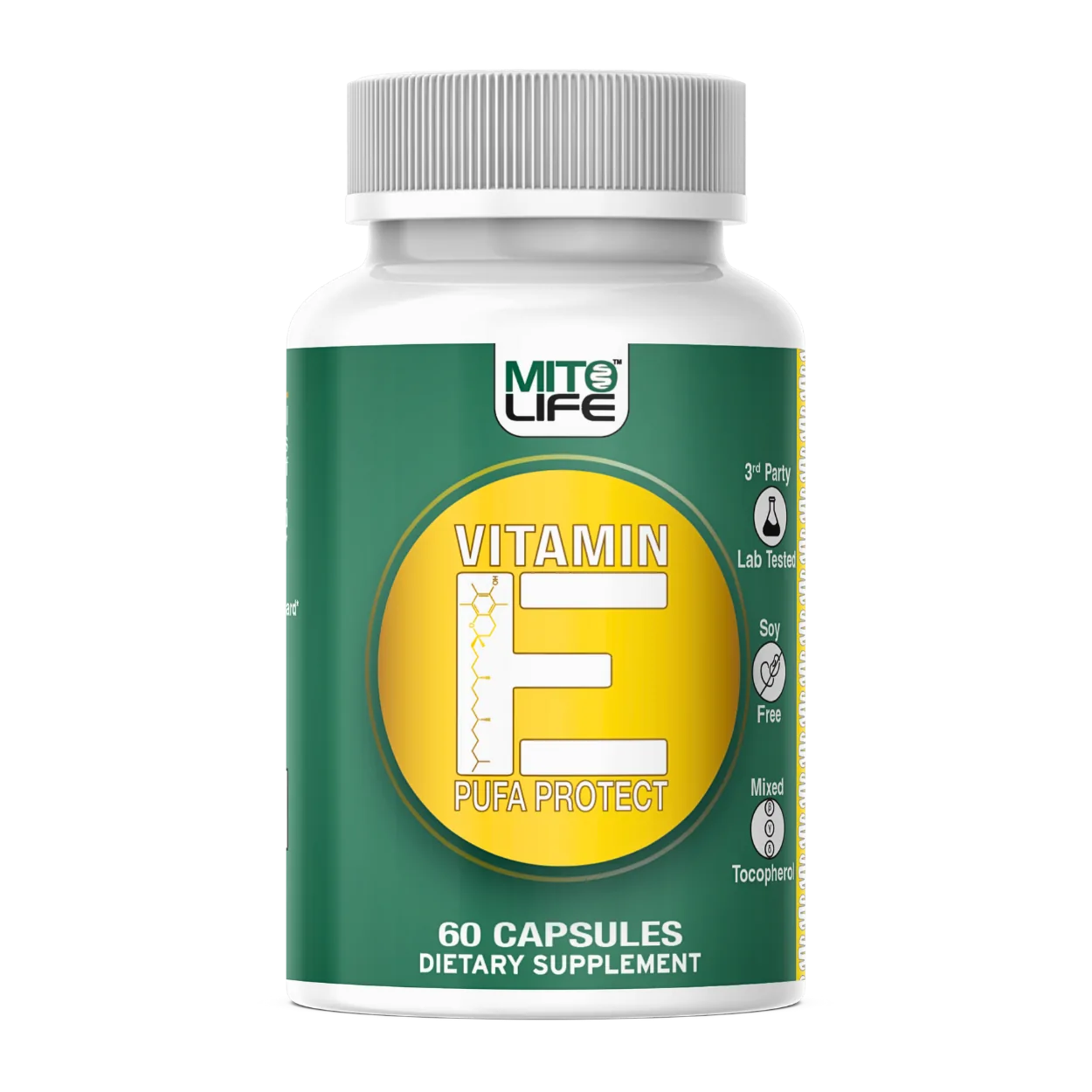
Companion · MitoLife
PUFA Protect
$50 · 60 capsules
- d-alpha-tocopherol 335 mg (827 IU)
- d-gamma 27.17 mg · d-delta 9.42 mg · d-beta 3.88 mg
- Mixed tocopherols, sunflower-sourced, no soy
Tocopherols only, not tocotrienols. Why the form matters
HOLISTICLOVEpaste at checkout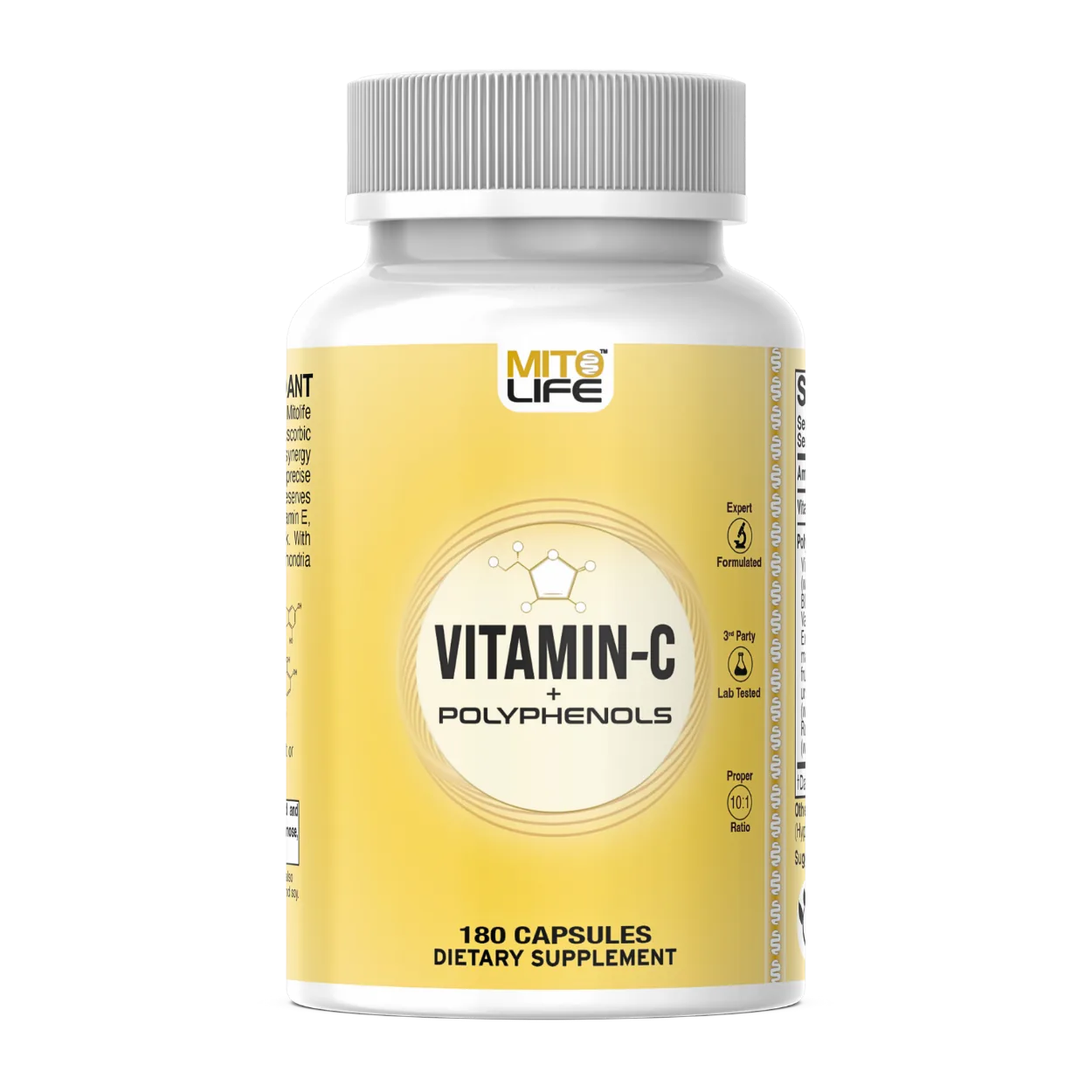
Companion · MitoLife
Vitamin C with Polyphenols
$30 · 180 capsules · 90 servings
- Serving: 2 capsules · 90 servings
- Vitamin C (ascorbic acid) 800 mg (890% DV)
- Polyphenol-C 80 mg: grape, blueberry, cranberry, blackberry, raspberry, strawberry
Label as read from the Supplement Facts panel on the maker's site.
HOLISTICLOVEpaste at checkoutThe Global Healing links track the referral; there is no code and the price is the maker's. The MitoLife companions take HOLISTICLOVE for 15% off. We earn a referral commission at no cost to you.
Iodine is the raw material of thyroid hormone. From 2001 to 2020 the median urinary iodine of US women of childbearing age fell from 135 to 103.5 micrograms per litre, and pregnant and nursing women stayed below adequate. Fluoride, bromide, chloride and perchlorate compete with iodine for the same entry into the thyroid. Both too little and too much iodine disturb the thyroid and the immune system, so the dose matters: test TSH, free T4, free T3, TPO antibodies and urinary iodine first. Selenium is the pair; magnesium, potassium and vitamins C and E are the companions.
Iodine: the common questions
Why is iodine called the mineral nobody talks about?
Because it fell quietly. National survey data show the median urinary iodine of US women of childbearing age dropped from 135 to 103.5 micrograms per litre between 2001 and 2020, with pregnant and nursing women below adequate the whole time. Urinary iodine is the standard population measure, and it moved the wrong way for twenty years.
What do fluoride, bromide and perchlorate have to do with iodine?
They are its chemical competitors. Iodine enters the thyroid through the sodium-iodide symporter, and perchlorate blocks that entry directly. Excess bromide lowers thyroid iodide uptake and raises the iodide lost in urine, and a systematic review found most included studies linked high fluoride exposure with altered thyroid function. More competition means the iodine you do get has a harder job.
Is 1,950 mcg of iodine too much?
It is 13 times the adult RDA of 150 mcg, and that deserves a plain answer: the evidence runs both ways. Iodine follows a U-shaped curve, where deficiency and excess both disturb thyroid and immune function, and excess iodine has been tied to hypothyroidism, thyroiditis and nodules in susceptible people. One labelled drop of a 3-drop serving is about 650 mcg. Test first: TSH, free T4, free T3, TPO antibodies and urinary iodine.
Why take selenium with iodine?
Selenium runs the deiodinase enzymes that convert T4 into active T3, and low selenium stalls that conversion. Selenium has also been shown to lower TPO antibodies in Hashimoto's. It is not a free pass: the GRASS trial found no benefit in newly diagnosed Graves' disease, and in Hashimoto's patients who were not deficient, supplementation was associated with higher antibodies. Measure it like iodine.
What labs should I check before taking iodine?
TSH, free T4, free T3, TPO antibodies and urinary iodine. TSH alone is not a thyroid panel. The free Lab Library explains each marker in plain English, and the thyroid-labs guide walks through how to read a full panel together.
Do I need potassium and magnesium too?
They are part of the same picture, and they come from food first. Fewer than 2 percent of US adults met the potassium recommendation in national data, and low magnesium has been tied to higher thyroid antibodies and goiter. Leafy greens, beans, potatoes, squash, avocado, nuts and seeds carry both. This page sells no bottle for either.
What is in Detoxadine and Liquid Selenium?
Detoxadine: 3 drops give 1,950 mcg of iodine (1,300% DV) in a glycerin base, not alcohol, about 200 servings per 1 fl oz bottle, $29.95. Liquid Selenium: 1 ml gives 200 mcg of selenium (360% DV) from organic mustard seed, about 60 servings per 2 fl oz bottle, $24.95. Labels as read on the manufacturer's site on 2026-10-13.
Is there a discount code?
Not for the iodine or the selenium: the Global Healing link tracks the referral and the price is the manufacturer's. The two MitoLife companions take the code HOLISTICLOVE for 15 percent off; copy it from the popup on the buy button and paste it at checkout. We earn a referral commission at no cost to you. Education only, not medical advice.
Every study on this page
Read them yourself.
All 40, grouped and numbered. Every marker above jumps to its entry here.
The decline2 studies · 1–2
The four halogens that crowd it out9 studies · 3–11
- 3Halogens as Thyroid Disruptors: Molecular Modeling of Competitive Interference with Iodine in Thyroid Hormone Biosynthesis (2026)
- 4Anion selectivity by the sodium iodide symporter (2003)
- 5Perchlorate exposure and human health: Integrating biomonitoring evidence, thyroid mechanisms, and risk assessment (2026)
- 6Association between urinary perchlorate and malignancies of endocrine-related tissues in U.S. adults: analysis of National Health and Nutrition Examination Survey (NHANES) data (2025)
- 7Is there any association between fluoride exposure and thyroid function modulation? A systematic review (2024)
- 8Fluoride exposure and thyroid hormone levels in pregnancy: The MIREC cohort (2024)
- 9Metabolism of bromide and its interference with the metabolism of iodine (2004)
- 10Toxicological evaluation of brominated vegetable oil in Sprague Dawley rats (2022)
- 11High-Performance Liquid Chromatography Method Optimization and Validation for Potassium Bromate Detection in Bread Using a Quality-by-Design Approach (2026)
Hormones and pregnancy4 studies · 12–15
- 12Critical Role of Iodine and Thyroid Hormones During Pregnancy (2025)
- 13Importance of iodide sufficiency and normal thyroid function in fertility and during gestation (2025)
- 14Reduced Educational Outcomes Persist into Adolescence Following Mild Iodine Deficiency in Utero, Despite Adequacy in Childhood: 15-Year Follow-Up of the Gestational Iodine Cohort Investigating Auditory Processing Speed and Working Memory (2017)
- 15Iodine deficiency in the first pregnancy trimester and intelligence in adolescence (2026)
Mood1 study · 16
Breast tissue, both directions4 studies · 17–20
Immune and gut: the U-shape2 studies · 21–22
Selenium, both directions6 studies · 23–28
- 23Selenium deficiency inhibits the conversion of thyroidal thyroxine (T4) to triiodothyronine (T3) in chicken thyroids (2014)
- 24Iodine and selenium intakes and status and thyroid function in midlife women with low bread intakes in New Zealand (2026)
- 25Unlocking the Therapeutic Potential: Selenium and Myo-Inositol Supplementation in Thyroid Disorders-Efficacy and Future Directions (2025)
- 26Selenium supplementation in individuals with newly diagnosed Graves' hyperthyroidism: a double-blind, multi-centre RCT (2026)
- 27The Impact of Selenium Deficiency and Supplementation on Hashimoto's Thyroiditis: A Clinical Evaluation (2026)
- 28Clinical Outcomes of Selenium Supplementation in Hashimoto's Thyroiditis Without Selenium Deficiency: A Large-Scale Retrospective Cohort Study (2026)
Magnesium and potassium4 studies · 29–32
- 29Immunological harmony: the role of magnesium in the development of euthyroid Hashimoto's thyroiditis (2024)
- 30Risk of Functional Disorders and/or Thyroid Autoimmunity and Its Association with 25OH Vitamin D and Magnesium Levels: A Population-Based Case-Control Study (2026)
- 31Sodium and potassium intakes among US adults: NHANES 2003–2008 (2012)
- 32Potassium Homeostasis and the Systemic Consequences of Intracellular Potassium Deficiency: From Molecular Mechanisms to Clinical Manifestations (2026)
Vitamin C and vitamin E4 studies · 33–36
- 33Association between total vitamin C intake and hypothyroidism among Hashimoto thyroiditis: National Health and Nutrition Examination Survey, 2007-2012 (2024)
- 34Vitamin C supplementation in patients with hypothyroidism requiring high-dose levothyroxine: a proof-of-concept pilot study (2025)
- 35Vitamin E Intake Modulates the Effect of Selenomethionine on Sexual Function and Depressive Symptoms in Reproductive-Age Women with Euthyroid Autoimmune Thyroiditis: A Pilot Study (2026)
- 36Influence of Vitamin E Intake on Sexual Function and Depressive Symptoms in Young Women with Euthyroid Autoimmune Thyroiditis Undergoing Vitamin D Therapy: A Pilot Study (2026)
The dose question4 studies · 37–40
- 37Risks of Iodine Excess (2024)
- 38The Wolff-Chaikoff Effect: A Case Report of Thyroid Dysfunction Induced by Lugol's Solution (2026)
- 39Analysis of the association between water iodine concentration and TyG-BMI index with thyroid diseases: a cross-sectional study in Shandong province, China (2026)
- 40Iodine excess in relation to decreased free thyroxine levels during pregnancy in an iodine-sufficient region, and potential interactions with iron and selenium (2026)
Education only, not medical advice. Nothing here diagnoses, treats, cures or prevents any disease. Study citations are nutrient science, not claims about any product.