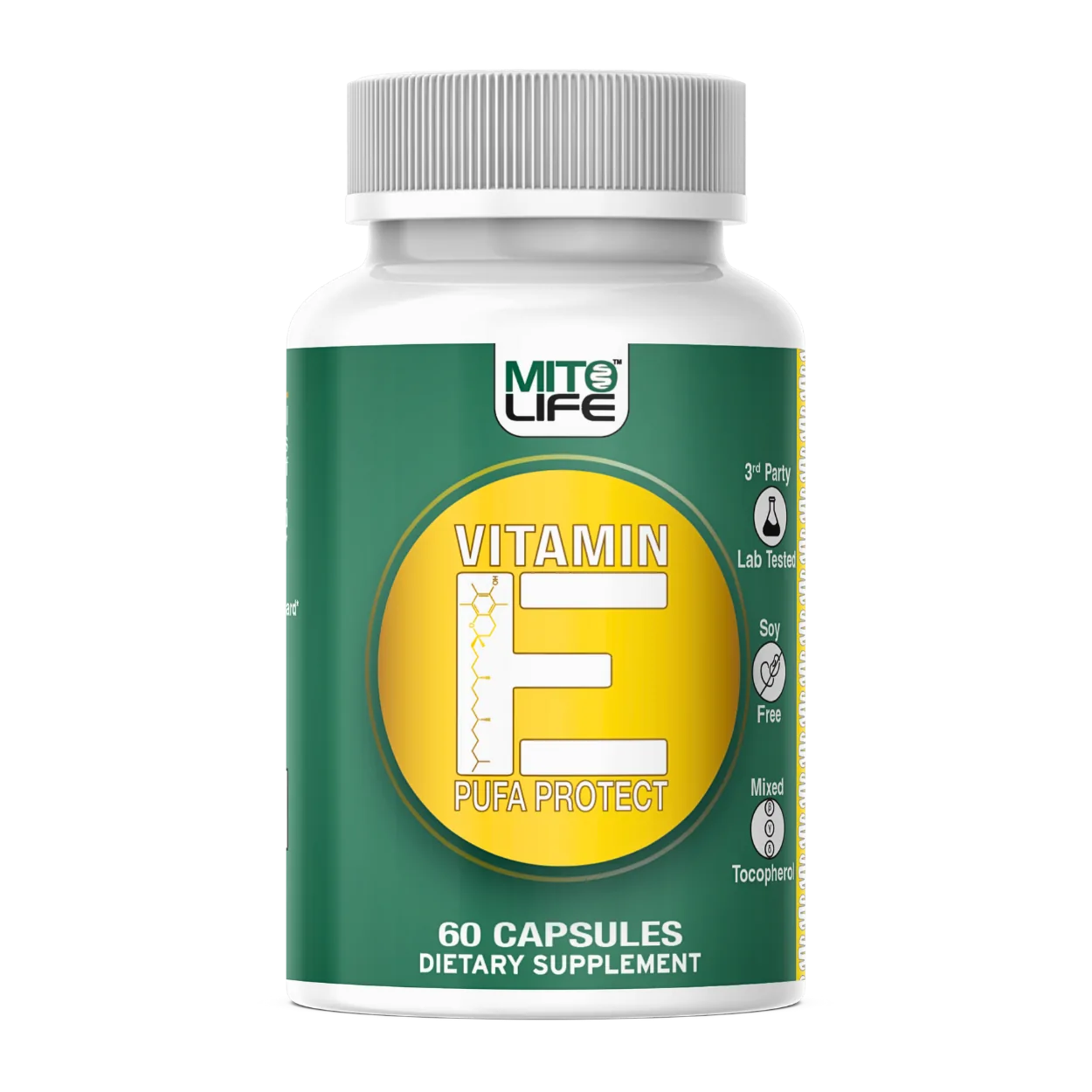
MitoLife
PUFA Protect
$50 / 60 capsules
- d-alpha-tocopherol 335 mg (827 IU)
- d-gamma-tocopherol 27.17 mg
- d-delta-tocopherol 9.42 mg
- d-beta-tocopherol 3.88 mg
- Sunflower-sourced, no soy, liquid-filled vegetarian capsule
Save 15% -- code HOLISTICLOVE (tap Buy to copy it before checkout)
Label as read on the manufacturer's site. Tocopherols only; not a tocotrienol product.
The science below is about vitamin E and its forms. The product above is a label. We keep them in separate sentences on purpose; every claim links to the study it came from.
Almost everyone is under the line. Nobody is measuring it.
In 26,282 US adults, 84 percent ate less vitamin E than the estimated average requirement.[1] A systematic review of 132 studies found most populations under the recommendation and 13 percent of blood readings below the threshold where function starts to fail.[2] A childhood review puts the highest deficiency prevalence in North America and Brazil.[3] Asian surveys report up to 67 to 80 percent in some groups, and the same review says the blood test has no validated cutoff.[4] The reason: serum vitamin E rides on your lipoproteins, so the number tracks your cholesterol, not your tissues.[5] A test nobody trusts becomes a test nobody orders, and a shortfall this common goes unmeasured.
Sources for this section (5)
- Inadequacy of immune health nutrients: intakes in US adults, NHANES 2005-2016 (2020)
- A systematic review of global alpha-tocopherol status assessed by intake and serum concentrations (2015)
- Vitamin E deficiency in childhood: a narrative review (2023)
- Vitamin E status in healthy populations in Asia: no validated cutoff (2021)
- Serum alpha-tocopherol tracks blood lipids (2025)
The form is the entire point
The trials that "failed" used the cheap fraction, alone.
Vitamin E is eight molecules, four tocopherols and four tocotrienols, and the assumption that alpha-tocopherol alone is vitamin E is one the nomenclature literature now rejects.[4] In eight adults given 1,200 IU of alpha-tocopherol a day, plasma gamma-tocopherol fell to 30 to 50 percent of baseline in eight weeks,[1] and the suppression shows up across the whole range of alpha doses.[2] Gamma is where much of the anti-inflammatory activity lives.[3] Now read what the famous trials used: a meta-analysis of 84 trials found no cardiovascular benefit,[5] a 19-trial meta-analysis linked 400 IU a day or more for a year or longer with higher all-cause mortality,[6] and SELECT found 17 percent more prostate cancer on 400 IU of synthetic vitamin E.[7] Synthetic. Alpha. Alone. That is the form on most shelves, and it is the form that failed. A randomized trial in type 2 diabetes tested alpha against gamma-rich mixed tocopherols for exactly this reason.[8] We ship those harm trials on this page because they are the argument: keep the family together, in the natural d- forms, at a dose the human data supports.
Sources for this section (8)
- Oral alpha-tocopherol supplements decrease plasma gamma-tocopherol levels in humans (1985)
- Alpha-tocopherol dose-response and gamma-tocopherol suppression
- Anti-inflammatory properties of alpha- and gamma-tocopherol (2007)
- Vitamin E nomenclature: is RRR-alpha-tocopherol the only vitamin E? (2024)
- Meta-analysis of 84 trials: vitamin E supplements and cardiovascular outcomes
- Meta-analysis: high-dosage vitamin E supplementation may increase all-cause mortality (2005)
- SELECT trial: synthetic vitamin E and prostate cancer incidence (JAMA, 2011)
- Alpha-tocopherol versus gamma-rich mixed tocopherols in type 2 diabetes: randomized trial
What it does when it is actually there
Every membrane you own
It donates an electron to the lipid peroxyl radical and breaks the chain reaction in the fatty membrane of the cell. The requirement rises with every gram of polyunsaturated fat you eat.[1]
Immune response, heart, hormones
200 mg a day gave older adults the strongest skin-test and vaccine antibody response, more than the higher dose.[2] In confirmed coronary disease, 400 to 800 IU meant fewer non-fatal heart attacks.[4] Higher intake tracked with less testosterone disruption from phthalates in 1,455 US men.[5]
The internal sunscreen
With the plant pigments from vegetables, 335 mg of vitamin E for 12 weeks significantly reduced skin reddening from a solar simulator in healthy volunteers.[3] Nutrients, not lotion. And the crops that carry it lost minerals between 1950 and 1999,[6] which is why a careful eater can still read low.
Sources for this section (6)
- Vitamin E function and requirements in relation to PUFA (2015)
- Vitamin E supplementation and in vivo immune response in healthy elderly subjects: randomized trial (JAMA, 1997)
- Carotenoids plus vitamin E protect against ultraviolet light-induced erythema in humans (2000)
- Randomised controlled trial of vitamin E in patients with coronary disease: CHAOS (Lancet, 1996)
- Nutrition intake and endocrine-disruptor effects on male sex hormones, NHANES (2025)
- Changes in USDA food composition data for 43 garden crops, 1950 to 1999 (2004)
The one we chose
Mixed tocopherols. Sunflower, not soy. d-, not dl-.
MitoLife
PUFA Protect
$50 / 60 capsules
- d-alpha-tocopherol 335 mg (827 IU)
- d-gamma-tocopherol 27.17 mg
- d-delta-tocopherol 9.42 mg
- d-beta-tocopherol 3.88 mg
- Sunflower-sourced, no soy, liquid-filled vegetarian capsule
Save 15% -- code HOLISTICLOVE (tap Buy to copy it before checkout)
Label as read on the manufacturer's site. Tocopherols only; not a tocotrienol product.
Supplements fill the gap. Food is the foundation.
Nuts, seeds, the germ of grains, leafy greens and the oils pressed from them carry vitamin E, and they lost minerals for seventy years. Pull up any marker on your own bloodwork in the free Lab Library and see the foods the research shows move it, then let the Diet Builder turn a gap into a grocery list.
Stop buying the fraction and calling it the vitamin.
You have seen the receipts: who is low, why the test misses it, which form the trials used, and what the whole family does when it is actually present. The next move is the form that keeps the family together, at a dose the human data supports.
Every claim on this page links to a published study. Education only, not medical advice. Structure and function of the body only; study citations are nutrient and mechanism science, not claims about any product. We earn a referral commission at no cost to you.