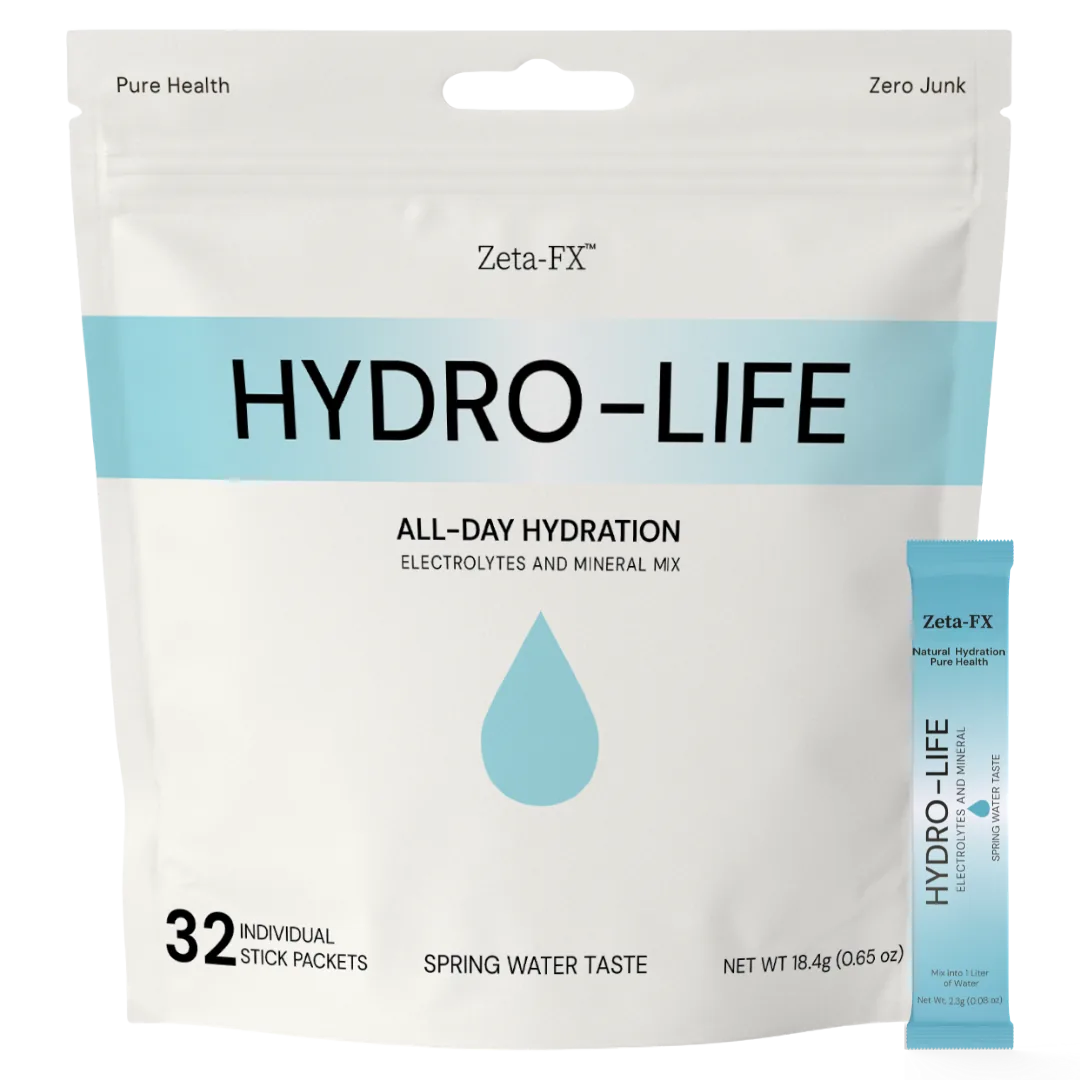
ZetaFX
Hydro-Life
Bulk pouch $39.99 / 200 servings (about 20 cents a serving)
- Per litre: potassium 451 mg, as potassium citrate + potassium bicarbonate
- Per litre: MSM 1000 mg · taurine 100 mg
- Other ingredients: none. No sodium, no sugar, no flavoring, no fillers
- Sticks: 1 per litre of filtered water. Bulk pouch or jar: scoop, no sticks
- Also: bulk jar $41.99 · 32 sticks $29.99 · 8-stick travel pack $12.99
Best value is the 200-serving bulk pouch with a scoop. Tracking is built into the link; no code needed.
Label as printed on the stick pack; prices read on the manufacturer's site 2026-09-29. Adds a real amount of potassium per day: reduced kidney function and ACE inhibitors, ARBs or potassium-sparing diuretics change the arithmetic. Know your own number first.
The science below is about potassium, taurine, MSM and the lining of your blood vessels. The product above is a label. We keep them in separate sentences on purpose; every claim links to the study it came from.
Hydration is not water. It is where the water goes.
Potassium sits inside the cell and sodium outside, and water follows the minerals. Skeletal muscle absorbs about 98 percent of a potassium dose within minutes as the body's main buffer,[1] so the blood carries only a small fraction of the total, and a 2026 review describes intracellular potassium deficiency with a completely normal serum level, linked to mitochondrial dysfunction, oxidative stress and impaired insulin sensitivity.[2] It is the same trap as serum magnesium, where a normal reading masks a depleted body.[3] And almost nobody is at the target: the NIH fact sheet puts most US adults well under it,[4] a 104-study benchmark puts the global mean below the recommendation,[5] and in one young-adult urine study more than 90 percent fell short.[6] In the USDA food survey for 2017-2018, about three in four US adults were under the Adequate Intake on the reporting day,[8] and under the older 4,700 milligram target fewer than 25 percent of men and fewer than 1 percent of women reached it.[9] Taurine is the molecule the cell uses to set its own volume, an osmolyte that matters most in the brain.[7] The essential minerals and water pages carry the rest of the foundation.
Sources for this section (9)
- Quantitative analysis of skeletal muscle contributions to extracellular potassium homeostasis (2026)
- Potassium homeostasis and the systemic consequences of intracellular potassium deficiency (2026)
- Magnesium: are we consuming enough? (2018)
- Potassium: Health Professional Fact Sheet (NIH Office of Dietary Supplements)
- Global mean potassium intake: a systematic review and Bayesian meta-analysis (2023)
- Potassium intake assessed by dietary recall and urinary excretion in young adults: African-PREDICT (2026)
- Taurine homeostasis and volume control (2017)
- Potassium Intake of the U.S. Population: What We Eat in America, NHANES 2017-2018 (USDA, 2022)
- Potassium Intake of the U.S. Population: What We Eat in America, NHANES 2009-2010 (USDA, 2012)
The slippery lining
Salt stiffens the vessel wall. Potassium softens it.
In endothelial cells, potassium softened the cell cortex and increased nitric oxide release while sodium stiffened it.[1] The glycocalyx, the gel coat inside every artery, shields the wall from excess salt, and its destruction contributes to cardiovascular disease;[2] in a microfluidic study its degradation rose with sodium and thickness fell.[3] The coat is also a sensor: with the sodium channel that aldosterone controls, it senses flow and triggers vasodilation, and in disease that sensing is lost.[4] Potassium lowers aldosterone in meta-analysis,[5] and in eight men on a high-salt diet potassium bicarbonate lowered adrenal glucocorticoid output where salt reduction alone did not.[6] In a randomized crossover of 94 adults, a low-sodium, high-potassium diet improved depression, tension and vigor scores.[7] The hospital knows the mineral matters: it runs saline by the bag, yet a low pre-operative potassium is grounds to postpone elective surgery, because it tracked with perioperative arrhythmia in 2,402 cardiac surgery patients[8] and with more complications after colorectal cancer surgery.[9] The saline itself is not neutral: a 2026 trial found a balanced fluid beat 0.9 percent saline on acid-base balance at the end of surgery.[10]
Sources for this section (10)
- Potassium softens vascular endothelium and increases nitric oxide release (2009)
- Glycocalyx-sodium interaction in vascular endothelium (2023)
- Excess sodium is deleterious on endothelial and glycocalyx barrier function: a microfluidic study (2018)
- Rapid shear stress-dependent ENaC membrane insertion is mediated by the endothelial glycocalyx and the mineralocorticoid receptor (2022)
- Effects of potassium supplementation on plasma aldosterone: meta-analysis in humans (2024)
- Glucocorticoid activity with NaCl-induced low-grade metabolic acidosis and oral alkalization (2016)
- Dietary electrolytes are related to mood: randomized crossover trial (2008)
- Preoperative serum potassium levels and perioperative outcomes in cardiac surgery patients (JAMA, 1999)
- Preoperative hypokalemia can increase complications after colorectal cancer surgery: propensity score matching analysis (2022)
- Plasma-Lyte 148 or 0.9% saline on acid-base balance in neurosurgery: randomized trial (2026)
What does the research say about each ingredient?
Potassium, as citrate + bicarbonate
Raising potassium lowers blood pressure across 33 trials[1] and dose-dependently across 32,[2] and higher intake tracks with about 24 percent lower stroke risk.[3] Citrate lowers pressure as well as chloride does[4] and raises urinary citrate and pH where lemonade cannot,[5] the alkali that fruit delivers.
Taurine
The osmolyte that sets cell volume. Across 20 randomized trials pooling 808 participants, taurine lowered systolic pressure by roughly 4 mmHg and heart rate by about 3.6 beats a minute.[6]
MSM, stated honestly
A review found doses to four grams a day associated with lower inflammation and oxidative-stress markers,[7] and a 12-week randomized trial in 88 adults with mild knee pain found a small but significant quality-of-life gain.[8] Moderate evidence, clean safety record, nothing more claimed.
Both directions, always: a UK trial in early hypertension found that raising potassium through fruit and vegetables or citrate did not significantly lower blood pressure,[9] and a 2025 review describes the dose-response as U-shaped, not linear.[10] Enough is the point, not more.
Sources for this section (10)
- Effects of oral potassium on blood pressure: meta-analysis of randomized controlled clinical trials (1997)
- Potassium intake and blood pressure: dose-response meta-analysis of 32 randomized trials (2020)
- Effect of increased potassium intake on cardiovascular risk factors and disease: systematic review and meta-analyses (2013)
- Potassium chloride and potassium citrate on blood pressure in hypertensives: crossover trial (2005)
- Lemonade versus potassium citrate: urine pH and citrate in kidney stone patients (2007)
- Cardiovascular benefits of taurine: meta-analysis of 20 randomized trials (2024)
- Methylsulfonylmethane: applications and safety of a novel dietary supplement (2017)
- Methylsulfonylmethane improves knee quality of life in mild knee pain: randomized placebo-controlled trial (2023)
- Increased potassium intake from fruit and vegetables or supplements does not lower blood pressure in early hypertension (2010)
- Dietary and physical activity approaches to the management of high blood pressure: U-shaped dose-response (2025)
The one we chose
Potassium citrate and bicarbonate. Taurine. MSM. Nothing else.
No sodium, no sugar, no flavoring. It tastes like water. The 200-serving pouch comes with a scoop, so there are no sticks to open; the sticks exist for travel.
ZetaFX
Hydro-Life
Bulk pouch $39.99 / 200 servings (about 20 cents a serving)
- Per litre: potassium 451 mg, as potassium citrate + potassium bicarbonate
- Per litre: MSM 1000 mg · taurine 100 mg
- Other ingredients: none. No sodium, no sugar, no flavoring, no fillers
- Sticks: 1 per litre of filtered water. Bulk pouch or jar: scoop, no sticks
- Also: bulk jar $41.99 · 32 sticks $29.99 · 8-stick travel pack $12.99
Best value is the 200-serving bulk pouch with a scoop. Tracking is built into the link; no code needed.
Label as printed on the stick pack; prices read on the manufacturer's site 2026-09-29. Adds a real amount of potassium per day: reduced kidney function and ACE inhibitors, ARBs or potassium-sparing diuretics change the arithmetic. Know your own number first.
Fruit is the model. The powder fills the gap.
Fruit and vegetables carry potassium with citrate, the way the body was built to receive it, and nobody eats eight to ten servings a day. Pull up potassium on your own bloodwork in the free Lab Library and see the foods the research shows move it, then let the Diet Builder turn a gap into a grocery list.
Stop paying for salt and calling it hydration.
You have seen the receipts: where the water goes, who is short, why the blood test misses it, what salt does to the lining, and what potassium, taurine and MSM do when they are actually there. Measure. Know. Improve. The next move costs about twenty cents a serving.
Every claim on this page links to a published study. Education only, not medical advice. Structure and function of the body only; study citations are nutrient and mechanism science, not claims about any product. We earn a referral commission at no cost to you. Written by Ryan Encinas, RN. Last updated 2026-09-29. Read how we cite and label opinion and the two root causes.