$60.00
Your discount applies with code HOLISTICLOVE.
When you buy through our links, we earn a small commission -- and that is what funds all the free education here. It never costs you more. Products are not intended to diagnose, treat, cure, or prevent any disease.
What it is
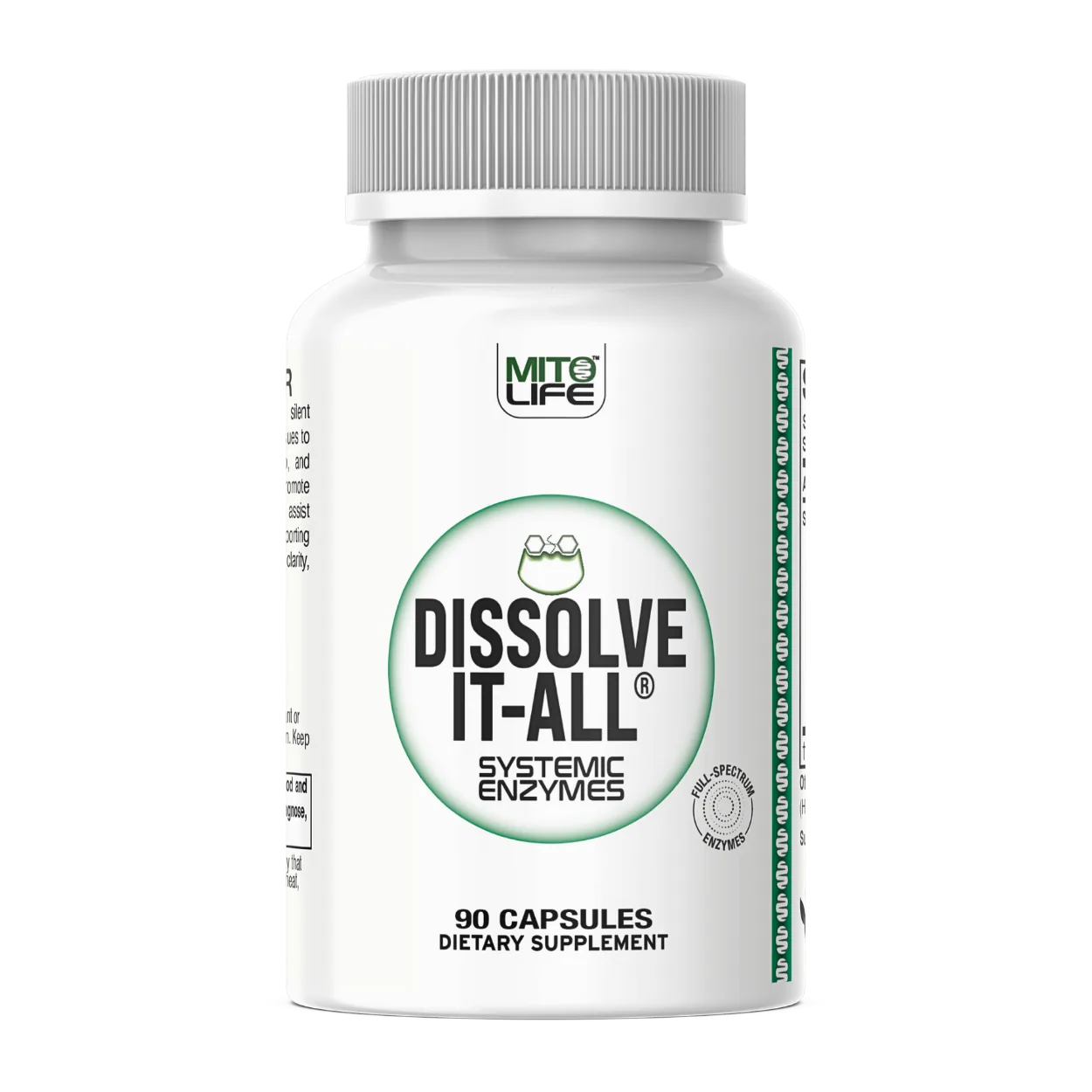
A blend of proteolytic (protein-digesting) enzymes taken between meals rather than with food, so they act systemically instead of on a meal. Used this way, proteolytic enzymes support the body's normal, everyday breakdown and clearing processes.
Why the evidence supports it
Proteolytic enzymes have a real but still-developing research base for supporting a normal inflammation response and the body's routine clearing work when taken away from food -- an honest 'growing evidence' tier rather than a settled one. The rationale is mechanistic: unoccupied by a meal, these enzymes stay available to the body's own housekeeping. So the claim stays modest -- this serves the cell's Maintain function, the ordinary daily upkeep, not a cleanse that fixes anything. Taken away from meals with plenty of water is how it is meant to be used.
What it supports
- Supports the body's normal breakdown and clearing processes
- Provides proteolytic enzymes taken between meals
- Supports a healthy inflammation response already within normal range
- Complements good hydration and a balanced routine
Which function it supports
Ties to the cell's Maintain function -- supporting the body's normal daily upkeep. What people use it for is a matter of preference, not a proven medical outcome.
Learn the why behind this pillarHow it relates to your cells and mind
Every product here ties back to a specific job your body does. This one touches the functions below -- follow either link to see the mechanism in full, then dig into the studies.
What it is made of -- and the mechanisms behind it
Each ingredient acts on several of the body's functions. Taken together, this product touches these cell and mind functions -- follow any to see the mechanism in full.
The ingredients
Mechanisms drawn from our ingredient knowledge base (1 profiled ingredients). Structure and function only -- not a treatment claim.
The science on the ingredients
These studies are research on the ingredients and mechanisms in this product, not on the finished product itself, and they are shown for education. For this ingredient most of the published work is laboratory or animal research rather than human trials, so read it as biology worth knowing rather than proof of an effect in people. Nothing here is medical advice, and nothing here may be used to diagnose, treat, cure, or prevent any disease. Talk to your own provider about what is right for you.
- A Randomized, Placebo-controlled Trial of Digestive Enzymes in Children with Autism Spectrum Disorders
Clinical Psychopharmacology and Neuroscience · 2015
In a small randomized placebo-controlled trial, a digestive-enzyme supplement was associated with improvements in some gastrointestinal and behavioral measures; single small RCT, structure/function support for digestion.
- A Randomized, Placebo-controlled Trial of Digestive Enzymes in Children with Autism Spectrum Disorders.
Clinical psychopharmacology and neuroscience : the official scientific journal of the Korean College of Neuropsychopharmacology · 2015
In a 3 month trial of 101 children with autism spectrum disorder, those given digestive enzymes showed more improvement in behavior, emotional response and gut symptoms than those given placebo.
- Detergent protease exposure and respiratory disease: case-referent analysis of a retrospective cohort
Occupational and environmental medicine · 2009
Detergent protease exposure showed clear monotonic dose-response relationship with occupational respiratory disease in European detergent factory workers.
- The role of protease activation of inflammation in allergic respiratory diseases
The Journal of allergy and clinical immunology · 2004
A review explains that proteases from mites and moulds growing in damp, water-damaged buildings can activate airway receptors that trigger inflammation, potentially contributing to rhinitis, asthma and nasal polyps.
- Protease-activated receptor 1 as an endogenous model of peptidergic Gαq-Gα12-biased G protein signaling
2026
In primary human platelets and cell assays, thrombin activated a receptor's Gaq and Ga12 signaling together, while a related protease triggered only Ga12 signaling, showing distinct outcomes depending on which protein cleaves it.
- Andrographolide as a potential inhibitor of SARS-CoV-2 main protease: an in silico approach
2021
In a computer modelling study, andrographolide from Andrographis paniculata docked into the SARS-CoV-2 main protease binding site and passed drug-likeness and absorption predictions; nothing was tested in cells or people.
Nattokinase supplementation for cognitive enhancement in asymptomatic intracranial/carotid stenosis: A randomized controlled trial.EmergingRandomized controlled trial2026
A randomized trial found six months of nattokinase supplementation did not improve global cognition but showed domain-specific visuospatial enhancement in patients with carotid stenosis.
Zhang K; Zhang X; Wang A; Zhong W; Pei Y; Jin H; Zhou Z; Chen C -- Journal of stroke and cerebrovascular diseases : the official journal of National Stroke Association
The Effect of Nattokinase-Monascus Supplements on Dyslipidemia: A Four-Month Randomized, Double-Blind, Placebo-Controlled Clinical Trial.EmergingRandomized controlled trial2023
A four-month randomized trial found nattokinase-Monascus supplementation improved LDL cholesterol and related lipid ratios without adverse events in dyslipidemia patients.
Liu X; Zeng X; Mahe J; Guo K; He P; Yang Q; Zhang Z; Li Z -- Nutrients
Effective management of atherosclerosis progress and hyperlipidemia with nattokinase: A clinical study with 1,062 participants.EmergingClinical trial2022
A 12-month study of 1,062 people who chose to take nattokinase, with no placebo group, found improved lipid and artery measures, more so with smoking, drinking, higher BMI, and added vitamin K2 or aspirin.
Chen H; Chen J; Zhang F; Li Y; Wang R; Zheng Q; Zhang X; Zeng J -- Frontiers in cardiovascular medicine
Nattokinase: A multifunctional food-derived enzyme for thrombophilia management.EmergingExpert review2026
Nattokinase exerts antithrombotic effects through fibrin degradation, platelet aggregation inhibition, and antioxidant and anti-inflammatory actions relevant to thrombophilia management.
Ma Y; Jia H; Fan J; Kang X; Huang W; Li Y; Li J -- Life sciences
Comparative Cardioprotective Effectiveness: NOACs vs. Nattokinase-Bridging Basic Research to Clinical Findings.EmergingExpert review2024
A narrative review compared cardioprotective mechanisms of direct oral anticoagulants and nattokinase, two approaches to vascular protection beyond standard anticoagulation.
Muric M; Nikolic M; Todorovic A; Jakovljevic V; Vucicevic K -- Biomolecules
Nattokinase-Associated Hemoperitoneum in an Elderly Woman.EmergingCase report2021
A case report described hemoperitoneum following nattokinase use, highlighting bleeding-related safety mechanisms to consider with this supplement.
Ramachandran L; Aqeel A; Jafri A; Sidhu Y; Mohamed Djirdeh T -- Cureus
Nattokinase: A Promising Alternative in Prevention and Treatment of Cardiovascular DiseasesNarrative review2018
Review summarizing nattokinase's fibrinolytic and circulatory-support properties. CONTESTED: systemic/fibrinolytic-enzyme evidence rests largely on small trials and reviews; not a proven disease treatment.
Chen H; McGowan EM; Ren N; et al. -- Biomarker Insights
Study on the transport and internalisation mechanism of dietary supplement nattokinase in the small intestine using animal and Caco-2 cell monolayer models.EmergingPreclinical study2023
Nattokinase transport and internalization in the small intestine was studied using animal and Caco-2 cell monolayer models to characterize absorption mechanisms.
Feng H; Liu C; Liu Q; Wang J; Zeng Y; Sun Y; Zhang M; Zhang H -- Xenobiotica; the fate of foreign compounds in biological systems
Stepwise Strategy to Identify Thrombin as a Hydrolytic Substrate for Nattokinase.EmergingPreclinical study2022
Thrombin was identified as a novel biological substrate for nattokinase, expanding understanding of its antithrombus mechanism involving inflammation and oxidative stress pathways.
Wang Y; Wang H; Zhang Y; Xu F; Wang J; Zhang F -- Journal of chemical information and modeling
Effectiveness of Mindfulness-Based Stress Reduction on Salivary Cortisol and α-amylase Level, Anxiety and Depression in Students: A Randomized and Parallel-Group Clinical TrialEstablishedRandomized controlled trial2025
In 30 students randomized to mindfulness-based stress reduction or control, the training improved general health and salivary alpha-amylase measures more than control, but did not significantly change students' cortisol levels.
Hassanvandi S; Mohammadzadegan R; Saadat SH; Hatef B; Shahyad S -- Applied psychophysiology and biofeedback
The short-term impact of music interventions on stress: Results of a multinational cluster-randomized trial using salivary cortisol and alpha-amylase assessments in care home residents with dementia.Randomized controlled trial2025
A multinational cluster-randomized trial found music therapy sessions produced significant pre-to-post reductions in salivary cortisol, alpha-amylase, and subjective stress in dementia care home residents.
Rasing NL; Janus SIM; Vink AC; Frischen UAS; Neuser J; Wake JD; Skoluda N; Sveinsdottir V; Geretsegger M; Langeland E; Kreutz G; Gold C; Nater UM; Zuidema SU -- Psychoneuroendocrinology
Effects of Mulberry Leaf and Corn Silk Extracts Against Alpha-Amylase and Alpha-Glucosidase In Vitro and on Postprandial Glucose in Prediabetic Individuals: A Randomized Crossover TrialEstablishedRandomized controlled trial2025
Mulberry leaf and corn silk extracts inhibited digestive enzymes in vitro, but in a small crossover trial of prediabetic adults the glucose-lowering effect appeared only in an overweight subgroup, not across all participants.
Sun Y et al. -- Nutrients
SimSAARlabim study - The role magic tricks play in reducing pain and stress in childrenEstablishedRandomized controlled trial2024
In 50 children aged 6-11 receiving routine vaccination, adding a magician's magic tricks did not significantly change heart rate, pain scores, or salivary cortisol, IgA and amylase stress markers compared to no tricks.
Teichfischer J; Weber R; Kaiser E; Poryo M; Weise JJ; Nisius A; Meyer S -- Vaccine
Neuromodulatory Interventions in Experimental Acute Pancreatitis: A Systematic Review of Rodent StudiesEmergingExpert review2026
In a systematic review of nine rodent studies, serotonergic blockers lowered serum amylase and lipase by 37 to 65 percent, but all interventions were given before or just after induction and bias risk was mostly unclear.
Maxim Rantsev; Alexey Sarapultsev; Valeriy Chereshnev
The biological functions of monoacylglycerol lipase (MAGL) in cancerEmergingExpert review2026
In a review, MAGL hydrolyzes 2-arachidonoylglycerol to produce arachidonic acid and free fatty acids that drive pro-inflammatory lipid mediators supporting tumor progression.
Faris Almutairi
The Role of Monoacylglycerol Lipase (MAGL) in Substance Use: A Systematic Review of Preclinical StudiesEmergingExpert review2026
In a systematic review of preclinical studies, MAGL inhibition consistently reduced withdrawal across cannabis, opioid, and nicotine models but showed variable effects on reward.
Bertina Jebanesan; Khadija Brouillette; Caleb J Browne; Isabelle Boileau; Laura M Best
Recent advances in neurodegenerative diseases therapeutics: The inhibition of monoacylglycerol lipase strategyEmergingExpert review2026
In a review, MAGL inhibition reduced neuroinflammation and neurodegeneration in preclinical models of Alzheimer's, Parkinson's, multiple sclerosis, and amyotrophic lateral sclerosis.
Delia Maciel Mendoza-Camacho; Hugo Alejandro Espinoza-Gutiérrez; Juan Manuel Viveros-Paredes; Mario Eduardo Flores-Soto; Aldo Rafael Tejeda-Martínez
Physical activity, cathepsin B, and cognitive healthEmergingExpert review2025
A review found physical activity raises plasma cathepsin B, a muscle-released protease linked to hippocampal neurogenesis and synaptic plasticity, but evidence for its role in human cognitive benefits is mixed.
Yu Q; Zhang Z; Herold F; Ludyga S; Kuang J; Chen Y; Liu Z; Erickson KI; Goodpaster BH; Cheval B; Pindus DM; Kramer AF; Hillman CH; Liu-Ambrose T; Kelley KW; Moon HY; Chen A; Zou L -- Trends in molecular medicine
Music-based interventions at workplaces: a scoping reviewEmergingExpert review2025
A scoping review found 25 of 30 workplace studies reported music-based interventions improved mood, reduced anxiety and stress, and lowered physiological markers like heart rate and salivary amylase, though 5 studies found no effect.
Israel Paul Nyarubeli; Bente E Moen; Viggo Krüger; Brynjulf Stige
Therapeutic Potentials of Medicinal Leech in Chinese MedicineEmergingExpert review2024
In a review of Chinese medicine practice, leech-derived proteins are grouped into direct anticoagulants such as hirudin, heparin and histamine, and protease inhibitors like decorsin and hementin, with hirudin the strongest thrombin inhibitor described.
Wu S; Zhou Y; Wang Y; Zhang Z -- The American journal of Chinese medicine
Endocannabinoid Metabolism and Traumatic Brain InjuryEmergingExpert review2021
In a review, monoacylglycerol lipase inhibition enhances 2-AG signaling, reducing neuroinflammation and improving cognitive outcomes after traumatic brain injury.
Zhu D; Gao F; Chen C -- Cells
An updated patent review of monoacylglycerol lipase (MAGL) inhibitors (2018-present)EmergingExpert review2021
In a review of 2018-present patents, MAGL inhibitor development accelerated, with reversible inhibitors remaining an unmet pharmaceutical need despite growing structural diversity.
Bononi G; Poli G; Rizzolio F; Tuccinardi T; Macchia M; Minutolo F; Granchi C -- Expert opinion on therapeutic patents
Potential of Fatty Acid Amide Hydrolase (FAAH), Monoacylglycerol Lipase (MAGL), and Diacylglycerol Lipase (DAGL) Enzymes as Targets for Obesity Treatment: A Narrative ReviewEmergingExpert review2021
A review found MAGL and DAGL inhibition lowered body weight in animal models and FAAH inhibition tended to increase it, while human genetic association studies of these enzymes mostly found no link to obesity.
Justin Matheson; Xin Ming Matthew Zhou; Zoe Bourgault; Bernard Le Foll -- Pharmaceuticals
Targeting Endocannabinoid Signaling: FAAH and MAG Lipase InhibitorsEmergingExpert review2021
A 2021 review evaluates FAAH and MAGL inhibitors that have reached human clinical trials for modulating brain endocannabinoid signaling, discussing safety caveats versus direct CB1 agonism by THC and future research directions.
van Egmond N; Straub VM; van der Stelt M -- Annual review of pharmacology and toxicology
Balanced by design -- we show supporting and contradicting findings. Search all studies
No product works in isolation
Every cell function above -- Sense, Exchange, Transform, Build, Maintain, Adapt -- needs the same broad base of optimal micronutrient levels running underneath it, all the time. Dissolve-It-All is not a stand-alone fix; it is one piece that plugs into that larger system. The foundation comes first, and this supports it.
Stacks well with
Pick your goal -- here is what Dissolve-It-All pairs with for each. Nothing works in isolation; these share the same systems.
Foundational, or targeted?
Not everything in the shop is meant to be taken forever. Some products here are foundational -- a daily nutrient base built for long-term, ongoing use. Others are targeted -- shorter-term support for a specific season, not a lifelong habit. If you are not sure which one this is, that is a fair question to ask us before you buy.
Learn more, on your terms
Do not take our word for it -- go read. Each topic below opens a pre-loaded search so you can explore the nutrient, the mechanism, or the device for yourself.
Search the full studies libraryHow to use it
Take on an empty stomach, away from meals by an hour or two, with a full glass of water so the enzymes act systemically rather than on food. Follow the brand's serving size.
Use code HOLISTICLOVE at checkout.
Where to get it
Ready when you are. This link takes you to the official, verified source for this product.
Get Dissolve-It-AllThe studies
See the research behind the science we point to.
Explore studiesThe blog
Plain-language reads on how it all fits together.
Read the blogOptimal nutrients are the definition of longevity
Long-term cell function depends on having what it needs, at the level it needs it, for as long as it needs it. That is the whole thesis behind everything we point you to here.
When you buy through our links, we earn a small commission -- and that is what funds all the free education here. It never costs you more. Products are not intended to diagnose, treat, cure, or prevent any disease.
Dissolve-It-All is a blend of proteolytic (protein-digesting) enzymes taken between meals rather than with food. Many people use enzymes this way to support the body's normal, everyday breakdown and clearing processes. It fits people who like systemic enzyme support as part of a balanced routine.
FAQ
What does Dissolve-It-All support?
It supports the body's normal breakdown and clearing processes, provides proteolytic enzymes taken between meals, supports a healthy inflammation response already within normal range, and complements good hydration and a balanced routine.
How do I take it?
Take on an empty stomach, away from meals by an hour or two, with a full glass of water so the enzymes act systemically rather than on food. Follow the brand's serving size.
What makes it different?
The language stays honest -- it is an enzyme blend people take to support normal housekeeping, not a cleanse that fixes anything. What people use it for is a matter of preference.