

$115.00
$144.00 save $29.00 -- applied automatically through this link
When you buy through our links, we earn a small commission -- and that is what funds all the free education here. It never costs you more. Products are not intended to diagnose, treat, cure, or prevent any disease.
What it is
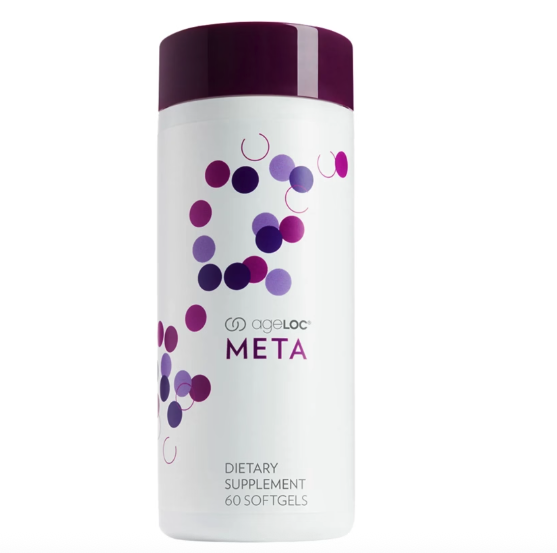
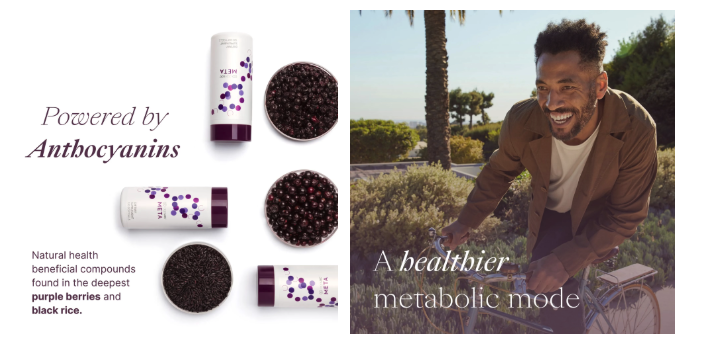
Only about 1 in 8 adults is metabolically healthy -- and that is exactly the problem ageLOC Meta is built for. It is a concentrated anthocyanin blend standardized to 215 mg per serving, drawn from black rice, black currant, and bilberry and built around the two pigments the research pointed to, cyanidin and delphinidin -- the deep purple-red compounds studied for metabolic and antioxidant support. Taken as four softgels daily, it is aimed squarely at the metabolic chemistry of how your body handles a meal.
Why the evidence supports it
Meta is named for metabolic chemistry, and that is the honest center of its evidence -- not a generic antioxidant story. The finished blend has its own signal: subjects who took it before a rich, high-fat meal showed a more favorable metabolic and inflammatory response than placebo. Behind that, its cyanidin and delphinidin -- chosen through LifeGen's gene-expression screening for their metabolic gene modulation, not antioxidant chemistry alone -- reach a striking spread of metabolic systems, and the human evidence is strongest right where the name points: the liver (anthocyanin trials lower ALT and liver-injury markers in people with fatty liver), the gut (they shift the microbiome toward more short-chain-fat production and help tighten the gut barrier), plus fat oxidation and healthy insulin and glucose handling -- with emerging work on the pancreas, on muscle glucose uptake, and on neuroprotection. Its anthocyanins do also switch on NRF2, which is one of these levers and where the everyday antioxidant-and-clearing piece comes in -- but the headline is metabolic breadth, honestly graded: liver and microbiome rest on human trials, while the pancreas and muscle links are still emerging. Kept honest, it supports the cell's Transform function -- how the body handles and clears the energy of a meal -- not weight loss or a blood-sugar treatment.
What it supports
- Supports the body's own antioxidant defenses
- Supports a healthy inflammation response around a meal
- Provides a concentrated spectrum of dietary anthocyanins
- Complements a balanced diet and everyday metabolic habits
Which function it supports
Ties to the cell's Transform function -- supporting metabolic chemistry across the liver, gut and microbiome, fat oxidation, and how the body handles and clears the energy of a meal.
Learn the why behind this pillarHow it relates to your cells and mind
Every product here ties back to a specific job your body does. This one touches the functions below -- follow either link to see the mechanism in full, then dig into the studies.
What it is made of -- and the mechanisms behind it
Each ingredient acts on several of the body's functions. Taken together, this product touches these cell and mind functions -- follow any to see the mechanism in full.
The ingredients
Mechanisms drawn from our ingredient knowledge base (4 profiled ingredients). Structure and function only -- not a treatment claim.
What’s actually in it
Label revision 2022-09-30Transcribed from the manufacturer’s official Product Information Page, exactly as printed. Ingredient names that link open our research page for that ingredient, with the studies behind it.
| Amount per 4 softgels | Amount | % DV |
|---|---|---|
| Calories | 15 | |
| Total Fat | 1 g | 1.5% |
| Total Carbohydrates | 1 g | 0% |
| ageLOC Meta Blendstandardized to 215 mg total anthocyanins; Black Rice (Oryza sativa L.) Extract, Black Currant (Ribes nigrum) Fruit Extract, Bilberry (Vaccinium myrtillus) Fruit Extract | 897.2 mg | † |
- Servings per container:
- 30
- Other ingredients:
- Olive Oil, Gelatin, Glycerin, Sunflower Lecithin, Beeswax.
Source: official Product Information Page . Amounts are the manufacturer’s, not ours. Structure and function only -- nothing here is medical advice, and nothing here may be used to diagnose, treat, cure, or prevent any disease.
The science on the ingredients
If you have had labs done
These are lab markers where this product's ingredients have measured evidence in our citation library. This is not a claim that the product will change your results -- the research attaches to the ingredient, and what a marker means depends on the whole picture. Each one links to its full entry, including what typically moves it and how to read it.
- Lipid Panel (Total Cholesterol, LDL, Non-HDL, Cholesterol/HDL Ratio, Triglycerides)emerging evidence
via Anthocyanins · 9 studies, 5 in people
What people often notice when this marker sits outside the usual range
Higher: The symptoms that actually travel with raised triglycerides belong to the metabolic pattern behind them -- the post-meal crash, central weight, rising blood pressure, fatty liver.
Lower: Very low total cholesterol alongside low albumin and unintended weight loss points at absorption or liver capacity, not at good health.
- Triglyceridesemerging evidence
via Anthocyanins · 9 studies, 5 in people
What people often notice when this marker sits outside the usual range
Higher: High triglycerides are usually silent and travel with the insulin-resistant pattern -- central weight gain, energy crashes after carb-heavy meals, a low HDL.
Lower: Low triglycerides are generally not a concern and often reflect good metabolic health.
- Triglyceridesemerging evidence
via Anthocyanins · 9 studies, 5 in people
What people often notice when this marker sits outside the usual range
Higher: A non-fasting draw or recent alcohol inflates the number -- confirm a true fasting sample before acting on a borderline value.
Lower: Low triglycerides are generally not a concern and often reflect good metabolic health and insulin sensitivity.
- Glucose (Fasting)emerging evidence
via Anthocyanins · 11 studies, 3 in people
Reviewed alongside curcumin and resveratrol for prevention and management of metabolic dysfunction; slow carbohydrate absorption and improve insulin sensitivity.
What people often notice when this marker sits outside the usual range
Higher: Waking at 3am, often with a racing heart -- 'why do i wake up at 3am every night'.
Lower: Shakiness, sweating, sudden anxiety and difficulty concentrating that resolve within minutes of eating.
Lab results are interpreted by a qualified clinician who knows your history. Nothing here diagnoses anything or replaces that conversation.
No product works in isolation
Every cell function above -- Sense, Exchange, Transform, Build, Maintain, Adapt -- needs the same broad base of optimal micronutrient levels running underneath it, all the time. ageLOC Meta is not a stand-alone fix; it is one piece that plugs into that larger system. The foundation comes first, and this supports it.
Stacks well with
Pick your goal -- here is what ageLOC Meta pairs with for each. Nothing works in isolation; these share the same systems.
For Epigenetics
For Gut Health
Foundational, or targeted?
Not everything in the shop is meant to be taken forever. Some products here are foundational -- a daily nutrient base built for long-term, ongoing use. Others are targeted -- shorter-term support for a specific season, not a lifelong habit. If you are not sure which one this is, that is a fair question to ask us before you buy.
Learn more, on your terms
Do not take our word for it -- go read. Each topic below opens a pre-loaded search so you can explore the nutrient, the mechanism, or the device for yourself.
Search the full studies libraryHow to use it
Take four softgels daily, often with a larger meal. Follow the current label for timing and serving size.
Where to get it
Ready when you are. This link takes you to the official, verified source for this product.
Get ageLOC MetaThe studies
See the research behind the science we point to.
Explore studiesThe blog
Plain-language reads on how it all fits together.
Read the blogOptimal nutrients are the definition of longevity
Long-term cell function depends on having what it needs, at the level it needs it, for as long as it needs it. That is the whole thesis behind everything we point you to here.
When you buy through our links, we earn a small commission -- and that is what funds all the free education here. It never costs you more. Products are not intended to diagnose, treat, cure, or prevent any disease.
ageLOC Meta is a concentrated anthocyanin blend from black rice, black currant, and bilberry. Anthocyanins are the deep purple-red plant pigments studied for antioxidant support, and this formula is aimed at supporting the body's healthy response around a meal. It fits people who want antioxidant support tied to their meals.
FAQ
What does ageLOC Meta support?
It supports the body's own antioxidant defenses and a healthy inflammation response around a meal, provides a concentrated spectrum of dietary anthocyanins, and complements a balanced diet and everyday metabolic habits.
How do I take it?
Take four softgels daily, often with a larger meal. Follow the current label for timing and serving size.
What makes it different?
There is a study on the actual finished formula looking at how the body handles the oxidative load of a rich meal. It is framed as antioxidant support around meals, not weight loss or blood-sugar treatment.