

$51.00
$63.00 save $12.00 -- applied automatically through this link
When you buy through our links, we earn a small commission -- and that is what funds all the free education here. It never costs you more. Products are not intended to diagnose, treat, cure, or prevent any disease.
What it is
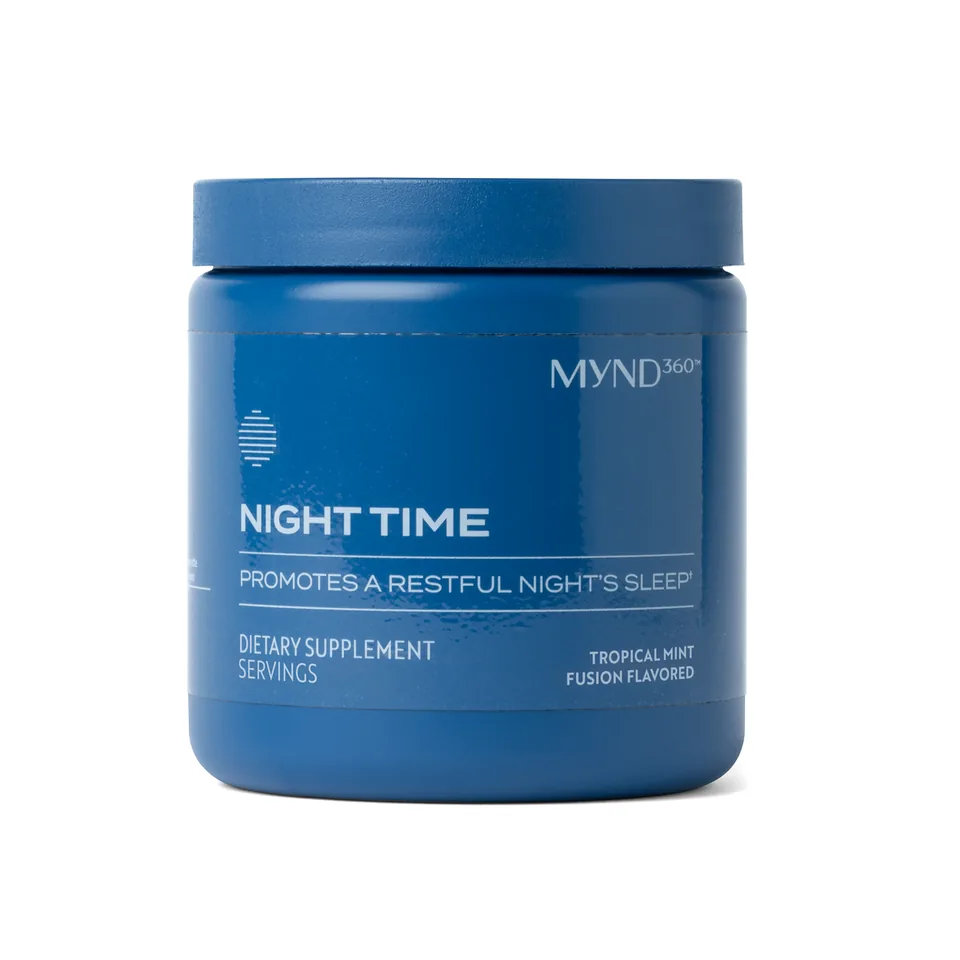
An evening drink scoop combining magnesium (about 225 mg, delivered as a well-tolerated citrate form that fizzes when mixed with warm water), saffron stigma extract (14 mg), and a low dose of melatonin (1 mg). Mixed into warm water about 30 minutes before bed, it is built to support an easier wind-down and a healthy sleep rhythm rather than to knock you out.
Why the evidence supports it
This is a well-reasoned sleep blend because each active is dosed to match its own research: saffron extract has placebo-controlled sleep-quality trials at about this amount, magnesium has human work on subjective sleep in people who run low, and melatonin's role in resetting the sleep-wake clock is among the more studied in supplement science -- kept deliberately low here at 1 mg. There is also a double-blind, placebo-controlled study on the blend itself (formulated without melatonin) reporting improved sleep quality. That makes it an evidence-based nudge for the Mind's Regulate function -- the circadian and calming signals that help the body downshift toward sleep -- meant to support a routine, not replace one. The saffron is worth a closer look: it is one of the most-studied botanicals for mood and cognition, and its mechanism is specific -- it modulates serotonin reuptake, the same target the SSRI class of medications acts on, alongside effects studied for memory. That is why its trial base runs so deep -- saffron has even been compared head-to-head against reference medications in randomized trials and meta-analyses and matched or beat them on the endpoints those studies measured (the trials are linked in the studies below, so you can read them yourself). The line we hold is clear: this is structure/function support for a balanced mood and healthy cognition, and a mechanism worth understanding -- not a treatment for any condition and not a substitute for prescribed medication, which are decisions for your doctor.
What it supports
- Supports an easier evening wind-down
- Supports a healthy, regular sleep rhythm
- Supports nervous-system calm before bed
- Provides magnesium, a mineral many people run low on
Which function it supports
Ties to the Mind world's Regulate function -- supporting the circadian and calming signals that help the body downshift toward sleep.
Learn the why behind this pillarHow it relates to your cells and mind
Every product here ties back to a specific job your body does. This one touches the functions below -- follow either link to see the mechanism in full, then dig into the studies.
What it is made of -- and the mechanisms behind it
Each ingredient acts on several of the body's functions. Taken together, this product touches these cell and mind functions -- follow any to see the mechanism in full.
The ingredients
Mechanisms drawn from our ingredient knowledge base (3 profiled ingredients). Structure and function only -- not a treatment claim.
What’s actually in it
Label revision US PIP dated 7/19/24Transcribed from the manufacturer’s official Product Information Page, exactly as printed. Ingredient names that link open our research page for that ingredient, with the studies behind it.
| Amount per 1 level scoop | Amount | % DV |
|---|---|---|
| Magnesiumas magnesium carbonate | 225 mg | 54% |
| SaffronCrocus sativus, stigma extract | 14 mg | * |
| Melatonin | 1 mg | * |
- Servings per container:
- 30
- Other ingredients:
- Citric acid, natural flavors (passion fruit, peach), stevia rebaudioside.
Source: official Product Information Page . Amounts are the manufacturer’s, not ours. Structure and function only -- nothing here is medical advice, and nothing here may be used to diagnose, treat, cure, or prevent any disease.
The science on the ingredients
These studies are research on the ingredients and mechanisms in this product, not on the finished product itself, and they are shown for education. Nothing here is medical advice, and nothing here may be used to diagnose, treat, cure, or prevent any disease. Talk to your own provider about what is right for you.
- An investigation into an evening intake of a saffron extract on sleep quality, cortisol, and melatonin concentrations in adults with poor sleep: a randomised, double-blind, placebo-controlled, multi-dose study
Sleep Med · 2021
- Meta-analysis: melatonin for the treatment of primary sleep disorders.
PloS one · 2013
- Magnesium supplementation and subjective sleep quality, RCT (elderly)
Journal of Research in Medical Sciences · 2012
If you have had labs done
These are lab markers where this product's ingredients have measured evidence in our citation library. This is not a claim that the product will change your results -- the research attaches to the ingredient, and what a marker means depends on the whole picture. Each one links to its full entry, including what typically moves it and how to read it.
- Fasting Insulin, Glucose & HOMA-IRsolid evidence
via Magnesium · 910 studies, 304 in people
What people often notice when this marker sits outside the usual range
Higher: The afternoon crash; hunger returning within two hours; central weight that will not shift; skin tags and darkened velvety skin in neck folds or armpits.
Lower: Not usually a concern; very low fasting insulin with low glucose warrants a clinician's look.
- Fasting Insulin, Glucose & HbA1csolid evidence
via Magnesium · 910 studies, 304 in people
What people often notice when this marker sits outside the usual range
Higher: The afternoon crash; central weight appearing where it never used to; hunger returning quickly; waking at 3am.
Lower: Not usually a concern in this context.
- Fasting Insulin and Insulin-like Growth Factor-1 (IGF-1)solid evidence
via Magnesium · 910 studies, 304 in people
The nutrients with real human evidence on insulin sensitivity -- read the fasting glucose entry for the counts and trials.
- Magnesiumsolid evidence
via Magnesium · 775 studies, 241 in people
What people often notice when this marker sits outside the usual range
Higher: Almost always caused by supplements plus reduced kidney function, not by food.
Lower: Muscle cramps, especially calves at night; eyelid twitching that goes on for days.
- Magnesiumsolid evidence
via Magnesium · 775 studies, 241 in people
What people often notice when this marker sits outside the usual range
Lower: For the full symptom picture in both directions, read the main magnesium entry -- it is the same measurement, and repeating it here would only risk the two drifting apart.
- Magnesium RBC (Red Blood Cell Magnesium)solid evidence
via Magnesium · 775 studies, 241 in people
What people often notice when this marker sits outside the usual range
Higher: Almost always supplements plus reduced kidney function rather than food.
Lower: Muscle cramps especially calves at night; eyelid twitching; restless legs.
- Magnesiumsolid evidence
via Magnesium · 775 studies, 241 in people
What people often notice when this marker sits outside the usual range
Higher: Because muscle-meat and refined foods are low in magnesium, shortfall is common on modern diets.
Lower: A high serum magnesium is rare and almost always tied to impaired kidney function (weakness, low blood pressure) -- a medical finding, since magnesium is renally cleared.
- Magnesiumsolid evidence
via Magnesium · 775 studies, 241 in people
What people often notice when this marker sits outside the usual range
Higher: A high serum magnesium is rare and almost always tied to impaired kidney function (weakness, low blood pressure) -- a medical finding, since magnesium is renally cleared.
- Vitamin D (25-Hydroxyvitamin D)solid evidence
via Magnesium · 43 studies, 16 in people
What people often notice when this marker sits outside the usual range
Higher: Excess comes from supplements, essentially never from sun.
Lower: Fatigue -- our library holds an explicit study of 25(OH)D and fatigue severity in adults.
- Vitamin Dsolid evidence
via Magnesium · 43 studies, 16 in people
Required for both activation steps.
What people often notice when this marker sits outside the usual range
Higher: Excess risks hypercalcaemia and kidney stones -- read the main vitamin D entry.
- Vitamin D (Gut Barrier)solid evidence
via Magnesium · 43 studies, 16 in people
Both hydroxylation steps that activate vitamin D are magnesium-dependent.
What people often notice when this marker sits outside the usual range
Higher: See the main vitamin D entry -- excess risks hypercalcaemia and kidney stones.
Lower: Vitamin D deficiency is consistently associated with altered gut microbiota and increased permeability in observational data.
- Vitamin D (25-hydroxyvitamin D)solid evidence
via Magnesium · 43 studies, 16 in people
Required for both hydroxylation steps.
What people often notice when this marker sits outside the usual range
Higher: Excess risks hypercalcaemia and kidney stones -- toxicity comes from supplements, essentially never from sun.
Lower: Fatigue, aching bones and muscles, low mood worse in winter, frequent illness, hair loss.
- Cortisolsolid evidence
via Magnesium · 34 studies, 16 in people
What people often notice when this marker sits outside the usual range
Higher: "Wired but tired" -- exhausted all day, then alert the moment the head hits the pillow.
Lower: Profound fatigue that is worst in the morning, and improves slightly through the day -- the reverse of the usual pattern.
via Saffron · 10 studies, 8 in people
What people often notice when this marker sits outside the usual range
Higher: The symptoms that actually travel with raised triglycerides belong to the metabolic pattern behind them -- the post-meal crash, central weight, rising blood pressure, fatty liver.
Lower: Very low total cholesterol alongside low albumin and unintended weight loss points at absorption or liver capacity, not at good health.
- Sodium, Potassium, Chloride & CO2 (Electrolytes)solid evidence
via Magnesium · 17 studies, 7 in people
What people often notice when this marker sits outside the usual range
Higher: HIGH SODIUM: thirst, dry mouth, confusion -- almost always dehydration rather than salt intake.
Lower: LOW SODIUM: headache, nausea, confusion, fatigue, muscle cramps.
- Glucose (Fasting)solid evidence
via Saffron · 8 studies, 7 in people
What people often notice when this marker sits outside the usual range
Higher: Waking at 3am, often with a racing heart -- 'why do i wake up at 3am every night'.
Lower: Shakiness, sweating, sudden anxiety and difficulty concentrating that resolve within minutes of eating.
- Hemoglobin A1c (HbA1c)solid evidence
via Saffron · 7 studies, 6 in people
What people often notice when this marker sits outside the usual range
Higher: Everything listed under fasting glucose, but with more time behind it -- HbA1c is a three-month average, so symptoms are usually established rather than new.
- High-Sensitivity C-Reactive Protein (hs-CRP)solid evidence
via Saffron · 5 studies, 4 in people
Systematic review and meta-analysis on inflammation and oxidative stress specifically -- reduced inflammatory markers.
What people often notice when this marker sits outside the usual range
Higher: Deep, unrefreshing fatigue -- searched as 'tired all the time blood tests normal' and 'why am i tired even after 8 hours sleep'.
Lower: No symptoms. Low is the desirable direction.
- Calciumsolid evidence
via Magnesium · 17 studies, 3 in people
Required for PTH release and for tissue response to it -- a low calcium that will not correct is a magnesium problem until proven otherwise.
What people often notice when this marker sits outside the usual range
Higher: "Bones, stones, groans and psychic moans" -- the old teaching phrase, and still the best summary: bone pain, kidney stones, abdominal pain and constipation, low mood and confusion.
Lower: Tingling around the mouth and in the fingers and toes.
- Bone Health: DEXA / T-score, CTX, P1NPemerging evidence
via Magnesium · 828 studies, 450 in people
Cofactor for both vitamin D activation and PTH secretion.
What people often notice when this marker sits outside the usual range
Higher: A high T-score is favourable; very high values occasionally reflect degenerative change in the spine artificially inflating the reading.
Lower: Bone loss is SILENT until a fracture.
- Vitamin D, Calcium, and Parathyroid Hormone (PTH)emerging evidence
via Magnesium · 828 studies, 450 in people
Cofactor for both vitamin D activation and PTH secretion.
What people often notice when this marker sits outside the usual range
Lower: CALCIUM LOW: tingling around the mouth and in fingers, muscle cramps and twitching, irritability.
- Potassiumemerging evidence
via Magnesium · 17 studies, 7 in people
What people often notice when this marker sits outside the usual range
Higher: Serum potassium is a SAFETY marker, tightly regulated -- the body defends the blood level even when dietary intake is low, so a normal serum value does not confirm good dietary intake.
Lower: A low serum potassium (hypokalaemia) can cause muscle cramps, weakness, fatigue, constipation and palpitations -- also a medical finding to address with a clinician.
- Potassiumemerging evidence
via Magnesium · 17 studies, 7 in people
What people often notice when this marker sits outside the usual range
Higher: Serum potassium is a tightly regulated SAFETY marker -- the body defends the blood level even when dietary intake is low, so a normal serum value does not confirm good dietary intake.
Lower: A low serum potassium (hypokalaemia) can cause muscle cramps, weakness, fatigue, constipation and palpitations -- also a medical finding to address with a clinician.
- Fasting Glucoseemerging evidence
via Saffron · 8 studies, 7 in people
What people often notice when this marker sits outside the usual range
Higher: A high fasting glucose is often silent early -- the classic high-sugar symptoms (excess thirst, frequent urination, fatigue, blurred vision) tend to appear later and higher.
Lower: A genuinely low glucose (hypoglycaemia) can cause shakiness, sweating, irritability, hunger and lightheadedness -- but a low-normal fasting value in a healthy person is usually favourable.
- HbA1c (Hemoglobin A1c)emerging evidence
via Saffron · 7 studies, 6 in people
What people often notice when this marker sits outside the usual range
Higher: A high HbA1c reflects the same chronic high-glucose state -- silent early, then thirst, frequent urination and fatigue at higher levels.
Lower: A low HbA1c is generally favourable, but an unexpectedly low value can reflect a red-cell condition rather than excellent control -- cross-check against fasting glucose if it surprises you.
- HbA1c (Glycated Hemoglobin)emerging evidence
via Saffron · 7 studies, 6 in people
What people often notice when this marker sits outside the usual range
Higher: A high HbA1c reflects the same chronic high-glucose state as glucose, averaged over roughly three months -- silent early, then thirst, frequent urination and fatigue at higher levels.
Lower: A low HbA1c is generally favourable, but an unexpectedly low value can reflect a red-cell condition rather than excellent control -- cross-check against fasting glucose if it surprises you.
- Triglyceride:HDL Ratioemerging evidence
via Magnesium · 9 studies, 5 in people
What people often notice when this marker sits outside the usual range
Lower: A low ratio suggests good insulin sensitivity -- the favourable direction.
- Fasting Insulinemerging evidence
via Magnesium · 9 studies, 5 in people
What people often notice when this marker sits outside the usual range
Higher: A high fasting insulin is one of the EARLIEST signals of insulin resistance -- insulin climbs to keep glucose normal for years before glucose itself rises.
Lower: A low fasting insulin, with a normal glucose, generally reflects good insulin sensitivity -- the favourable direction.
- Fasting Glucoseemerging evidence
via Magnesium · 9 studies, 5 in people
What people often notice when this marker sits outside the usual range
Higher: A high fasting glucose is often silent early -- the classic high-sugar symptoms (excess thirst, frequent urination, fatigue, blurred vision) tend to appear later and higher.
Lower: A genuinely low glucose (hypoglycaemia) can cause shakiness, sweating, irritability, hunger and lightheadedness -- but a low-normal fasting value in a healthy person is usually favourable.
- Fasting Insulinemerging evidence
via Magnesium · 9 studies, 5 in people
What people often notice when this marker sits outside the usual range
Higher: Must be drawn fasting to be interpretable, and read alongside glucose (as HOMA-IR), never in isolation.
Lower: A low fasting insulin, with a normal glucose, generally reflects good insulin sensitivity -- the favourable direction.
- HOMA-IR (calculated -- a derived value, not a measured one)emerging evidence
via Magnesium · 9 studies, 5 in people
What people often notice when this marker sits outside the usual range
Higher: Because it is built from fasting insulin, it carries that assay's variability -- interpret the trend on one lab, not an absolute number.
Lower: A low HOMA-IR (roughly under 2.0) is commonly read as insulin-sensitive -- the favourable direction, though the cutoff is population-dependent.
- Triglyceride : HDL Ratio (calculated -- a derived value)emerging evidence
via Magnesium · 9 studies, 5 in people
What people often notice when this marker sits outside the usual range
Lower: A low ratio suggests good insulin sensitivity -- the favourable direction.
via Magnesium · 9 studies, 5 in people
What people often notice when this marker sits outside the usual range
Higher: The TyG index is a calculated insulin-resistance marker built from fasting triglycerides and fasting glucose -- a derived number, not a felt symptom.
Lower: A lower TyG index (within a population) is the favourable direction -- the validating studies read it as higher-versus-lower, not against a fixed line.
- hs-CRP (High-Sensitivity C-Reactive Protein)emerging evidence
via Saffron · 5 studies, 4 in people
What people often notice when this marker sits outside the usual range
Higher: A high hs-CRP reflects low-grade inflammation SOMEWHERE -- you tend to feel the underlying cause (a cold, a flare, a sore joint, poor sleep, extra weight) rather than the CRP itself.
Lower: A low hs-CRP is favourable and simply reflects little systemic inflammation at the moment of the draw.
- hs-CRP (High-Sensitivity C-Reactive Protein)emerging evidence
via Saffron · 5 studies, 4 in people
What people often notice when this marker sits outside the usual range
Higher: hs-CRP is non-specific -- read it as a trend and in context, never as a stand-alone verdict.
Lower: A low hs-CRP is favourable and simply reflects little systemic inflammation at the moment of the draw.
- Calciumemerging evidence
via Magnesium · 17 studies, 3 in people
What people often notice when this marker sits outside the usual range
Higher: A high serum calcium needs clinical work-up -- causes include parathyroid, vitamin D and kidney issues -- not a supplement adjustment.
- HDL Cholesterolemerging evidence
via Saffron · 3 studies, 3 in people
What people often notice when this marker sits outside the usual range
Higher: Silent, and NOT automatically good news.
Lower: Silent. HDL produces no sensation at any level.
- Thyroid-Stimulating Hormone (TSH)emerging evidence
via Magnesium · 1 studies, 1 in people
Severely low serum magnesium associated with positive anti-thyroglobulin antibodies -- an association, and a reason to check rather than a demonstrated lever.
What people often notice when this marker sits outside the usual range
Higher: Cold all the time, especially hands and feet, and needing more layers than everyone else in the room.
Lower: Racing or irregular heartbeat, palpitations, waking at night with the heart pounding.
- Thyroglobulin Antibodies (TgAb)emerging evidence
via Magnesium · 1 studies, 1 in people
What people often notice when this marker sits outside the usual range
Higher: Same picture as TPO antibodies -- frequently silent for years, then the hypothyroid symptoms appearing while TSH still reads normal.
Lower: Negative is the desired result.
- Estradiol, FSH, LH, Prolactin, DHEA-S & Testosteroneemerging evidence
via Magnesium · 8 studies, 0 in people
What people often notice when this marker sits outside the usual range
Higher: HIGH FSH with low oestradiol is the menopause transition signal.
Lower: Joint aches that appeared with no injury; skin and hair changing texture.
- Albumin, Globulin, Bilirubin & Alkaline Phosphatase (ALP)emerging evidence
via Magnesium · 6 studies, 0 in people
A cofactor alongside zinc for alkaline phosphatase activity.
What people often notice when this marker sits outside the usual range
Higher: HIGH ALP: bone pain or liver/bile symptoms.
Lower: LOW ALBUMIN: swelling of ankles and feet, puffiness around the eyes, fatigue, poor wound healing, muscle loss.
- eGFR, Creatinine & BUNmixed evidence
via Magnesium · 4 studies, 1 in people
What people often notice when this marker sits outside the usual range
Higher: Later: swelling in ankles and around the eyes, foamy urine, fatigue, poor appetite, itching, night urination, high blood pressure.
Lower: A low creatinine usually reflects low muscle mass rather than excellent kidneys, and in older adults it can hide meaningfully reduced filtration.
Lab results are interpreted by a qualified clinician who knows your history. Nothing here diagnoses anything or replaces that conversation.
No product works in isolation
Every cell function above -- Sense, Exchange, Transform, Build, Maintain, Adapt -- needs the same broad base of optimal micronutrient levels running underneath it, all the time. MYND360 Night Time is not a stand-alone fix; it is one piece that plugs into that larger system. The foundation comes first, and this supports it.
Stacks well with
Pick your goal -- here is what MYND360 Night Time pairs with for each. Nothing works in isolation; these share the same systems.
For Brain & Sleep
Foundational, or targeted?
Not everything in the shop is meant to be taken forever. Some products here are foundational -- a daily nutrient base built for long-term, ongoing use. Others are targeted -- shorter-term support for a specific season, not a lifelong habit. If you are not sure which one this is, that is a fair question to ask us before you buy.
Learn more, on your terms
Do not take our word for it -- go read. Each topic below opens a pre-loaded search so you can explore the nutrient, the mechanism, or the device for yourself.
Search the full studies libraryHow to use it
Mix one scoop into water about 30 to 60 minutes before bed. It provides roughly 225 mg magnesium, 14 mg saffron, and 1 mg melatonin per scoop. Start low with melatonin if you are sensitive.
Where to get it
Ready when you are. This link takes you to the official, verified source for this product.
Get MYND360 Night TimeThe studies
See the research behind the science we point to.
Explore studiesThe blog
Plain-language reads on how it all fits together.
Read the blogOptimal nutrients are the definition of longevity
Long-term cell function depends on having what it needs, at the level it needs it, for as long as it needs it. That is the whole thesis behind everything we point you to here.
When you buy through our links, we earn a small commission -- and that is what funds all the free education here. It never costs you more. Products are not intended to diagnose, treat, cure, or prevent any disease.
MYND360 Night Time is an evening drink scoop combining magnesium, saffron extract, and a low dose of melatonin. It is aimed at supporting an easier wind-down and a healthy sleep rhythm rather than knocking you out. It fits people who want a gentle nudge toward their natural sleep timing.
FAQ
What does MYND360 Night Time support?
It supports an easier evening wind-down, a healthy regular sleep rhythm, and nervous-system calm before bed, and it provides magnesium, a mineral many people run low on.
How do I take it?
Mix one scoop into water about 30 to 60 minutes before bed. The melatonin is kept low, so start low if you are sensitive to it.
What makes it different?
The saffron and melatonin amounts line up with what the human studies actually used, and the melatonin is kept low. It is gentle circadian and wind-down support that helps a routine rather than replacing one.