$75.00
$94.00 save $19.00 -- applied automatically through this link
When you buy through our links, we earn a small commission -- and that is what funds all the free education here. It never costs you more. Products are not intended to diagnose, treat, cure, or prevent any disease.
What it is
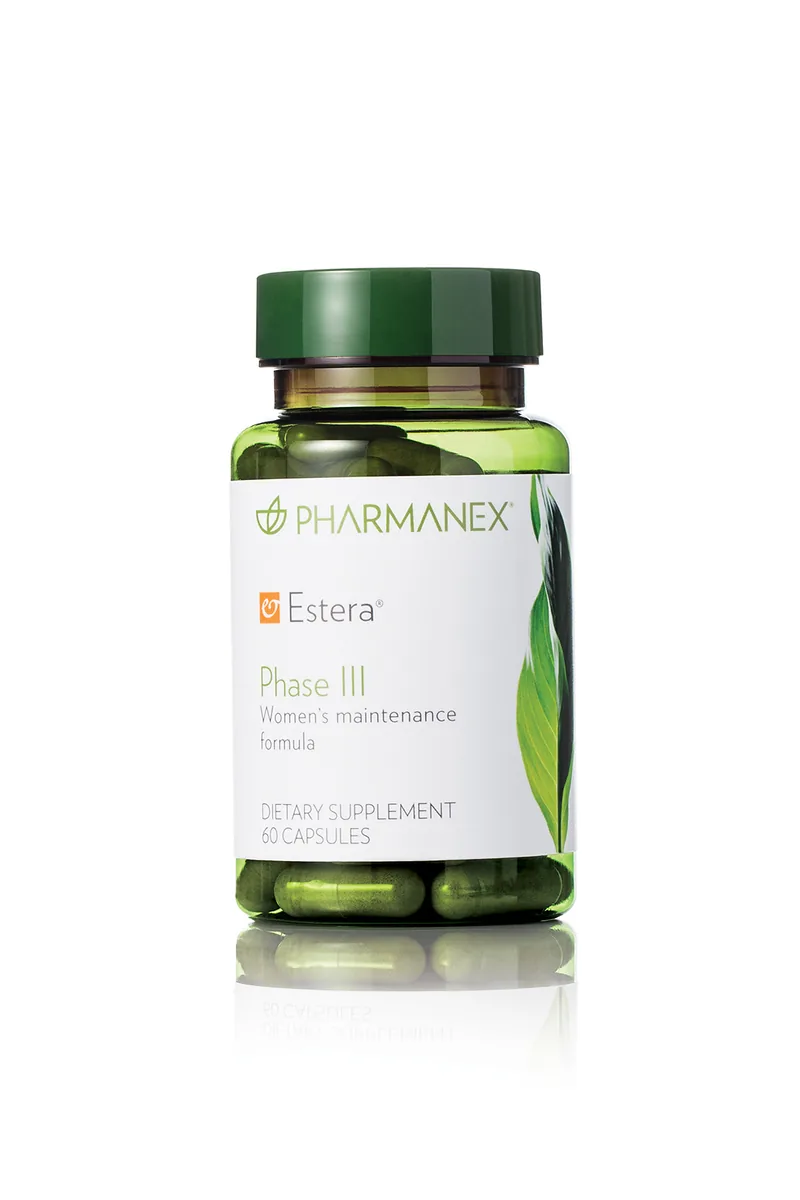
The maintenance-phase companion to Estera Phase 2, carrying forward the same I3C/DIM compound family from cruciferous vegetables. Where Phase 2 is framed around a woman's active transition, Phase III Maintenance is built for the ongoing, ordinary upkeep of that same estrogen-metabolism pathway once things have settled. Exact per-serving amounts are held as until the current label is verified.
Why the evidence supports it
The evidence rationale is the same one that supports Phase 2: human studies of I3C and DIM show a consistent shift in estrogen metabolism toward the 2-hydroxyestrone pathway, working with the liver's normal detox machinery rather than adding or blocking a hormone. Building a maintenance-specific formula is the sensible move -- it keeps the mechanism in play for the long term instead of asking women to stay on a transition dose indefinitely. It is an evidence-based way to support the cell's Adapt function over time, and, like the whole Estera line, it is estrogen-metabolism support only, not treatment of any hormonal condition.
What it supports
- Supports the body's ongoing, healthy estrogen metabolism
- Supports the liver's normal detoxification pathways over the long term
- Provides the same I3C/DIM compound family as Estera Phase 2
- Complements a cruciferous-vegetable-rich diet as a maintenance habit
Which function it supports
Ties to the cell's Adapt function -- the same I3C/DIM-driven liver detox and methylation-linked estrogen-metabolism support as Phase 2, positioned for long-term maintenance. This is estrogen-metabolism support only, not treatment of any hormonal condition.
Learn the why behind this pillarHow it relates to your cells and mind
Every product here ties back to a specific job your body does. This one touches the functions below -- follow either link to see the mechanism in full, then dig into the studies.
What it is made of -- and the mechanisms behind it
Each ingredient acts on several of the body's functions. Taken together, this product touches these cell and mind functions -- follow any to see the mechanism in full.
The ingredients
Mechanisms drawn from our ingredient knowledge base (6 profiled ingredients). Structure and function only -- not a treatment claim.
What’s actually in it
Label revision US PIP, copyright 2021Transcribed from the manufacturer’s official Product Information Page, exactly as printed. Ingredient names that link open our research page for that ingredient, with the studies behind it.
| Amount per 2 capsules | Amount | % DV |
|---|---|---|
| Broccoli Powder | 300 mg | * |
| Diindolylmethanean indole | 100 mg | * |
| Genisteinfrom soy isoflavone extract | 55 mg | * |
| Pomegranate FruitPunica granatum, extract | 40 mg | * |
| Lignansfrom flaxseed | 20 mg | * |
- Servings per container:
- 30
- Other ingredients:
- Gelatin, microcrystalline cellulose, magnesium stearate, silicon dioxide.
- Allergens:
- Contains Soy
Source: official Product Information Page . Amounts are the manufacturer’s, not ours. Structure and function only -- nothing here is medical advice, and nothing here may be used to diagnose, treat, cure, or prevent any disease.
The science on the ingredients
If you have had labs done
These are lab markers where this product's ingredients have measured evidence in our citation library. This is not a claim that the product will change your results -- the research attaches to the ingredient, and what a marker means depends on the whole picture. Each one links to its full entry, including what typically moves it and how to read it.
- Sex Hormone Binding Globulin (SHBG)emerging evidence
via Indole-3-carbinol / DIM · 1 studies, 1 in people
What people often notice when this marker sits outside the usual range
Higher: High SHBG lowers FREE testosterone even when total testosterone reads perfectly normal: low libido, low drive, fatigue, loss of muscle.
Lower: SHBG produces no symptoms of its own -- it changes what the sex hormones do, so the symptoms are theirs.
- Fecal Calprotectinemerging evidence
via Pomegranate extract · 1 studies, 1 in people
A 12-week juice intervention with a modulatory effect on the relevant transcriptional profile.
What people often notice when this marker sits outside the usual range
Higher: Diarrhoea, often with urgency; blood or mucus in stool.
- Estradiol, FSH, LH, Prolactin, DHEA-S & Testosteronemixed evidence
via Black cohosh (Cimicifuga racemosa) · 17 studies, 3 in people
What people often notice when this marker sits outside the usual range
Higher: HIGH FSH with low oestradiol is the menopause transition signal.
Lower: Joint aches that appeared with no injury; skin and hair changing texture.
- Estradiol (E2)mixed evidence
via Black cohosh (Cimicifuga racemosa) · 17 studies, 3 in people
What people often notice when this marker sits outside the usual range
Lower: Hot flushes and night sweats; vaginal dryness and painful sex; poor sleep.
- Estradiol (E2)mixed evidence
via Soy isoflavones (Genistein/Daidzein) · 9 studies, 2 in people
What people often notice when this marker sits outside the usual range
Higher: Breast tenderness, heavy or painful periods, fluid retention, worsening premenstrual mood, headaches around the period.
Lower: Vaginal dryness, painful sex, poor sleep, low mood, hot flushes, brain fog and word-finding difficulty.
Lab results are interpreted by a qualified clinician who knows your history. Nothing here diagnoses anything or replaces that conversation.
No product works in isolation
Every cell function above -- Sense, Exchange, Transform, Build, Maintain, Adapt -- needs the same broad base of optimal micronutrient levels running underneath it, all the time. Estera Phase III Maintenance is not a stand-alone fix; it is one piece that plugs into that larger system. The foundation comes first, and this supports it.
Stacks well with
Pick your goal -- here is what Estera Phase III Maintenance pairs with for each. Nothing works in isolation; these share the same systems.
For Women's Health
For Mood & Hormones
Foundational, or targeted?
Not everything in the shop is meant to be taken forever. Some products here are foundational -- a daily nutrient base built for long-term, ongoing use. Others are targeted -- shorter-term support for a specific season, not a lifelong habit. If you are not sure which one this is, that is a fair question to ask us before you buy.
Learn more, on your terms
Do not take our word for it -- go read. Each topic below opens a pre-loaded search so you can explore the nutrient, the mechanism, or the device for yourself.
Search the full studies libraryHow to use it
Take the labeled daily serving with a meal, following the current bottle directions, typically as an ongoing maintenance routine rather than a short course.
Where to get it
Ready when you are. This link takes you to the official, verified source for this product.
Get Estera Phase III MaintenanceThe studies
See the research behind the science we point to.
Explore studiesThe blog
Plain-language reads on how it all fits together.
Read the blogOptimal nutrients are the definition of longevity
Long-term cell function depends on having what it needs, at the level it needs it, for as long as it needs it. That is the whole thesis behind everything we point you to here.
When you buy through our links, we earn a small commission -- and that is what funds all the free education here. It never costs you more. Products are not intended to diagnose, treat, cure, or prevent any disease.
Estera Phase III Maintenance carries the same I3C and DIM family forward as the long-term companion to Phase 2. Where Phase 2 is framed around an active transition, Phase III is for the steady state afterwards.
FAQ
What does Estera Phase III support?
It supports the body's ongoing, healthy metabolism of oestrogen using the same cruciferous-derived compounds as Phase 2, framed for long-term maintenance rather than an active transition.
How do I take it?
Take the daily serving with food, per the label, as the continuing step after Phase 2.
What makes it different?
It is the maintenance tier rather than a different formula family, so the compounds stay familiar while the framing shifts from transition to long haul. The same honest caveat applies as for Phase 2: the cruciferous hormone evidence is contested.