
$42.00
$52.00 save $10.00 -- applied automatically through this link
When you buy through our links, we earn a small commission -- and that is what funds all the free education here. It never costs you more. Products are not intended to diagnose, treat, cure, or prevent any disease.
What it is
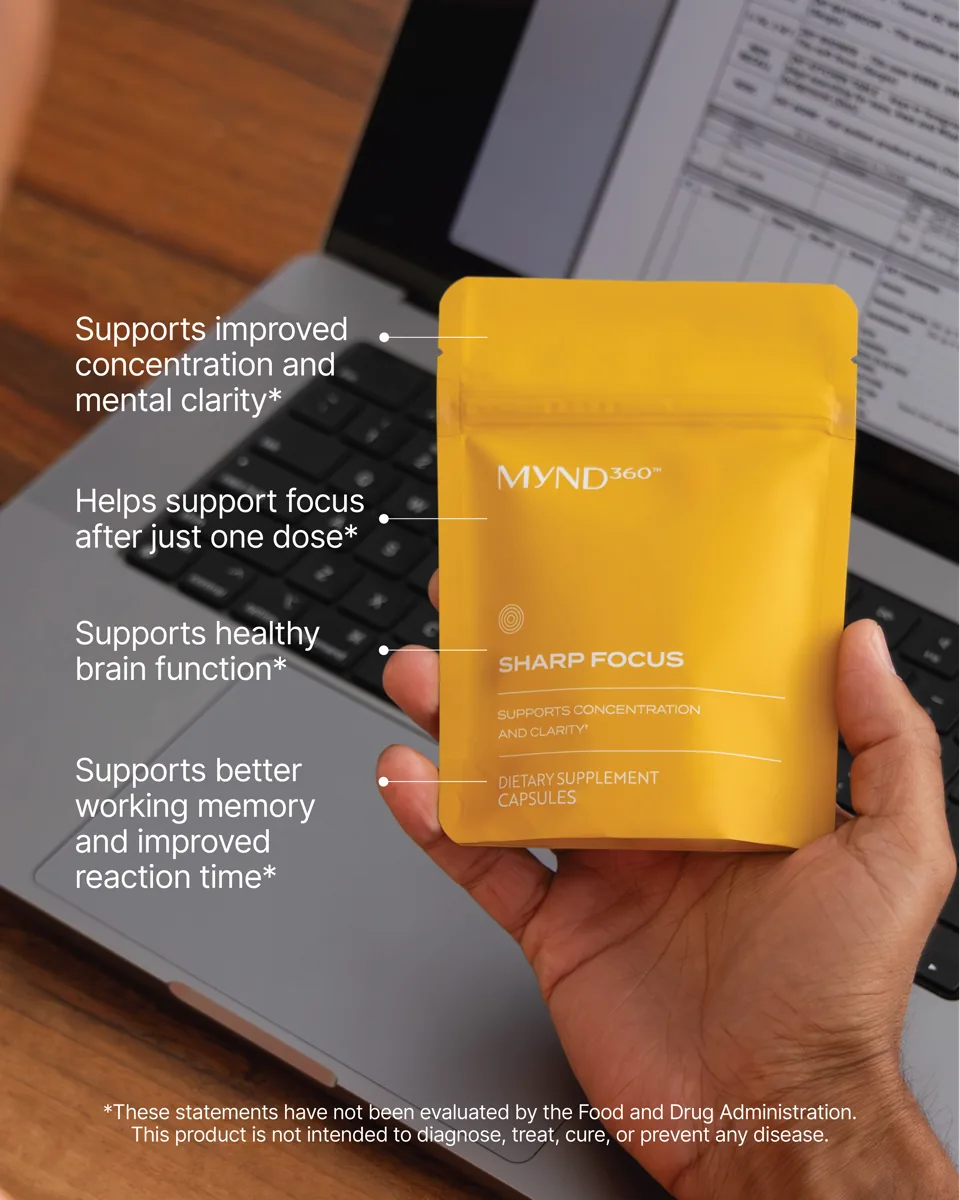
A focus blend that pairs a moderate 100 mg of caffeine (in a microencapsulated, slower-release form) and choline with the traditional cognitive herb bacopa (Bacopa monnieri, 300 mg) and vitamins B6 and B12. Taken as two capsules in the morning, it is built to support both in-the-moment alertness and, with steady daily use, everyday mental clarity.
Why the evidence supports it
The design is honest about two different timescales, and each has research to match: caffeine is among the most-studied compounds for immediate focus, alertness, and reaction time, while bacopa is one of the better-studied focus herbs -- but its benefits show up over four to twelve weeks of consistent use, not in a single dose. Choline and B vitamins round it out as everyday nutritional support for the nervous system. That two-speed, evidence-based build is aimed squarely at the Mind's Process function -- normal brain signaling now, and the neuroplasticity behind learning and memory over time -- with the honest reminder that bacopa rewards patience.
What it supports
- Supports everyday alertness and mental clarity
- Supports focus and attention during demanding tasks
- Provides bacopa, a traditional herb studied for cognition
- Complements good sleep and steady daily rhythms
Which function it supports
Ties to the Mind world's Process function -- supporting the brain's normal signaling and, with bacopa, the neuroplasticity involved in learning and memory.
Learn the why behind this pillarHow it relates to your cells and mind
Every product here ties back to a specific job your body does. This one touches the functions below -- follow either link to see the mechanism in full, then dig into the studies.
What it is made of -- and the mechanisms behind it
Each ingredient acts on several of the body's functions. Taken together, this product touches these cell and mind functions -- follow any to see the mechanism in full.
The ingredients
Mechanisms drawn from our ingredient knowledge base (5 profiled ingredients). Structure and function only -- not a treatment claim.
What’s actually in it
Label revision US PIP dated 07/23/24Transcribed from the manufacturer’s official Product Information Page, exactly as printed. Ingredient names that link open our research page for that ingredient, with the studies behind it.
| Amount per 2 capsules | Amount | % DV |
|---|---|---|
| Vitamin B6as pyridoxine HCl | 1.7 mg | 100% |
| Vitamin B12as cyanocobalamin | 2.4 mcg | 100% |
| Choline | 110 mg | 20% |
| Bacopa monnieriextract | 300 mg | * |
| Caffeinemicroencapsulated | 100 mg | * |
- Servings per container:
- 30
- Other ingredients:
- Hypromellose, microcrystalline cellulose, rice fiber.
Source: official Product Information Page . Amounts are the manufacturer’s, not ours. Structure and function only -- nothing here is medical advice, and nothing here may be used to diagnose, treat, cure, or prevent any disease.
The science on the ingredients
These studies are research on the ingredients and mechanisms in this product, not on the finished product itself, and they are shown for education. Nothing here is medical advice, and nothing here may be used to diagnose, treat, cure, or prevent any disease. Talk to your own provider about what is right for you.
- Effects of 12-Week Bacopa monnieri Consumption on Attention, Cognitive Processing, Working Memory, and Functions of Both Cholinergic and Monoaminergic Systems in Healthy Elderly Volunteers
Evidence-Based Complementary and Alternative Medicine · 2012
- Efficacy of Standardized Extract of <i>Bacopa monnieri</i> (Bacognize®) on Cognitive Functions of Medical Students: A Six‐Week, Randomized Placebo‐Controlled Trial
Evidence-based Complementary and Alternative Medicine · 2016
If you have had labs done
These are lab markers where this product's ingredients have measured evidence in our citation library. This is not a claim that the product will change your results -- the research attaches to the ingredient, and what a marker means depends on the whole picture. Each one links to its full entry, including what typically moves it and how to read it.
- Methylmalonic Acid (MMA)solid evidence
via Vitamin B12 · 546 studies, 181 in people
What people often notice when this marker sits outside the usual range
Higher: Tingling, numbness or burning in the feet and hands, usually symmetrical and worse at night.
Lower: Normal MMA is the reassuring result and carries no symptoms.
- Homocysteinesolid evidence
via Vitamin B12 · 188 studies, 70 in people
The enzyme that uses folate's methyl group is B12-dependent, so folate cannot work without it.
What people often notice when this marker sits outside the usual range
Higher: Usually SILENT -- it is a biochemical finding, not a felt one, which is why it is a measurement worth making rather than a symptom to notice.
Lower: No symptoms. Very low values occasionally accompany high-dose supplementation and are not a concern in themselves.
via Vitamin B12 · 188 studies, 70 in people
What people often notice when this marker sits outside the usual range
Higher: Usually silent -- a biochemical finding rather than a felt one.
- Homocysteinesolid evidence
via Vitamin B12 · 188 studies, 70 in people
What people often notice when this marker sits outside the usual range
Higher: A high homocysteine is usually silent, and reads partly as a methylation- and B-vitamin-status signal.
Lower: A low homocysteine is generally favourable and reflects good methylation and adequate B-vitamin status.
- Hemoglobin, Hematocrit, RBC Count, MCV & RDWsolid evidence
via Vitamin B12 · 55 studies, 16 in people
What people often notice when this marker sits outside the usual range
Higher: Commonest causes are dehydration (a false rise), smoking, sleep apnoea, altitude and testosterone therapy -- all worth asking about before anything rarer.
Lower: LOW MCV (small cells) points at iron deficiency, or at thalassaemia trait if iron studies are normal.
- ALT & AST (Liver Enzymes)solid evidence
via Choline · 21 studies, 5 in people
What people often notice when this marker sits outside the usual range
Higher: Fatigue disproportionate to activity is the commonest complaint that turns out to have a raised ALT behind it.
- Magnesiumemerging evidence
via Vitamin B6 · 16 studies, 7 in people
Improves magnesium's entry into cells -- the classic pairing, and the reason many magnesium products include it.
What people often notice when this marker sits outside the usual range
Higher: Almost always caused by supplements plus reduced kidney function, not by food.
Lower: Muscle cramps, especially calves at night; eyelid twitching that goes on for days.
- Magnesiumemerging evidence
via Vitamin B6 · 16 studies, 7 in people
What people often notice when this marker sits outside the usual range
Higher: Because muscle-meat and refined foods are low in magnesium, shortfall is common on modern diets.
Lower: A high serum magnesium is rare and almost always tied to impaired kidney function (weakness, low blood pressure) -- a medical finding, since magnesium is renally cleared.
- Magnesiumemerging evidence
via Vitamin B6 · 16 studies, 7 in people
What people often notice when this marker sits outside the usual range
Higher: A high serum magnesium is rare and almost always tied to impaired kidney function (weakness, low blood pressure) -- a medical finding, since magnesium is renally cleared.
- Magnesium RBC (Red Blood Cell Magnesium)emerging evidence
via Vitamin B6 · 17 studies, 6 in people
Improves magnesium's entry into cells -- the classic pairing, and the reason many magnesium products include it.
What people often notice when this marker sits outside the usual range
Higher: Almost always supplements plus reduced kidney function rather than food.
Lower: Muscle cramps especially calves at night; eyelid twitching; restless legs.
- eGFR, Creatinine & BUNemerging evidence
via Vitamin B12 · 8 studies, 3 in people
What people often notice when this marker sits outside the usual range
Higher: Later: swelling in ankles and around the eyes, foamy urine, fatigue, poor appetite, itching, night urination, high blood pressure.
Lower: A low creatinine usually reflects low muscle mass rather than excellent kidneys, and in older adults it can hide meaningfully reduced filtration.
Lab results are interpreted by a qualified clinician who knows your history. Nothing here diagnoses anything or replaces that conversation.
No product works in isolation
Every cell function above -- Sense, Exchange, Transform, Build, Maintain, Adapt -- needs the same broad base of optimal micronutrient levels running underneath it, all the time. MYND360 Sharp Focus is not a stand-alone fix; it is one piece that plugs into that larger system. The foundation comes first, and this supports it.
Stacks well with
Pick your goal -- here is what MYND360 Sharp Focus pairs with for each. Nothing works in isolation; these share the same systems.
For Brain & Sleep
Foundational, or targeted?
Not everything in the shop is meant to be taken forever. Some products here are foundational -- a daily nutrient base built for long-term, ongoing use. Others are targeted -- shorter-term support for a specific season, not a lifelong habit. If you are not sure which one this is, that is a fair question to ask us before you buy.
Learn more, on your terms
Do not take our word for it -- go read. Each topic below opens a pre-loaded search so you can explore the nutrient, the mechanism, or the device for yourself.
Search the full studies libraryHow to use it
Take two capsules earlier in the day, since it provides about 100 mg of caffeine. Bacopa's benefits build with several weeks of consistent use.
Where to get it
Ready when you are. This link takes you to the official, verified source for this product.
Get MYND360 Sharp FocusThe studies
See the research behind the science we point to.
Explore studiesThe blog
Plain-language reads on how it all fits together.
Read the blogOptimal nutrients are the definition of longevity
Long-term cell function depends on having what it needs, at the level it needs it, for as long as it needs it. That is the whole thesis behind everything we point you to here.
When you buy through our links, we earn a small commission -- and that is what funds all the free education here. It never costs you more. Products are not intended to diagnose, treat, cure, or prevent any disease.
MYND360 Sharp Focus is a focus blend pairing bacopa (a traditional cognitive herb) and choline with B vitamins and a moderate dose of caffeine. It aims to support both in-the-moment alertness and, with steady use, everyday mental clarity. It fits people who want a familiar lift plus a longer-game focus herb.
FAQ
What does MYND360 Sharp Focus support?
It supports everyday alertness and mental clarity and focus during demanding tasks, provides bacopa (a traditional herb studied for cognition), and complements good sleep and steady daily rhythms.
How do I take it?
Take two capsules earlier in the day, since it provides a moderate dose of caffeine. Bacopa's benefits build with several weeks of consistent use.
What makes it different?
It combines a fast, familiar lift from caffeine with bacopa, one of the better-studied focus herbs that works over weeks rather than in a single dose. That two-speed design is honest.