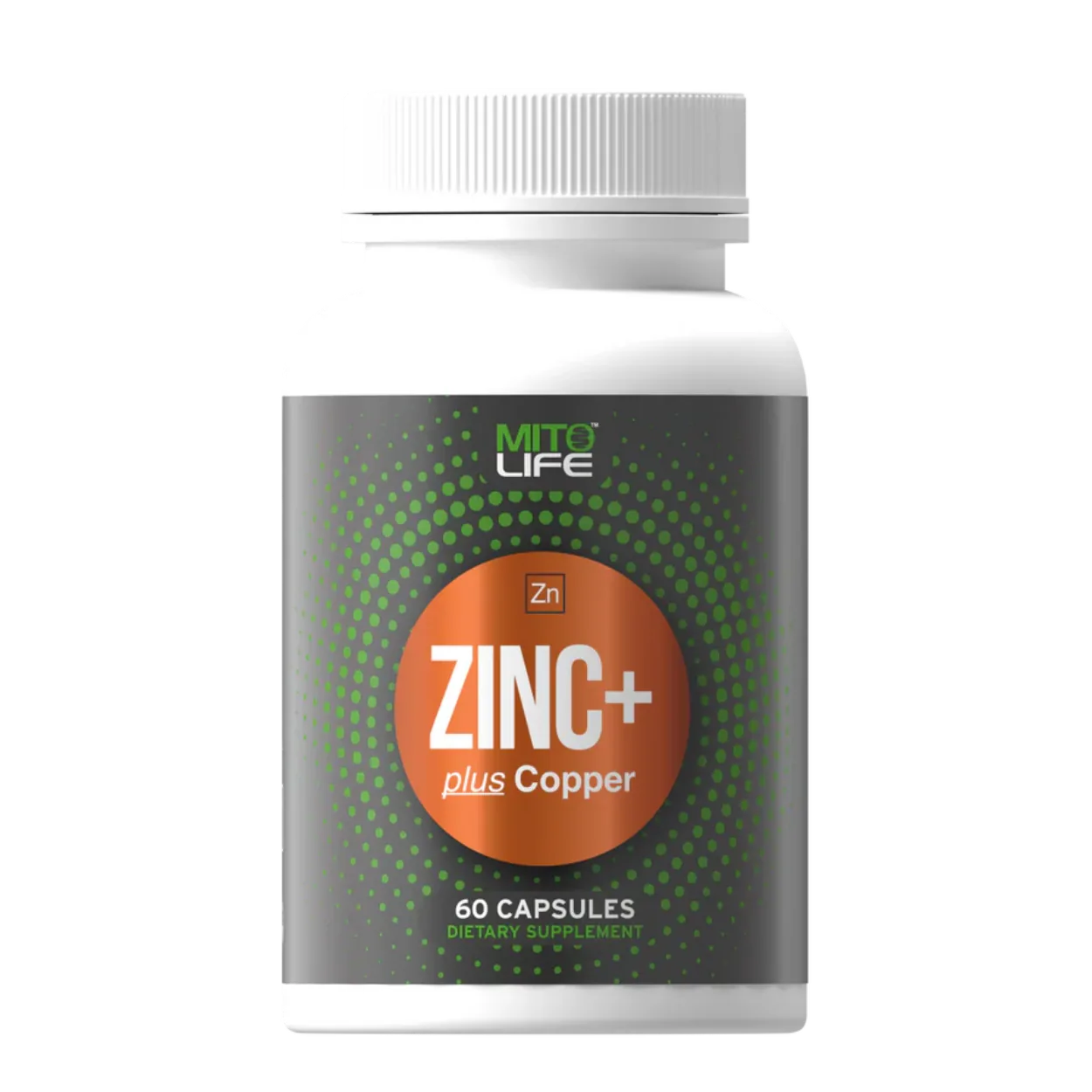
$30.00
Your discount applies with code HOLISTICLOVE.
When you buy through our links, we earn a small commission -- and that is what funds all the free education here. It never costs you more. Products are not intended to diagnose, treat, cure, or prevent any disease.
What it is
A supplement that pairs zinc with copper in a deliberate, sensible ratio. The pairing is straight physiology: zinc and copper compete for the same absorption pathway, so taking zinc on its own for a stretch can gradually draw down the body's copper. Supplying both keeps that balance intact.
Why the evidence supports it
The zinc-copper interaction is well-documented mineral physiology, not a fringe idea -- the two share an absorption pathway, and sustained zinc-alone intake is a recognized way to quietly create a copper shortfall. Pairing them is the evidence-based way to support zinc status without opening that gap. Both minerals sit behind large numbers of enzymes, so keeping their ratio steady serves the cell's Maintain function -- the everyday upkeep those enzymes carry out. Zinc's reach is bigger than most realize: it is most concentrated in bone, the eyes, and reproductive tissue, and because bone is the living home of the marrow where immune cells are made, zinc and copper sit at the crossroads of bone strength and immune function at once. Zinc is even central to the 'spark of life' -- the burst of zinc a human egg releases at the moment of fertilization. For the same minerals in whole-food form, this pairs with Desiccated Oyster. If you take other zinc-containing products, count this toward your total.
What it supports
- Supports normal zinc status and immune function
- Keeps zinc and copper in a healthy balance
- Helps avoid the copper drawdown that zinc-alone can cause
- Supports normal everyday mineral balance
Which function it supports
Ties to the cell's Maintain function -- zinc and copper both sit behind many enzymes, and keeping their ratio steady supports normal cellular upkeep.
Learn the why behind this pillarHow it relates to your cells and mind
Every product here ties back to a specific job your body does. This one touches the functions below -- follow either link to see the mechanism in full, then dig into the studies.
What it is made of -- and the mechanisms behind it
Each ingredient acts on several of the body's functions. Taken together, this product touches these cell and mind functions -- follow any to see the mechanism in full.
The ingredients
Mechanisms drawn from our ingredient knowledge base (3 profiled ingredients). Structure and function only -- not a treatment claim.
What’s actually in it
Label revision label image on the product page, read 2026-09-11Transcribed from the manufacturer’s official Product Information Page, exactly as printed. Ingredient names that link open our research page for that ingredient, with the studies behind it.
| Amount per 1 capsule | Amount | % DV |
|---|---|---|
| Zincas Zinc Carnosine | 16 mg | 145.4% |
| Zinc Carnosine | 75 mg | * |
| Copperas Copper Orotate | 2 mg | 222.2% |
| Copper Orotate | 13 mg | * |
- Servings per container:
- 60
- Other ingredients:
- Vegetarian capsule (hypromellose and water), bamboo extract.
Source: official Product Information Page . Amounts are the manufacturer’s, not ours. Structure and function only -- nothing here is medical advice, and nothing here may be used to diagnose, treat, cure, or prevent any disease.
The science on the ingredients
If you have had labs done
These are lab markers where this product's ingredients have measured evidence in our citation library. This is not a claim that the product will change your results -- the research attaches to the ingredient, and what a marker means depends on the whole picture. Each one links to its full entry, including what typically moves it and how to read it.
- Zincsolid evidence
via Zinc · 2,123 studies, 444 in people
What people often notice when this marker sits outside the usual range
Higher: Nausea and metallic taste at high oral doses.
Lower: Frequent colds that last longer than everyone else's.
- Zincsolid evidence
via Zinc · 2,123 studies, 444 in people
Studied alongside selenium in subclinical hypothyroidism.
What people often notice when this marker sits outside the usual range
Lower: For the full symptom picture in both directions, read the main zinc entry -- it is the same measurement, and repeating it here would only risk the two drifting apart.
- Zinc and the Zinc:Copper Ratiosolid evidence
via Zinc · 2,123 studies, 444 in people
What people often notice when this marker sits outside the usual range
Higher: ⚠️ THE ZINC:COPPER RATIO'S REAL CONTENT IS A SAFETY WARNING, AND IT IS A GOOD ONE.
Lower: Low zinc: loss or dulling of taste and smell, slow wound healing, acne, white spots on nails, hair thinning, frequent colds, low testosterone, poor night vision.
- Seleniumsolid evidence
via Zinc · 262 studies, 72 in people
What people often notice when this marker sits outside the usual range
Higher: A garlic smell on the breath with no garlic eaten -- the classic early sign.
Lower: Frequent infections and slow recovery from them -- selenium is required by the immune system's antioxidant defences.
- Vitamin Asolid evidence
via Zinc · 110 studies, 45 in people
What people often notice when this marker sits outside the usual range
Lower: For the full symptom picture in both directions, read the main vitamin A entry -- it is the same measurement, and repeating it here would only risk the two drifting apart.
- Retinol (Vitamin A)solid evidence
via Zinc · 110 studies, 45 in people
What people often notice when this marker sits outside the usual range
Higher: Headache, bone and joint pain, dry cracked lips, hair loss, liver enzyme elevation.
Lower: Night vision that is worse than it was -- the earliest and most specific sign.
- Ferritin, Iron, Iron Saturation & TIBCsolid evidence
via Copper · 238 studies, 40 in people
What people often notice when this marker sits outside the usual range
Higher: Often SILENT for years, which is what makes iron overload dangerous.
Lower: Fatigue that rest does not fix -- and it appears at LOW FERRITIN, long before haemoglobin falls or anaemia exists.
via Copper · 238 studies, 40 in people
What people often notice when this marker sits outside the usual range
Higher: In the functional mineral model framing, the concern is not iron DEFICIENCY but iron DYSREGULATION -- iron in the wrong place, unbound and oxidative, with a normal or high ferritin.
Lower: Fatigue that rest does not fix -- and it appears at LOW FERRITIN, long before haemoglobin falls.
- Serum Ceruloplasminsolid evidence
via Copper · 238 studies, 40 in people
What people often notice when this marker sits outside the usual range
Higher: Usually inflammation, pregnancy or oral oestrogen rather than a copper problem.
Lower: In the functional mineral model framing, low ceruloplasmin means copper is present but not properly bound and directed -- producing fatigue, poor iron handling, and oxidative stress.
- Hemoglobin, Hematocrit, RBC Count, MCV & RDWsolid evidence
via Zinc · 43 studies, 24 in people
What people often notice when this marker sits outside the usual range
Higher: Commonest causes are dehydration (a false rise), smoking, sleep apnoea, altitude and testosterone therapy -- all worth asking about before anything rarer.
Lower: LOW MCV (small cells) points at iron deficiency, or at thalassaemia trait if iron studies are normal.
via Zinc · 108 studies, 22 in people
What people often notice when this marker sits outside the usual range
Higher: HIGH ALP: bone pain or liver/bile symptoms.
Lower: LOW ALBUMIN: swelling of ankles and feet, puffiness around the eyes, fatigue, poor wound healing, muscle loss.
- Glucose (Fasting)solid evidence
via Zinc · 18 studies, 9 in people
What people often notice when this marker sits outside the usual range
Higher: Waking at 3am, often with a racing heart -- 'why do i wake up at 3am every night'.
Lower: Shakiness, sweating, sudden anxiety and difficulty concentrating that resolve within minutes of eating.
- White Blood Cell Count & Differentialsolid evidence
via Zinc · 17 studies, 9 in people
What people often notice when this marker sits outside the usual range
Higher: Usually an active infection -- fever, feeling unwell, a specific site that hurts.
Lower: Frequent or lingering infections; mouth ulcers; slow recovery.
- Zonulin (serum and fecal)solid evidence
via Zinc · 11 studies, 7 in people
What people often notice when this marker sits outside the usual range
Higher: Bloating and abdominal discomfort that does not track neatly with any one food.
Lower: No symptoms; an intact barrier is the desired state.
- Thyroid-Stimulating Hormone (TSH)solid evidence
via Zinc · 9 studies, 5 in people
Studied alongside selenium in subclinical hypothyroidism with mechanistic and clinical evidence; required for deiodinase activity and for the receptor that reads the hormone.
What people often notice when this marker sits outside the usual range
Higher: Cold all the time, especially hands and feet, and needing more layers than everyone else in the room.
Lower: Racing or irregular heartbeat, palpitations, waking at night with the heart pounding.
- Thyroid-Stimulating Hormone (TSH)solid evidence
via Zinc · 9 studies, 5 in people
What people often notice when this marker sits outside the usual range
Higher: HIGH TSH = UNDERACTIVE THYROID -- the counterintuitive part people get wrong constantly.
Lower: LOW TSH = OVERACTIVE THYROID, or too much thyroid medication -- the commoner cause in anyone already treated.
- Hemoglobin A1c (HbA1c)solid evidence
via Zinc · 6 studies, 4 in people
Supplementation moved glycaemic biomarkers including HbA1c.
What people often notice when this marker sits outside the usual range
Higher: Everything listed under fasting glucose, but with more time behind it -- HbA1c is a three-month average, so symptoms are usually established rather than new.
- High-Sensitivity C-Reactive Protein (hs-CRP)solid evidence
via Zinc · 5 studies, 4 in people
Meta-analysis of supplementation and immune factors in adults shows movement in inflammatory measures; zinc is also required for the antioxidant enzymes that restrain the response.
What people often notice when this marker sits outside the usual range
Higher: Deep, unrefreshing fatigue -- searched as 'tired all the time blood tests normal' and 'why am i tired even after 8 hours sleep'.
Lower: No symptoms. Low is the desirable direction.
- Free T3 (Triiodothyronine) & Free T4 (Thyroxine)solid evidence
via Zinc · 5 studies, 3 in people
Required for deiodinase activity and for thyroid hormone receptor binding; assessed jointly with iodine and selenium.
What people often notice when this marker sits outside the usual range
Higher: Palpitations, tremor, heat intolerance, anxiety, weight loss, loose stools, poor sleep -- the overactive picture.
Lower: The hypothyroid picture even when TSH reads normal -- cold, flat, foggy, constipated, dry-skinned, losing hair.
- Free T3 (Free Triiodothyronine)solid evidence
via Zinc · 5 studies, 3 in people
What people often notice when this marker sits outside the usual range
Higher: Palpitations, tremor, heat intolerance, anxiety, weight loss, loose stools.
Lower: The hypothyroid picture EVEN WHEN TSH READS NORMAL -- cold, flat, foggy, constipated, dry-skinned, losing hair.
- Mercuryemerging evidence
via Zinc · 62 studies, 9 in people
What people often notice when this marker sits outside the usual range
Higher: Often silent at dietary levels.
Lower: No symptoms. Mercury has no biological function -- there is no deficiency.
- Fasting Glucoseemerging evidence
via Zinc · 18 studies, 9 in people
What people often notice when this marker sits outside the usual range
Higher: A high fasting glucose is often silent early -- the classic high-sugar symptoms (excess thirst, frequent urination, fatigue, blurred vision) tend to appear later and higher.
Lower: A genuinely low glucose (hypoglycaemia) can cause shakiness, sweating, irritability, hunger and lightheadedness -- but a low-normal fasting value in a healthy person is usually favourable.
- Fasting Insulinemerging evidence
via Zinc · 18 studies, 9 in people
What people often notice when this marker sits outside the usual range
Higher: Must be drawn fasting to be interpretable, and read alongside glucose (as HOMA-IR), never in isolation.
Lower: A low fasting insulin, with a normal glucose, generally reflects good insulin sensitivity -- the favourable direction.
- Fasting Glucoseemerging evidence
via Zinc · 18 studies, 9 in people
What people often notice when this marker sits outside the usual range
Higher: A high fasting glucose is often silent early -- the classic high-sugar symptoms (excess thirst, frequent urination, fatigue, blurred vision) tend to appear later and higher.
Lower: A genuinely low glucose (hypoglycaemia) can cause shakiness, sweating, irritability, hunger and lightheadedness -- but a low-normal fasting value in a healthy person is usually favourable.
- Leademerging evidence
via Zinc · 21 studies, 8 in people
What people often notice when this marker sits outside the usual range
Higher: In adults, usually SILENT at the levels now common.
Lower: No symptoms. Lead has no biological function -- there is no deficiency, and lower is always better.
- Estradiol, FSH, LH, Prolactin, DHEA-S & Testosteroneemerging evidence
via Zinc · 15 studies, 5 in people
What people often notice when this marker sits outside the usual range
Higher: HIGH FSH with low oestradiol is the menopause transition signal.
Lower: Joint aches that appeared with no injury; skin and hair changing texture.
- Total & Free Testosteroneemerging evidence
via Zinc · 15 studies, 5 in people
What people often notice when this marker sits outside the usual range
Higher: Acne, oily skin, unwanted facial or body hair, scalp hair thinning at the crown.
Lower: Low libido, low drive, loss of muscle tone, flat mood.
- Total & Free Testosteroneemerging evidence
via Zinc · 15 studies, 5 in people
What people often notice when this marker sits outside the usual range
Lower: Low libido; reduced spontaneous erections; erectile difficulty.
- HbA1c (Hemoglobin A1c)emerging evidence
via Zinc · 6 studies, 4 in people
What people often notice when this marker sits outside the usual range
Higher: A high HbA1c reflects the same chronic high-glucose state -- silent early, then thirst, frequent urination and fatigue at higher levels.
Lower: A low HbA1c is generally favourable, but an unexpectedly low value can reflect a red-cell condition rather than excellent control -- cross-check against fasting glucose if it surprises you.
- HbA1c (Glycated Hemoglobin)emerging evidence
via Zinc · 6 studies, 4 in people
What people often notice when this marker sits outside the usual range
Higher: A high HbA1c reflects the same chronic high-glucose state as glucose, averaged over roughly three months -- silent early, then thirst, frequent urination and fatigue at higher levels.
Lower: A low HbA1c is generally favourable, but an unexpectedly low value can reflect a red-cell condition rather than excellent control -- cross-check against fasting glucose if it surprises you.
- hs-CRP (High-Sensitivity C-Reactive Protein)emerging evidence
via Zinc · 5 studies, 4 in people
What people often notice when this marker sits outside the usual range
Higher: hs-CRP is non-specific -- read it as a trend and in context, never as a stand-alone verdict.
Lower: A low hs-CRP is favourable and simply reflects little systemic inflammation at the moment of the draw.
- HDL Cholesterolemerging evidence
via Zinc · 5 studies, 3 in people
What people often notice when this marker sits outside the usual range
Higher: A high HDL-C is generally read as favourable, but it is a cargo measure, not the whole story -- and very high HDL from some causes does not carry the protective meaning people assume.
- Prolactincontested evidence
via Zinc · 2,298 studies, 1,096 in people
Popular in functional-medicine circles for 'balancing' prolactin, with weak direct human trial evidence for changing serum prolactin specifically.
What people often notice when this marker sits outside the usual range
Higher: Irregular, infrequent or absent periods; cycles that lengthen then stop.
Lower: Rarely clinically significant outside the postpartum period.
Lab results are interpreted by a qualified clinician who knows your history. Nothing here diagnoses anything or replaces that conversation.
No product works in isolation
Every cell function above -- Sense, Exchange, Transform, Build, Maintain, Adapt -- needs the same broad base of optimal micronutrient levels running underneath it, all the time. Zinc + Copper is not a stand-alone fix; it is one piece that plugs into that larger system. The foundation comes first, and this supports it.
Stacks well with
Pick your goal -- here is what Zinc + Copper pairs with for each. Nothing works in isolation; these share the same systems.
For Minerals
For Immune
For Bone & Cartilage
For Eyes
Foundational, or targeted?
Not everything in the shop is meant to be taken forever. Some products here are foundational -- a daily nutrient base built for long-term, ongoing use. Others are targeted -- shorter-term support for a specific season, not a lifelong habit. If you are not sure which one this is, that is a fair question to ask us before you buy.
Learn more, on your terms
Do not take our word for it -- go read. Each topic below opens a pre-loaded search so you can explore the nutrient, the mechanism, or the device for yourself.
Search the full studies libraryHow to use it
Take with water, with or without food, once daily. If you take other zinc-containing products, count this toward your total. Follow the label.
Use code HOLISTICLOVE at checkout.
Where to get it
Ready when you are. This link takes you to the official, verified source for this product.
Get Zinc + CopperThe studies
See the research behind the science we point to.
Explore studiesThe blog
Plain-language reads on how it all fits together.
Read the blogOptimal nutrients are the definition of longevity
Long-term cell function depends on having what it needs, at the level it needs it, for as long as it needs it. That is the whole thesis behind everything we point you to here.
When you buy through our links, we earn a small commission -- and that is what funds all the free education here. It never costs you more. Products are not intended to diagnose, treat, cure, or prevent any disease.
Zinc + Copper pairs zinc with copper in a sensible ratio. The reason is simple physiology: taking zinc on its own over time can gradually draw down the body's copper, so the two are best kept in balance. It fits anyone who supplements zinc and wants to do it responsibly.
FAQ
What does Zinc + Copper support?
It supports normal zinc status and immune function, keeps zinc and copper in a healthy balance, helps avoid the copper drawdown that zinc-alone can cause, and supports normal everyday mineral balance.
How do I take it?
Take with water, with or without food, once daily. If you take other zinc-containing products, count this toward your total. Follow the label.
What makes it different?
Pairing them is the responsible way to support zinc status without quietly creating a copper gap. The zinc-copper imbalance shows up more often than people expect.