$30.00
Your discount applies with code HOLISTICLOVE.
When you buy through our links, we earn a small commission -- and that is what funds all the free education here. It never costs you more. Products are not intended to diagnose, treat, cure, or prevent any disease.
What it is
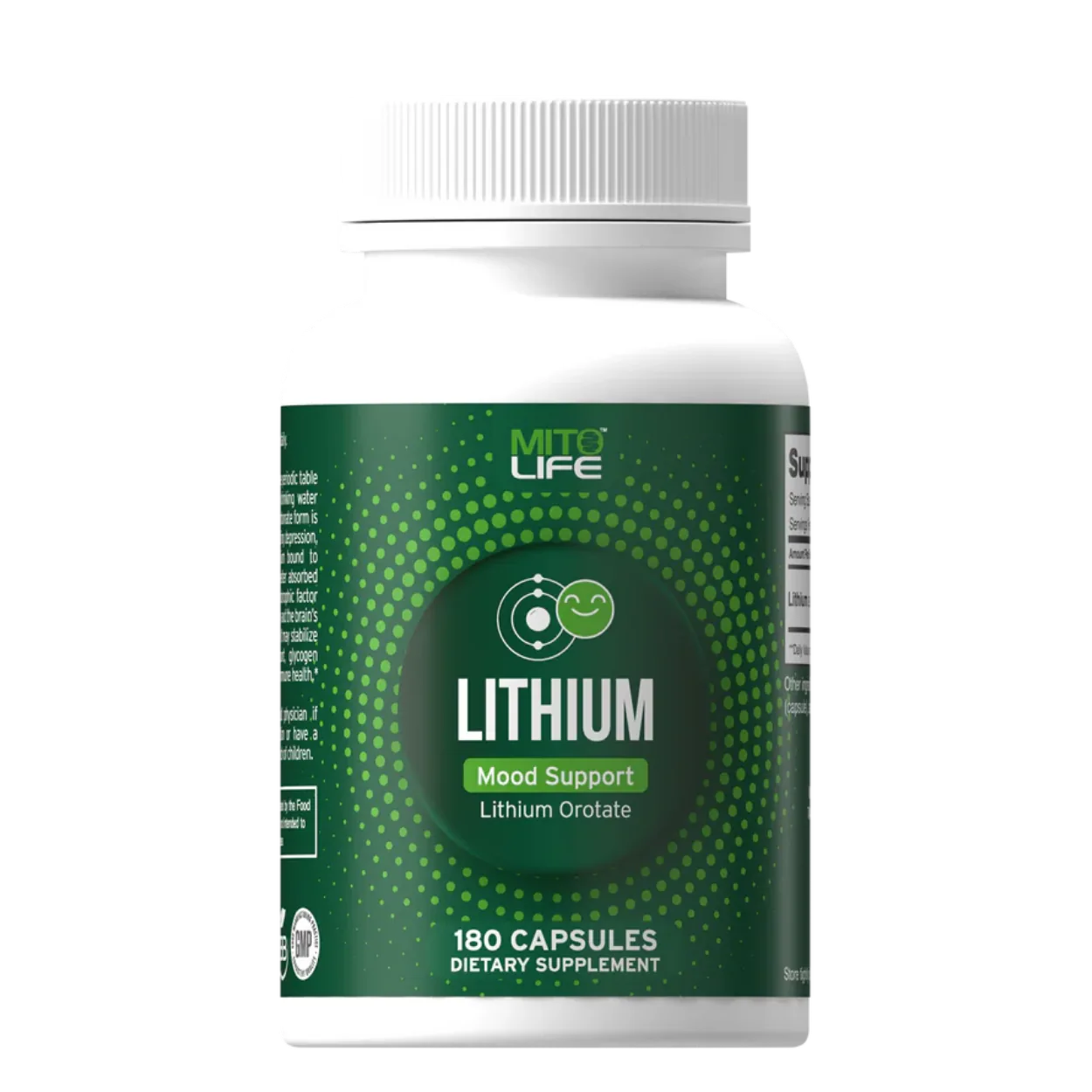
A very low-dose form of lithium bound to orotic acid -- a trace amount, a small fraction of the doses used in prescription medicine. At this trace level it is used to support everyday mood steadiness and a calmer nervous system, not as a pharmaceutical.
Why the evidence supports it
Honesty first: the research on low-dose lithium orotate specifically is genuinely thin -- mostly older case reports and small observational accounts never replicated in controlled trials -- so the orotate form sits at the low end of the evidence tiers and is not presented as settled. The broader lithium science, though, is richer than most realize, and our library reflects it: beyond mood regulation, lithium is studied for neuroprotective signaling in the brain, a supportive role in bone, and -- more emerging -- roles in methylation and immune/autoimmune modulation (for instance, dampening the IFN-gamma-driven side of nervous-system autoimmunity). Those are mechanisms of broader lithium biology, held at emerging tiers, not proven claims for a trace-dose supplement. It works under the Mind's Regulate function and the cell's Exchange. Because lithium clears through the kidneys, this is not a substitute for prescription lithium, and anyone with reduced kidney function should not take it without a doctor's oversight.
What it supports
- Supports everyday nervous-system calm
- Supports steady, even mood as part of a balanced routine
- Provides lithium at a low, trace level
- Best used with awareness of the safety notes below
Which function it supports
Ties to the Mind world's Regulate function -- supporting the everyday steadiness of the nervous system at a trace dose, not the pharmaceutical effect of prescription lithium.
Learn the why behind this pillarHow it relates to your cells and mind
Every product here ties back to a specific job your body does. This one touches the functions below -- follow either link to see the mechanism in full, then dig into the studies.
What it is made of -- and the mechanisms behind it
Each ingredient acts on several of the body's functions. Taken together, this product touches these cell and mind functions -- follow any to see the mechanism in full.
The ingredients
Mechanisms drawn from our ingredient knowledge base (2 profiled ingredients). Structure and function only -- not a treatment claim.
What’s actually in it
Label revision label image on the product page, read 2026-09-11Transcribed from the manufacturer’s official Product Information Page, exactly as printed. Ingredient names that link open our research page for that ingredient, with the studies behind it.
| Amount per 1 capsule | Amount | % DV |
|---|---|---|
| Lithiumas Lithium Orotate | 10 mg | ** |
- Servings per container:
- 180
- Other ingredients:
- Vegetarian capsule (hypromellose and water), bamboo extract.
Source: official Product Information Page . Amounts are the manufacturer’s, not ours. Structure and function only -- nothing here is medical advice, and nothing here may be used to diagnose, treat, cure, or prevent any disease.
The science on the ingredients
These studies are research on the ingredients and mechanisms in this product, not on the finished product itself, and they are shown for education. For this ingredient most of the published work is laboratory or animal research rather than human trials, so read it as biology worth knowing rather than proof of an effect in people. Nothing here is medical advice, and nothing here may be used to diagnose, treat, cure, or prevent any disease. Talk to your own provider about what is right for you.
- Lithium Orotate: Evidence-Based Analysis of Efficacy and Safety, Jen Masson Nutrition
clinical summary; lithiumorotate.org FAQ summary
Lithium orotate is sold as an unregulated dietary supplement with no standardized dosing/purity oversight; lithium is renally cleared and contraindicated without monitoring in reduced kidney function (eGFR <30).
- Lithium orotate: distinct compound or simply Li+ after administration?PubMed
British Journal of Psychiatry · 2026
Clarifies the need to demonstrate a stable orotate complex in physiological fluids before claiming salt-specific delivery -- Argues gastric chemistry predicts dissociation; no stable LiO complex has been demonstrated in physiological fluids; oral studies can show comparable PK
- Lithium orotate: A superior option for lithium therapy?PubMed
Brain and Behavior · 2021
Explains proposed carrier mechanisms and identifies testable PK and tolerability hypotheses -- Concludes clinical application is not recommended because benefits and risks are too sparsely studied
- Possible dangers of a nutritional supplement lithium orotatePubMed
Annals of Clinical Psychiatry · 2013
Raised clinician awareness of supplement self-medication and the need to may support lithium-orotate exposure as clinically relevant -- No new trial or incidence data; argument rests mainly on the Sartori series the 1979 renal animal study and 2007 overdose case
- Lithium Orotate: Breakthrough Treatment for Alzheimer’s Disease?DOI
2025
This brief piece reports that low-dose lithium orotate prevented pathology and reversed memory loss in Alzheimer's mouse models and may avoid the kidney and thyroid toxicity of lithium carbonate, though human trials are still needed.
- ChemInform Abstract: Orotate Complexes. Synthesis and Crystal Structure of Lithium Orotate(‐ I) Monohydrate and Magnesium Bis(orotate(‐I)) OctahydrateDOI
ChemInform · 1991
This entry is an abstracting-service summary with no original findings of its own; it points readers to the full text of the earlier lithium and magnesium orotate crystal-structure paper it condenses.
Lithium and the Brain-Bone Axis: A Bridge between Osteoporosis and Alzheimer's DiseaseEmergingExpert review2026
GSK-3 inhibition and beta-catenin stabilization run the same Wnt pathway in osteoblasts and in neurons, so one signaling mechanism reaches both bone-forming cells and brain tissue. This is the shared-substrate argument for why a single ion shows up in two organ systems that are usually studied separately.
Lee JW, Hasegawa T, Ikedo A et al. -- Current Osteoporosis Reports
Lithium orotate: distinct compound or simply Li+ after administration?Expert review2026
Clarifies the need to demonstrate a stable orotate complex in physiological fluids before claiming salt-specific delivery -- Argues gastric chemistry predicts dissociation; no stable LiO complex has been demonstrated in physiological fluids; oral studies can show comparable PK
Hajek T et al. -- British Journal of Psychiatry
Structural Brain Network Alterations in Relation to Treatment and Illness Severity in Bipolar DisorderEmergingPrimary research (design unspecified)2026
Lithium orotate was linked to emotional processing and mood regulation through neural signaling modulation relevant to emotional regulation and stability.
Nabulsi L, Kang M, Jahanshad N et al -- Biological psychiatry
Effects of low-dose lithium supplementation on thermal inactivation of SERCA in cardiac muscle of male miceEmerging2026
Male mice given 10 mg/kg/day lithium chloride in drinking water for six weeks had higher cardiac SERCA2 content but lower baseline SERCA activity, with less activity loss under heat stress than controls.
Hamstra SI; Geromella MS; Klentrou P; Tiidus PM; MacPherson REK; Fajardo VA -- Bioscience reports
LITHIUM AND ALZHEIMER’S DISEASE: NEUROBIOLOGICAL MECHANISMS, ETHICAL IMPLICATIONS, AND SOCIAL PERSPECTIVES ON COGNITIVE AGINGEmergingPrimary research (design unspecified)2026
Chronic low-dose lithium exposure was associated with delayed cognitive decline and reduced Alzheimer's disease incidence, but randomized trial evidence remains inconclusive.
Katarzyna Anna Kowalska; Jakub Tomasz Latos; Franciszek Szweda; Tomasz Poczwardowski; Adrianna Kaczmarek; Marcin Chwalczuk; Olivia Grygorcewicz; Marta Koneczna; Karolina Alicja Krystyniak; Kinga Augustyniak; Klaudia Leszto; Natalia Smuniewska -- RS Global Journals
Low-dose lithium supplementation promotes musculoskeletal and metabolic health in ovariectomized female mice.EmergingPrimary research (design unspecified)2026
Low-dose lithium supplementation enhanced muscle force and fatigue resistance, restored bone mineral density, and improved insulin tolerance in ovariectomized mice.
Marcella, Bianca M; Braun, Jessica L; Marais, Amélie A T; Hockey, Briana L; Geromella, Mia S; Baranowski, Ryan W; Vandenboom, Rene; MacPherson, Rebecca E K; Fajardo, Val A -- PubMed Central (PMC)
Low-Dose Lithium for Mild Cognitive ImpairmentEmergingPrimary research (design unspecified)2026
In a pilot trial of 80 older adults with mild cognitive impairment, two years of low-dose lithium met none of six coprimary outcomes, though CVLT-II recall declined more slowly (0.73 versus 1.42 points yearly).
Weinstein, Andrea M.; Lopresti, Brian J.; Alkhateeb, Salem K.; Santini, Tales; Diaz, Jihui L.; Zeng, Xuemei; Ibrahim, Tamer S.; Gildengers, Ariel G.; Emanuel, James E.; Butters, Meryl A.; Lopez, Oscar L.; Anderson, Stewart J.
Lithium and long-term cognitive outcomes in bipolar disorder and early dementia: a systematic review.EmergingPrimary research (design unspecified)2026
Three of four randomized trials reported slower cognitive decline in mild cognitive impairment and Alzheimer's disease with low-dose lithium for ≥12 months.
Deng, Rosalyn; Shargorodsky, Alisa; Teopiz, Kayla; Dri, Christine E; Wong, Sabrina; Le, Gia Han; Zheng, Yang Jing; McIntyre, Roger S -- PubMed Central (PMC)
Voluntary wheel running combined with low-dose lithium supplementation improves novel object recognition in male DBA/2 J mdx mice.EmergingPrimary research (design unspecified)2026
Combined voluntary wheel running and low-dose lithium supplementation improved novel object recognition in male dystrophic mdx mice.
Copeland, Emily N; Mohammad, Ahmad; Baranowski, Bradley J; Marcella, Bianca M; Beaudette, Shawn M; MacPherson, Rebecca E K; Fajardo, Val A -- PubMed Central (PMC)
Towards a Safe and Effective Lithium Therapeutic Range for Older Adults With Bipolar Disorder: An ISBD Task Force Systematic ReviewEstablishedSystematic review2026
This systematic review of observational studies in older adults with bipolar disorder found serum lithium levels of 0.82-1.00 mmol/L linked to more side effects, supporting age-specific therapeutic ranges.
Paula V Nunes; Andrew T Olagunju; Debbie Zittema; Astha Dhyani; Lei Fu; Peijun Chen; Laura Montejo; Gabriel R Fries; Lars V Kessing; Eduard Vieta; Orestes V Forlenza; Annemieke Dols; Hilary P Blumberg; Lisa T Eyler; Kenneth I Shulman
Psychopharmacological Treatment in Patients with Heart Failure: A Narrative Review of Mood Stabilizers and AntipsychoticsEmergingExpert review2026
A narrative review found that lithium's narrow safety margin raises toxicity risk when combined with heart failure drugs like ACE inhibitors, diuretics or SGLT2 inhibitors, and that antipsychotics vary widely in causing orthostatic hypotension.
Błażej Pilarski; Szymon Florek; Alexander Suchodolski; Mariola Szulik; Robert Pudlo
Dietary Lithium, Silicon, and Boron: An Updated Critical Review of Their Roles in Metabolic Regulation, Neurobiology, Bone Health, and the Gut MicrobiomeExpert review2026
This updated review covers the emerging evidence for lithium, silicon, and boron as trace dietary factors relevant to metabolism, bone, and brain health.
Eleni Melenikioti; Eleni Pavlidou; Antonios Dakanalis; Constantinos Giaginis; Sousana K Papadopoulou -- Nutrients
Pharmacological Management, Safety, and Outcomes in Bipolar Disorder: An Integrated Narrative Review of Clinical and Translational EvidenceEmergingExpert review2026
Lithium and combination therapies improved bipolar disorder relapse prevention, cognitive outcomes, and mortality despite poor medication adherence and monitoring compliance. Sleep disturbances associated with poorer functional outcomes requiring integrated monitoring strategies.
Gudisa Bereda
Glymphatic Dysfunction in bipolar disorder: A scoping review and integrative pathophysiological frameworkEmergingExpert review2026
A scoping review finds preliminary neuroimaging evidence that glymphatic markers are altered in bipolar disorder and correlate with illness duration, and that lithium may act partly by modulating choroid plexus circadian rhythm and aquaporin-4.
Zhangyan Shan; Qianyu Zhu; Shuai Wang; Yu Xia; Yuanyuan Yang; Lin Tian
Diagnosis and Management of Acute and Chronic Lithium-Associated NephrotoxicityEmergingExpert review2026
A review concluded that the lowest effective lithium dose with close monitoring of kidney function and serum levels is critical to preventing irreversible injury, with discontinuation a difficult risk-benefit call.
Namrata Krishnan; Mark A Perazella
Toxic Metals in a Green Transition: Global Health Risks, Sources, and Policy Responses-Insights from the Munich Toxic Metals Symposium 2025EmergingExpert review2026
A synthesis of findings from a 2025 Munich symposium describes mining and recycling of lithium, cobalt, and nickel for the energy transition as exposing workers and communities to lead, mercury, arsenic, cadmium, and manganese above safe thresholds in some facilities.
Stephan Bose-O'Reilly; Stefan Rakete; Philip J Landrigan; Johanna Elbel; Monica Nordberg; Gunnar Nordberg; Karin Broberg; Dewi Yunia Fitriani; Jenna Forsyth; Joanna Gaitens; Jinky Leilanie Lu; Dennis Nowak; Ernesto Sanchez-Triana; Sophie Turner; John Yabe; Melissa McDiarmid; Florencia Harari
Composition and Critical Mineral Content of Major Industrial Wastewaters: Implications for Treatment and Resource Recovery TechnologiesEmergingExpert review2026
Industrial wastewaters from oil, gas, mining, and power sectors contain recoverable critical minerals including lithium and rare-earth elements, with recovery potential varying by waste stream composition.
Monong Wang; Jaebeom Park; Sui Xiong Tay; Vineet Bansal; Emily J Rabe; Ryan S Kingsbury
Advances in Porous Silicon Materials for Sensing, Energy Storage, and MicroelectronicsEmergingExpert review2026
Porous silicon with tunable morphology and modified surfaces enables applications in refractive index sensing, lithium-ion battery anodes, supercapacitors, and RF isolation devices.
Yujie Wang; Donghua Wang
Organophosphorus flame retardants (OPFRs) in lithium-ion batteries: Classification, physicochemical properties, environmental behavior, human exposure and toxicityEmergingExpert review2026
A review of flame retardants used in lithium-ion batteries found that chemicals released during battery production, dismantling and recycling show consistent signs of toxicity, with aromatic and halogenated types building up in the body more than simpler alkyl versions.
Haozheng Li; Juntong Wei; Shanfa Yu; Hongna Zhang; Yuxin Zheng
Exploring the effects of pharmacological treatments on suicidality in children and adolescents: a structured review of the literature and narrative synthesisEmergingExpert review2026
Esketamine and ketamine rapidly reduced acute suicidality within 24 hours in adolescents with depression; lithium reduced long-term suicidality in bipolar youth.
Andrea Amerio; Enrico Venturini; Mirko Capanna; Luca Ploner; Irene Schiavetti; Alessandra Costanza; Massimiliano Clausi; Paola Bertuccio; Anna Odone; Helen Minnis; Ruchika Gajwani; Renato de Filippis; Pasquale De Fazio; Mario Amore; Andrea Aguglia; Gianluca Serafini
Metalloimmunotherapies: metal-driven regulatory networks in the immune microenvironmentEmergingExpert review2026
Metal ions including iron, manganese, zinc, copper, magnesium, cobalt, nickel, lithium, and rare earths regulate inflammation via NF-κB, MAPK, AKT, STAT, and ROS pathways.
Bo Wen; Yifei Wu; Xinqi Lian; Xiaoming Li; Benhua Xue; Jimin Guo
Targeting Mitochondrial Dysfunction in Alzheimer’s Disease Neurons: Lithium Boosts Oxidative PhosphorylationEmergingPrimary research (design unspecified)2026
Lithium treatment significantly increased mitochondrial oxygen consumption, ATP production, and OXPHOS complex expression in 3xTg-AD neurons but not healthy controls.
Benedict C. Albensi; Aida Adlimoghaddam -- Cells
Targeting Mitochondrial Dysfunction in Alzheimer's Disease Neurons: Lithium Boosts Oxidative PhosphorylationEmergingPrimary research (design unspecified)2026
Lithium treatment significantly increased mitochondrial oxygen consumption, cytochrome C oxidase, and OXPHOS complex expression in Alzheimer neurons specifically
Benedict C Albensi; Aida Adlimoghaddam
Findings on Impact of Circadian Genes and Bipolar Disorder: A Bibliometric Analysis From 1996 to 2024EmergingPrimary research (design unspecified)2026
This bibliometric analysis of 400 publications found rapidly growing research on circadian genes and bipolar disorder, with keyword trends clustering around depression, light therapy, and lithium treatment.
Zhuoer Ruan; Jie Zhu
Balanced by design -- we show supporting and contradicting findings. Search all studies
No product works in isolation
Every cell function above -- Sense, Exchange, Transform, Build, Maintain, Adapt -- needs the same broad base of optimal micronutrient levels running underneath it, all the time. Lithium Orotate is not a stand-alone fix; it is one piece that plugs into that larger system. The foundation comes first, and this supports it.
Stacks well with
Pick your goal -- here is what Lithium Orotate pairs with for each. Nothing works in isolation; these share the same systems.
For Brain & Sleep
For Mood & Hormones
For Minerals
For Immune
Foundational, or targeted?
Not everything in the shop is meant to be taken forever. Some products here are foundational -- a daily nutrient base built for long-term, ongoing use. Others are targeted -- shorter-term support for a specific season, not a lifelong habit. If you are not sure which one this is, that is a fair question to ask us before you buy.
Learn more, on your terms
Do not take our word for it -- go read. Each topic below opens a pre-loaded search so you can explore the nutrient, the mechanism, or the device for yourself.
Search the full studies libraryHow to use it
Take the low labeled dose with water, usually once daily. It is not a replacement for any prescribed medication. Lithium is cleared by the kidneys, so kidney function is the one number worth knowing about yourself first, along with anything else you take that acts on mood or the nervous system.
Use code HOLISTICLOVE at checkout.
Where to get it
Ready when you are. This link takes you to the official, verified source for this product.
Get Lithium OrotateThe studies
See the research behind the science we point to.
Explore studiesThe blog
Plain-language reads on how it all fits together.
Read the blogOptimal nutrients are the definition of longevity
Long-term cell function depends on having what it needs, at the level it needs it, for as long as it needs it. That is the whole thesis behind everything we point you to here.
When you buy through our links, we earn a small commission -- and that is what funds all the free education here. It never costs you more. Products are not intended to diagnose, treat, cure, or prevent any disease.
Lithium Orotate is a very low-dose form of lithium, a tiny fraction of the prescription doses used in medicine. At this trace level people use it to support everyday mood steadiness and a calmer nervous system. It fits people wanting gentle, everyday calm support within clear safety guardrails.
FAQ
What does Lithium Orotate support?
It supports everyday nervous-system calm and steady, even mood as part of a balanced routine, and provides lithium at a low, trace level. It is best used with awareness of the safety notes.
How do I take it?
Take the low labeled dose with water, usually once daily. It is not a replacement for any prescribed medication. Lithium is cleared by the kidneys, so kidney function is the one number worth knowing about yourself first, along with anything else you take that acts on mood or the nervous system.
What makes it different?
This is a low, trace dose and not the same as prescription lithium, which is a serious medication for diagnosed conditions. Never use this as a substitute for that.