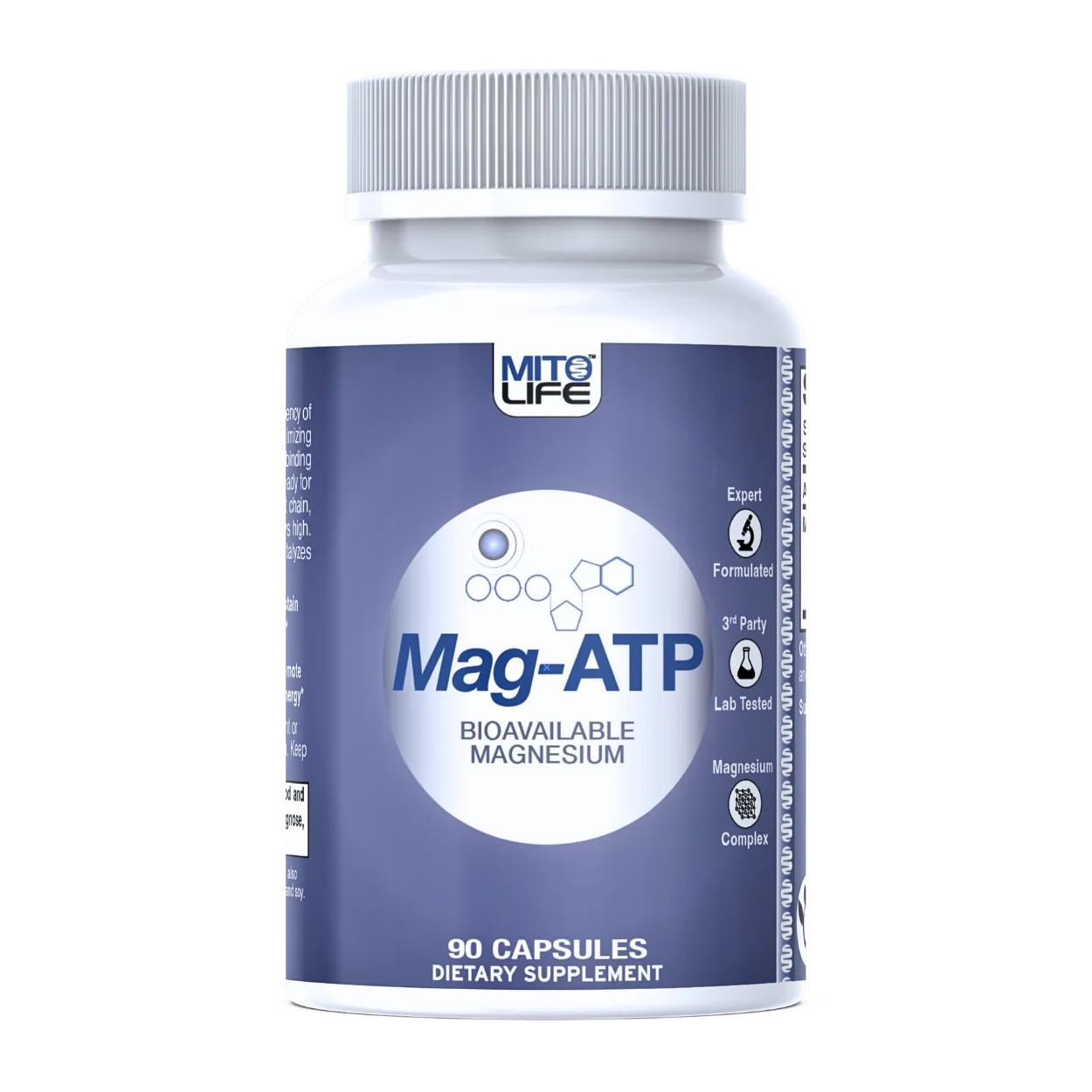
$25.00
Your discount applies with code HOLISTICLOVE.
When you buy through our links, we earn a small commission -- and that is what funds all the free education here. It never costs you more. Products are not intended to diagnose, treat, cure, or prevent any disease.
What it is
A well-absorbed, gentle-on-the-stomach magnesium -- the mineral that sits behind more of the body's chemistry than almost any other. Every molecule of ATP, the cell's energy currency, is actually Mg-ATP: magnesium is the counter-ion that makes ATP usable, which is why 'Mag-ATP' is in the name. Beyond energy it is a required cofactor in over 300 enzyme reactions, and a large share of people run low on it -- likely the single mineral most people are actually short on.
Why the evidence supports it
Magnesium is one of the most consistently studied minerals across the whole body, not just one system. Our library ties it to a long list of proven structure/function roles: it is required to make ATP usable (the cell's energy currency), it calms nerve excitability at the NMDA receptor (why randomized trials of magnesium, including a bisglycinate form, improved sleep and insomnia severity, and why low status tracks with a more activated stress/HPA axis), it supports healthy vascular tone and blood pressure already within a normal range, it is needed to activate vitamin D, it participates in healthy glucose and insulin handling, and it is a structural partner for bone alongside calcium. That breadth is the point: magnesium works through the cell's Transform and Exchange functions -- the mineral behind energy, nerve signaling, vascular tone, bone, and metabolic balance at once -- which is why a well-absorbed form is one of the highest-leverage, best-supported additions most people can make.
What it supports
- Supports nervous-system calm
- Supports an easier wind-down and healthy, restful sleep
- Supports healthy muscle relaxation
- Supports normal mineral balance and hundreds of enzyme reactions
Which function it supports
Ties to the Mind world's Regulate function (and the cell's Exchange) -- magnesium helps calm nerve signaling and downshift the system toward rest.
Learn the why behind this pillarHow it relates to your cells and mind
Every product here ties back to a specific job your body does. This one touches the functions below -- follow either link to see the mechanism in full, then dig into the studies.
What it is made of -- and the mechanisms behind it
Each ingredient acts on several of the body's functions. Taken together, this product touches these cell and mind functions -- follow any to see the mechanism in full.
The ingredients
Mechanisms drawn from our ingredient knowledge base (1 profiled ingredients). Structure and function only -- not a treatment claim.
What’s actually in it
Label revision label image on the product page, read 2026-09-12Transcribed from the manufacturer’s official Product Information Page, exactly as printed. Ingredient names that link open our research page for that ingredient, with the studies behind it.
| Amount per 3 capsules | Amount | % DV |
|---|---|---|
| Magnesiumas magnesium bisglycinate chelate and magnesium taurate | 300 mg | 71% |
- Servings per container:
- 30
- Other ingredients:
- Vegetarian capsule (hypromellose and water), bamboo extract.
Source: official Product Information Page . Amounts are the manufacturer’s, not ours. Structure and function only -- nothing here is medical advice, and nothing here may be used to diagnose, treat, cure, or prevent any disease.
The science on the ingredients
These studies are research on the ingredients and mechanisms in this product, not on the finished product itself, and they are shown for education. Nothing here is medical advice, and nothing here may be used to diagnose, treat, cure, or prevent any disease. Talk to your own provider about what is right for you.
- Effectiveness of mineral supplements (magnesium, chromium, zinc, selenium, chromium picolinate) in reducing insulin resistance in polycystic ovary syndrome: a meta-analysis of randomized controlled trialsPubMed
2026
This meta-analysis of 11 trials in women with polycystic ovary syndrome found mineral supplementation (magnesium, chromium, zinc, selenium) significantly reduced fasting glucose, insulin, HOMA-IR, total cholesterol, and triglycerides, with mixed lipid effects.
- Impact of oral magnesium supplementation on glycemic and cardiometabolic outcomes in prediabetic adults: a systematic review and meta-analysis.PubMed
Journal of diabetes and metabolic disorders · 2026
A meta-analysis on Magnesium found that mgCl₂ demonstrated stronger HDL-C improvement in subgroup analysis.
- Association Between Levels of Magnesium and Diabetic Retinopathy in Diabetic Patients with Type 2 Diabetes Mellitus: An Updated Systematic Review and Meta-AnalysisPubMed
2026
This meta-analysis of 17 studies found magnesium levels were significantly lower in people with type 2 diabetes and retinopathy than in those without, and lowest in proliferative disease, though certainty was low.
- Safety and Efficacy of Perioperative Magnesium Sulfate Injection for Postoperative Pain Management and Opioid Sparing Effects in Surgeries of the Nervous System: A Systematic Review and Meta Analysis.PubMed
Current pain and headache reports · 2026
A meta-analysis found that magnesium sulfate, an NMDA receptor antagonist and calcium channel blocker, has shown promise in reducing postoperative pain and opioid consumption.
- Comprehensive Effects of Magnesium Supplementation on Cardiometabolic Risk Factors: A Systematic Review and Dose-Response Meta-AnalysisPubMed
Nutrients · 2026
A meta-analysis of 78 randomized trials found magnesium supplementation significantly reduced body weight, blood pressure, insulin resistance, LDL cholesterol, fasting glucose, and triglycerides while increasing HDL cholesterol, though effects were modest.
- Does Magnesium Affect Sex Hormones and Cardiometabolic Risk Factors in Patients with PCOS? Findings from a Systematic Review and Meta-AnalysisPubMed
2025
A systematic review and meta-analysis of six randomized trials found magnesium supplementation had no significant effect on sex hormones or cardiometabolic risk factors in women with polycystic ovary syndrome.
Effectiveness of mineral supplements (magnesium, chromium, zinc, selenium, chromium picolinate) in reducing insulin resistance in polycystic ovary syndrome: a meta-analysis of randomized controlled trialsEstablishedMeta-analysis2026
This meta-analysis of 11 trials in women with polycystic ovary syndrome found mineral supplementation (magnesium, chromium, zinc, selenium) significantly reduced fasting glucose, insulin, HOMA-IR, total cholesterol, and triglycerides, with mixed lipid effects.
Jiahui Ye; Siyuan Cen; Qiaoxia Qi; Cancan Wang; Jing Wang; Jiaqi Wang; Gong Yaping; Jinglong Wang
Effects of magnesium and potassium on insulin resistance and blood sugar level among insomniac patients with diabetes mellitus-A randomized controlled trialEstablishedRandomized controlled trial2026
In a randomized trial of 320 insomniac patients with diabetes, magnesium plus potassium lowered HOMA-IR, and fasting blood sugar fell in all treatment groups but not in the placebo group.
Khalid S; Bashir S; Mehboob R; Waseem H; Shahid I; Alzahrani AR; Mazhar Z; Alharazy S -- Journal of investigative medicine : the official publication of the American Federation for Clinical Research
The effects of magnesium L-threonate (Magtein ) on cognitive performance and sleep quality in adults: a randomised, double-blind, placebo-controlled trial.EmergingRandomized controlled trial2026
In 100 adults aged 18 to 45 with dissatisfied sleep, 6 weeks of magnesium L-threonate (Magtein) improved overall cognition, reaction time, and some sleep-impairment and heart-rate measures versus placebo, and was well tolerated.
Lopresti AL; Smith SJ -- Frontiers in nutrition
Effects of magnesium supplementation on serum brain-derived neurotrophic factor levels and cognitive function in patients undergoing fluoxetine therapy for depressionEstablishedRandomized controlled trial2026
In 40 adults with depression taking fluoxetine, adding 350 mg daily magnesium for six weeks was associated with greater MoCA improvement than fluoxetine alone, though serum BDNF change did not differ significantly between groups.
Noor NJ; Syamsuddin S; Liaury K; Tawali S; Idris I; Azis I; Lisal ST -- East Asian archives of psychiatry : official journal of the Hong Kong College of Psychiatrists = Dong Ya jing shen ke xue zhi : Xianggang jing shen ke yi xue yuan qi kan
Micro and Macronutrient Deficiencies and Their Correlation with Menopausal SymptomsEmergingExpert review2026
Nutrient deficiencies including inadequate protein and magnesium in menopausal women amplify menopausal symptoms; calcium intake below recommended levels drives parathyroid hormone elevation and metabolic syndrome.
Ruchika Garg
Development and translation of biodegradable metal stents: from heart to brainEmergingExpert review2026
This review found magnesium-based stents degrade rapidly and may offer neuroprotective benefits, while zinc- and iron-based stents need further safety study for cerebrovascular use.
Xiaofeng Cao; Guanjun Chen; Yuchen Fan; Yunong Shen; Ming Li; Yufeng Zheng
The role of minerals in ischaemic heart diseaseEmergingExpert review2026
This review links disrupted calcium, magnesium, zinc, copper, and manganese levels to vascular calcification, arrhythmia risk, oxidative damage, and altered lipid metabolism in ischaemic heart disease.
Selvan D; Skrypnik K; Suliburska J -- Journal of physiology and pharmacology : an official journal of the Polish Physiological Society
Dietary and nutritional supplementation strategies for table tennis athletes: a mini-reviewEmergingExpert review2026
Table tennis athletes require balanced intake of carbohydrates, protein, fats, and micronutrients including iron, magnesium, and vitamin D for performance.
Ziyang Wang; Lulu Shen; Song Gao
Recent advances in the clinical significance and physiological functions of uromodulin: a narrative reviewEmergingExpert review2026
In a review, the physiological roles and observational clinical associations of the marker in chronic kidney disease, acute kidney injury and cardiovascular disease were synthesised to guide clinical use.
Zhaoxu Hou; Yu Zhang; Chanyuan Zhang; Xuejing Wang
Chloride at the spotlight-but not alone: towards a multi-ionic diuretic strategyEmergingExpert review2026
This review argues that chloride, alongside potassium, magnesium, and acid-base status, is a key driver of diuretic resistance in heart failure and cardiorenal syndrome, beyond the traditional sodium-centered model.
Marco Montomoli; Maria Ines Gil Martins Roxo; Miguel González-Rico; Julio Núñez; Gonzalo Núñez-Marín; Belén Aguilar Uriarte; Rafael De La Espriella; María Jesús Puchades; José L Górriz
Diabetes-induced Multiorgan Damage: Can Magnesium Delay the process?EmergingExpert review2026
This review describes how magnesium supports insulin synthesis, release and action, and how magnesium deficiency is linked to insulin resistance, impaired glucose tolerance and diabetes complications.
Martins E; Haque ATME; Razzaque MS -- Current nutrition reports
Cyclic vomiting syndromeEmergingExpert review2026
In children with cyclic vomiting syndrome, diagnosis came an average of 2.3 years after symptoms began, and 2025 North American pediatric guidelines recommend coenzyme Q10, riboflavin and magnesium as preventive treatments.
Hikita T -- Brain & development
Heat stress associated depression and allied affliction: Therapeutic roles of nutrition, micronutrients, and phytochemicals-a reviewEmergingExpert review2026
This review describes chronic heat stress driving depression and anxiety through HPA-axis hyperactivation, oxidative stress and neuroinflammation, and highlights B vitamins, vitamin D, magnesium, zinc and selenium as supportive nutrients.
Taha Majid Mahmood Sheikh; Abdul Malik Tareen; Muhammad Asif Arain
Prevention and Management of Carboplatin NephrotoxicityEmergingExpert review2026
This review describes carboplatin kidney toxicity, most often low blood magnesium, and stresses that GFR-based dose adjustment matters because the Cockcroft-Gault equation often overestimates GFR and can lead to carboplatin overdose.
Renato A Caires; Elerson C Costalonga; Verônica Torres Costa E Silva
The Effect of Magnesium Supplementation on Exercise Performance and Recovery: A Narrative ReviewEmergingExpert review2026
This narrative review found magnesium supplementation may help some muscle function and recovery measures in people with low magnesium status, but evidence on fatigue and endurance is inconsistent and does not support routine use.
Klaudia Cybulska; Paula Biernat; Anna Czerwińska; Dagmara Cybulska; Jeremi Morka; Michał Sobczak; Emilia Wołyniec; Bartłomiej Kulpa -- African Journal of Biomedical Research
Exploring the role of pistachio nutrients and bioactive components in sleep health: a narrative reviewEmergingExpert review2026
This narrative review concluded that pistachio nutrients such as vitamin B6, magnesium and phytomelatonin could plausibly support sleep, but human trials are still needed.
Ashley Mixon; Jara Pérez-Jiménez; Marie‐Pierre St‐Onge -- Nutrition Research Reviews
Magnesium at the Neurovascular Interface: A Narrative Review of Atherosclerosis, Peripheral Arterial Disease, and Neuropathic PainEmergingExpert review2026
In a review, magnesium acts in over 600 enzymatic reactions and low status was associated with endothelial dysfunction, vascular calcification and neuropathic pain via NMDA receptor antagonism and blood-brain barrier integrity.
Yonghyun Yoon; Rowook Park; Jaehyun Shim; Junyoung Park; Jihyo Hwang; Jungyoun Kim; King Hei Stanley Lam; Teinny Suryadi; Anwar Suhaimi
Early Biomarkers, Risk Factors, and Functional Indicators of Healthy Longevity and Their Relationship with DietEmergingExpert review2026
Dietary quality and specific nutrients including fiber, omega-3 fatty acids, and magnesium were consistent determinants of healthy aging markers.
Daniela Martini; Mariangela Rondanelli; Lorenzo Morelli; Francesco Landi
Magnesium Supplementation for Sleep in Adults: A Systematic Review of Randomized Controlled TrialsEmergingExpert review2026
Across 12 trials in adults, oral magnesium showed inconsistent, low-certainty effects on sleep, with possible modest benefit on some self-reported measures, so it is not yet supported for routine insomnia treatment.
Adrian L. Lopresti; Stephen J. Smith; Peter D. Drummond -- Journal of Dietary Supplements
Sleep and nutrition for athletes. The Nutrition Society, Scottish Section Conference 2024EmergingExpert review2026
This review reported that carbohydrate, caffeine, kiwifruit, magnesium and tart cherry have an evidence base in athletes' sleep, and that more research is needed.
Doherty R; Madigan S; Warrington G; Ellis JG -- The Proceedings of the Nutrition Society
Impact of Serum Phosphate, Potassium and Other Electrolyte Levels on Sudden Cardiac Death and Cardiovascular Mortality in Haemodialysis and Peritoneal Dialysis: A Systematic Review and Meta-AnalysisEmergingExpert review2026
In a meta-analysis of 35 dialysis cohorts, high phosphate and low magnesium were each associated with roughly twofold higher cardiovascular mortality, and extreme potassium and low sodium were also linked to higher risk.
Beata Franczyk; Jacek Rysz; Anna Gluba-Sagr
Ruminal Magnesium Transport Revisited: Apparent Absorption and Estimate of RequirementEmergingExpert review2026
This review of ruminant studies found that rumen magnesium absorption falls with excess potassium and sodium deficiency, and that hypomagnesemia stems mainly from impaired absorption rather than low magnesium intake.
H Martens
Beyond magnesium sulphate - Rethinking magnesium's impact on maternal and foetal health in low to middle-income countries: A scoping reviewEmergingExpert review2026
This scoping review of eleven studies found lower magnesium in women with hypertensive disorders of pregnancy, with supplementation trials inconsistent, so magnesium insufficiency may contribute but causality is unconfirmed.
Naeera Abdul; Vinogrin Dorsamy; Chauntelle Bagwandeen
Dietetic Prescriptions in Bipolar Disorder: Nutritional Strategies to Support Mood Stability and Reduce Relapse Risk-A Narrative ReviewEmergingExpert review2026
This review describes Mediterranean-style diets, omega-3 fatty acids, and micronutrients including magnesium, zinc, and vitamins D and B-complex as potentially supporting mood stability in bipolar disorder, while a Western-style diet appeared to worsen mood instability.
Giuseppe Marano; Ester Maria Marzo; Greta Sfratta; Gianandrea Traversi; Esmeralda Capristo; Eleonora Gaetani; Marianna Mazza
Balanced by design -- we show supporting and contradicting findings. Search all studies
If you have had labs done
These are lab markers where this product's ingredients have measured evidence in our citation library. This is not a claim that the product will change your results -- the research attaches to the ingredient, and what a marker means depends on the whole picture. Each one links to its full entry, including what typically moves it and how to read it.
- Fasting Insulin, Glucose & HOMA-IRsolid evidence
via Magnesium · 910 studies, 304 in people
What people often notice when this marker sits outside the usual range
Higher: The afternoon crash; hunger returning within two hours; central weight that will not shift; skin tags and darkened velvety skin in neck folds or armpits.
Lower: Not usually a concern; very low fasting insulin with low glucose warrants a clinician's look.
- Fasting Insulin, Glucose & HbA1csolid evidence
via Magnesium · 910 studies, 304 in people
What people often notice when this marker sits outside the usual range
Higher: The afternoon crash; central weight appearing where it never used to; hunger returning quickly; waking at 3am.
Lower: Not usually a concern in this context.
- Fasting Insulin and Insulin-like Growth Factor-1 (IGF-1)solid evidence
via Magnesium · 910 studies, 304 in people
The nutrients with real human evidence on insulin sensitivity -- read the fasting glucose entry for the counts and trials.
- Magnesiumsolid evidence
via Magnesium · 775 studies, 241 in people
What people often notice when this marker sits outside the usual range
Higher: Almost always caused by supplements plus reduced kidney function, not by food.
Lower: Muscle cramps, especially calves at night; eyelid twitching that goes on for days.
- Magnesiumsolid evidence
via Magnesium · 775 studies, 241 in people
What people often notice when this marker sits outside the usual range
Lower: For the full symptom picture in both directions, read the main magnesium entry -- it is the same measurement, and repeating it here would only risk the two drifting apart.
- Magnesium RBC (Red Blood Cell Magnesium)solid evidence
via Magnesium · 775 studies, 241 in people
What people often notice when this marker sits outside the usual range
Higher: Almost always supplements plus reduced kidney function rather than food.
Lower: Muscle cramps especially calves at night; eyelid twitching; restless legs.
- Magnesiumsolid evidence
via Magnesium · 775 studies, 241 in people
What people often notice when this marker sits outside the usual range
Higher: Because muscle-meat and refined foods are low in magnesium, shortfall is common on modern diets.
Lower: A high serum magnesium is rare and almost always tied to impaired kidney function (weakness, low blood pressure) -- a medical finding, since magnesium is renally cleared.
- Magnesiumsolid evidence
via Magnesium · 775 studies, 241 in people
What people often notice when this marker sits outside the usual range
Higher: A high serum magnesium is rare and almost always tied to impaired kidney function (weakness, low blood pressure) -- a medical finding, since magnesium is renally cleared.
- Vitamin D (25-Hydroxyvitamin D)solid evidence
via Magnesium · 43 studies, 16 in people
What people often notice when this marker sits outside the usual range
Higher: Excess comes from supplements, essentially never from sun.
Lower: Fatigue -- our library holds an explicit study of 25(OH)D and fatigue severity in adults.
- Vitamin Dsolid evidence
via Magnesium · 43 studies, 16 in people
Required for both activation steps.
What people often notice when this marker sits outside the usual range
Higher: Excess risks hypercalcaemia and kidney stones -- read the main vitamin D entry.
- Vitamin D (Gut Barrier)solid evidence
via Magnesium · 43 studies, 16 in people
Both hydroxylation steps that activate vitamin D are magnesium-dependent.
What people often notice when this marker sits outside the usual range
Higher: See the main vitamin D entry -- excess risks hypercalcaemia and kidney stones.
Lower: Vitamin D deficiency is consistently associated with altered gut microbiota and increased permeability in observational data.
- Vitamin D (25-hydroxyvitamin D)solid evidence
via Magnesium · 43 studies, 16 in people
Required for both hydroxylation steps.
What people often notice when this marker sits outside the usual range
Higher: Excess risks hypercalcaemia and kidney stones -- toxicity comes from supplements, essentially never from sun.
Lower: Fatigue, aching bones and muscles, low mood worse in winter, frequent illness, hair loss.
- Cortisolsolid evidence
via Magnesium · 34 studies, 16 in people
What people often notice when this marker sits outside the usual range
Higher: "Wired but tired" -- exhausted all day, then alert the moment the head hits the pillow.
Lower: Profound fatigue that is worst in the morning, and improves slightly through the day -- the reverse of the usual pattern.
- Sodium, Potassium, Chloride & CO2 (Electrolytes)solid evidence
via Magnesium · 17 studies, 7 in people
What people often notice when this marker sits outside the usual range
Higher: HIGH SODIUM: thirst, dry mouth, confusion -- almost always dehydration rather than salt intake.
Lower: LOW SODIUM: headache, nausea, confusion, fatigue, muscle cramps.
- Glucose (Fasting)solid evidence
via Magnesium · 9 studies, 5 in people
Oral supplementation improved glycaemic control in older adults with prediabetes and insulin resistance.
What people often notice when this marker sits outside the usual range
Higher: Waking at 3am, often with a racing heart -- 'why do i wake up at 3am every night'.
Lower: Shakiness, sweating, sudden anxiety and difficulty concentrating that resolve within minutes of eating.
- Calciumsolid evidence
via Magnesium · 17 studies, 3 in people
Required for PTH release and for tissue response to it -- a low calcium that will not correct is a magnesium problem until proven otherwise.
What people often notice when this marker sits outside the usual range
Higher: "Bones, stones, groans and psychic moans" -- the old teaching phrase, and still the best summary: bone pain, kidney stones, abdominal pain and constipation, low mood and confusion.
Lower: Tingling around the mouth and in the fingers and toes.
- Hemoglobin A1c (HbA1c)solid evidence
via Magnesium · 4 studies, 3 in people
Improved glycaemic control in prediabetes; the same insulin-signalling cofactor role as under fasting glucose.
What people often notice when this marker sits outside the usual range
Higher: Everything listed under fasting glucose, but with more time behind it -- HbA1c is a three-month average, so symptoms are usually established rather than new.
- Bone Health: DEXA / T-score, CTX, P1NPemerging evidence
via Magnesium · 828 studies, 450 in people
Cofactor for both vitamin D activation and PTH secretion.
What people often notice when this marker sits outside the usual range
Higher: A high T-score is favourable; very high values occasionally reflect degenerative change in the spine artificially inflating the reading.
Lower: Bone loss is SILENT until a fracture.
- Vitamin D, Calcium, and Parathyroid Hormone (PTH)emerging evidence
via Magnesium · 828 studies, 450 in people
Cofactor for both vitamin D activation and PTH secretion.
What people often notice when this marker sits outside the usual range
Lower: CALCIUM LOW: tingling around the mouth and in fingers, muscle cramps and twitching, irritability.
- Potassiumemerging evidence
via Magnesium · 17 studies, 7 in people
What people often notice when this marker sits outside the usual range
Higher: Serum potassium is a SAFETY marker, tightly regulated -- the body defends the blood level even when dietary intake is low, so a normal serum value does not confirm good dietary intake.
Lower: A low serum potassium (hypokalaemia) can cause muscle cramps, weakness, fatigue, constipation and palpitations -- also a medical finding to address with a clinician.
- Potassiumemerging evidence
via Magnesium · 17 studies, 7 in people
What people often notice when this marker sits outside the usual range
Higher: Serum potassium is a tightly regulated SAFETY marker -- the body defends the blood level even when dietary intake is low, so a normal serum value does not confirm good dietary intake.
Lower: A low serum potassium (hypokalaemia) can cause muscle cramps, weakness, fatigue, constipation and palpitations -- also a medical finding to address with a clinician.
- Triglyceride:HDL Ratioemerging evidence
via Magnesium · 9 studies, 5 in people
What people often notice when this marker sits outside the usual range
Lower: A low ratio suggests good insulin sensitivity -- the favourable direction.
- Fasting Insulinemerging evidence
via Magnesium · 9 studies, 5 in people
What people often notice when this marker sits outside the usual range
Higher: A high fasting insulin is one of the EARLIEST signals of insulin resistance -- insulin climbs to keep glucose normal for years before glucose itself rises.
Lower: A low fasting insulin, with a normal glucose, generally reflects good insulin sensitivity -- the favourable direction.
- Fasting Glucoseemerging evidence
via Magnesium · 9 studies, 5 in people
What people often notice when this marker sits outside the usual range
Higher: A high fasting glucose is often silent early -- the classic high-sugar symptoms (excess thirst, frequent urination, fatigue, blurred vision) tend to appear later and higher.
Lower: A genuinely low glucose (hypoglycaemia) can cause shakiness, sweating, irritability, hunger and lightheadedness -- but a low-normal fasting value in a healthy person is usually favourable.
- Fasting Insulinemerging evidence
via Magnesium · 9 studies, 5 in people
What people often notice when this marker sits outside the usual range
Higher: Must be drawn fasting to be interpretable, and read alongside glucose (as HOMA-IR), never in isolation.
Lower: A low fasting insulin, with a normal glucose, generally reflects good insulin sensitivity -- the favourable direction.
- HOMA-IR (calculated -- a derived value, not a measured one)emerging evidence
via Magnesium · 9 studies, 5 in people
What people often notice when this marker sits outside the usual range
Higher: Because it is built from fasting insulin, it carries that assay's variability -- interpret the trend on one lab, not an absolute number.
Lower: A low HOMA-IR (roughly under 2.0) is commonly read as insulin-sensitive -- the favourable direction, though the cutoff is population-dependent.
- Fasting Glucoseemerging evidence
via Magnesium · 9 studies, 5 in people
What people often notice when this marker sits outside the usual range
Higher: A high fasting glucose is often silent early -- the classic high-sugar symptoms (excess thirst, frequent urination, fatigue, blurred vision) tend to appear later and higher.
Lower: A genuinely low glucose (hypoglycaemia) can cause shakiness, sweating, irritability, hunger and lightheadedness -- but a low-normal fasting value in a healthy person is usually favourable.
- Triglyceride : HDL Ratio (calculated -- a derived value)emerging evidence
via Magnesium · 9 studies, 5 in people
What people often notice when this marker sits outside the usual range
Lower: A low ratio suggests good insulin sensitivity -- the favourable direction.
via Magnesium · 9 studies, 5 in people
What people often notice when this marker sits outside the usual range
Higher: The TyG index is a calculated insulin-resistance marker built from fasting triglycerides and fasting glucose -- a derived number, not a felt symptom.
Lower: A lower TyG index (within a population) is the favourable direction -- the validating studies read it as higher-versus-lower, not against a fixed line.
- Calciumemerging evidence
via Magnesium · 17 studies, 3 in people
What people often notice when this marker sits outside the usual range
Higher: A high serum calcium needs clinical work-up -- causes include parathyroid, vitamin D and kidney issues -- not a supplement adjustment.
- HbA1c (Hemoglobin A1c)emerging evidence
via Magnesium · 4 studies, 3 in people
What people often notice when this marker sits outside the usual range
Higher: A high HbA1c reflects the same chronic high-glucose state -- silent early, then thirst, frequent urination and fatigue at higher levels.
Lower: A low HbA1c is generally favourable, but an unexpectedly low value can reflect a red-cell condition rather than excellent control -- cross-check against fasting glucose if it surprises you.
- HbA1c (Glycated Hemoglobin)emerging evidence
via Magnesium · 4 studies, 3 in people
What people often notice when this marker sits outside the usual range
Higher: A high HbA1c reflects the same chronic high-glucose state as glucose, averaged over roughly three months -- silent early, then thirst, frequent urination and fatigue at higher levels.
Lower: A low HbA1c is generally favourable, but an unexpectedly low value can reflect a red-cell condition rather than excellent control -- cross-check against fasting glucose if it surprises you.
- Thyroid-Stimulating Hormone (TSH)emerging evidence
via Magnesium · 1 studies, 1 in people
Severely low serum magnesium associated with positive anti-thyroglobulin antibodies -- an association, and a reason to check rather than a demonstrated lever.
What people often notice when this marker sits outside the usual range
Higher: Cold all the time, especially hands and feet, and needing more layers than everyone else in the room.
Lower: Racing or irregular heartbeat, palpitations, waking at night with the heart pounding.
- Thyroglobulin Antibodies (TgAb)emerging evidence
via Magnesium · 1 studies, 1 in people
What people often notice when this marker sits outside the usual range
Higher: Same picture as TPO antibodies -- frequently silent for years, then the hypothyroid symptoms appearing while TSH still reads normal.
Lower: Negative is the desired result.
- Estradiol, FSH, LH, Prolactin, DHEA-S & Testosteroneemerging evidence
via Magnesium · 8 studies, 0 in people
What people often notice when this marker sits outside the usual range
Higher: HIGH FSH with low oestradiol is the menopause transition signal.
Lower: Joint aches that appeared with no injury; skin and hair changing texture.
- Albumin, Globulin, Bilirubin & Alkaline Phosphatase (ALP)emerging evidence
via Magnesium · 6 studies, 0 in people
A cofactor alongside zinc for alkaline phosphatase activity.
What people often notice when this marker sits outside the usual range
Higher: HIGH ALP: bone pain or liver/bile symptoms.
Lower: LOW ALBUMIN: swelling of ankles and feet, puffiness around the eyes, fatigue, poor wound healing, muscle loss.
- eGFR, Creatinine & BUNmixed evidence
via Magnesium · 4 studies, 1 in people
What people often notice when this marker sits outside the usual range
Higher: Later: swelling in ankles and around the eyes, foamy urine, fatigue, poor appetite, itching, night urination, high blood pressure.
Lower: A low creatinine usually reflects low muscle mass rather than excellent kidneys, and in older adults it can hide meaningfully reduced filtration.
Lab results are interpreted by a qualified clinician who knows your history. Nothing here diagnoses anything or replaces that conversation.
No product works in isolation
Every cell function above -- Sense, Exchange, Transform, Build, Maintain, Adapt -- needs the same broad base of optimal micronutrient levels running underneath it, all the time. Mag-ATP is not a stand-alone fix; it is one piece that plugs into that larger system. The foundation comes first, and this supports it.
Stacks well with
Pick your goal -- here is what Mag-ATP pairs with for each. Nothing works in isolation; these share the same systems.
For Brain & Sleep
For Minerals
For Mood & Hormones
For Energy & Mitochondria
Foundational, or targeted?
Not everything in the shop is meant to be taken forever. Some products here are foundational -- a daily nutrient base built for long-term, ongoing use. Others are targeted -- shorter-term support for a specific season, not a lifelong habit. If you are not sure which one this is, that is a fair question to ask us before you buy.
Learn more, on your terms
Do not take our word for it -- go read. Each topic below opens a pre-loaded search so you can explore the nutrient, the mechanism, or the device for yourself.
Search the full studies libraryHow to use it
Take in the evening, an hour or so before bed, with a little water. If you are new to it, start on the lower end of the label and build up.
Use code HOLISTICLOVE at checkout.
Where to get it
Ready when you are. This link takes you to the official, verified source for this product.
Get Mag-ATPThe studies
See the research behind the science we point to.
Explore studiesThe blog
Plain-language reads on how it all fits together.
Read the blogOptimal nutrients are the definition of longevity
Long-term cell function depends on having what it needs, at the level it needs it, for as long as it needs it. That is the whole thesis behind everything we point you to here.
When you buy through our links, we earn a small commission -- and that is what funds all the free education here. It never costs you more. Products are not intended to diagnose, treat, cure, or prevent any disease.
Mag-ATP is a calming, well-absorbed magnesium (bisglycinate and taurate) chosen for gentleness on the stomach and support for nervous-system calm. Magnesium is a mineral a large share of people run low on, and it sits behind hundreds of body reactions. It fits anyone who wants an easier wind-down at night.
FAQ
What does Mag-ATP support?
It supports nervous-system calm, an easier wind-down and healthy restful sleep, healthy muscle relaxation, and normal mineral balance across hundreds of enzyme reactions.
How do I take it?
Take in the evening, an hour or so before bed, with a little water. If you are new to it, start on the lower end of the label and build up.
What makes it different?
It uses calming, better-absorbed forms of magnesium that are kind to the gut, making it one of the simplest, most-supported additions for winding the nervous system down.