When you buy through our links, we earn a small commission — and that is what funds all the free education here. It never costs you more. Products are not intended to diagnose, treat, cure, or prevent any disease.
What it is
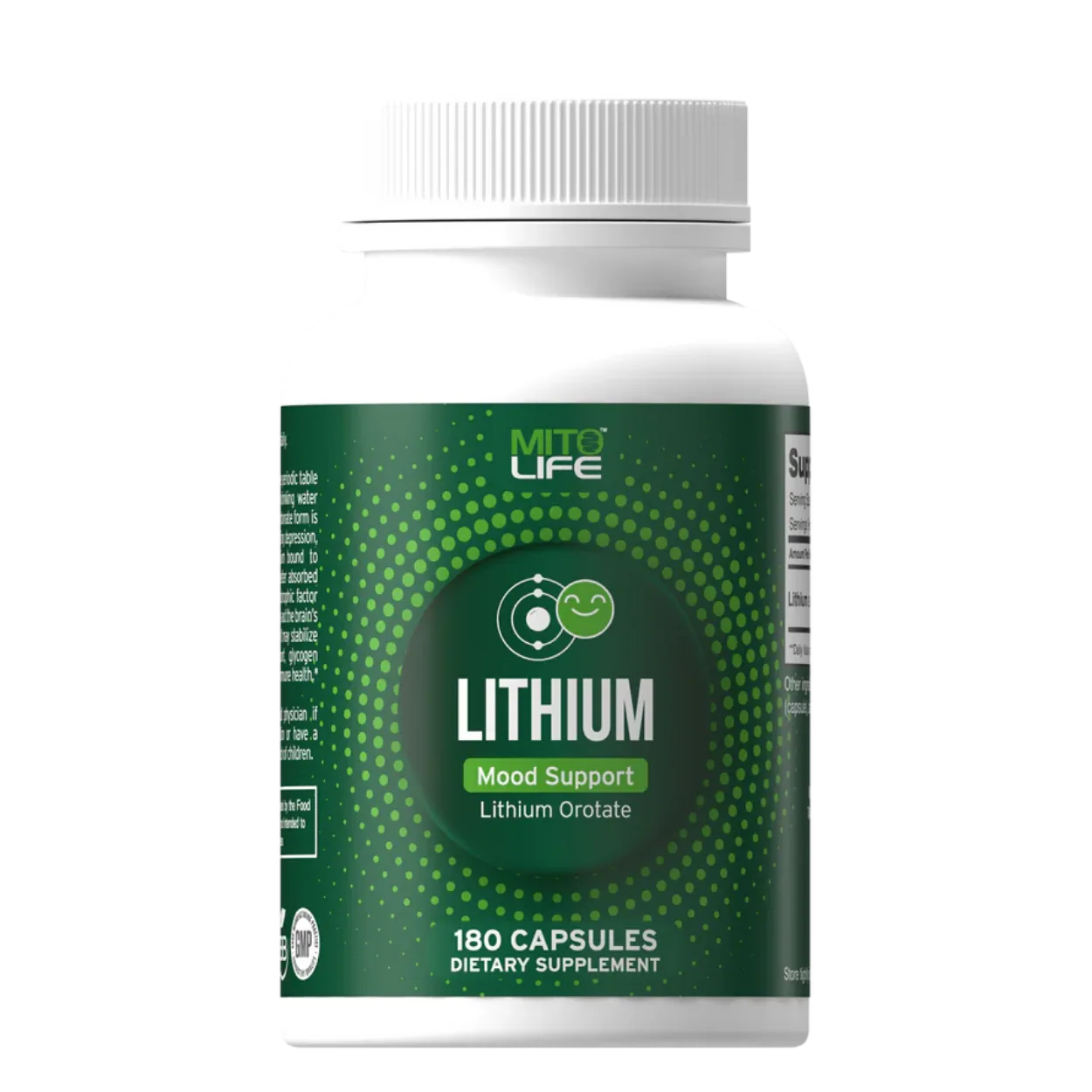
A very low-dose form of lithium bound to orotic acid — a trace amount, a small fraction of the doses used in prescription medicine. At this trace level it is used to support everyday mood steadiness and a calmer nervous system, not as a pharmaceutical.
Why the evidence supports it
Honesty first: the research on low-dose lithium orotate specifically is genuinely thin — mostly older case reports and small observational accounts never replicated in controlled trials — so the orotate form sits at the low end of the evidence tiers and is not presented as settled. The broader lithium science, though, is richer than most realize, and our library reflects it: beyond mood regulation, lithium is studied for neuroprotective signaling in the brain, a supportive role in bone, and — more emerging — roles in methylation and immune/autoimmune modulation (for instance, dampening the IFN-gamma-driven side of nervous-system autoimmunity). Those are mechanisms of broader lithium biology, held at emerging tiers, not proven claims for a trace-dose supplement. It works under the Mind's Regulate function and the cell's Exchange. Because lithium clears through the kidneys, this is not a substitute for prescription lithium, and anyone with reduced kidney function should not take it without a doctor's oversight.
What it supports
- Supports everyday nervous-system calm
- Supports steady, even mood as part of a balanced routine
- Provides lithium at a low, trace level
- Best used with awareness of the safety notes below
Which function it supports
Ties to the Mind world's Regulate function — supporting the everyday steadiness of the nervous system at a trace dose, not the pharmaceutical effect of prescription lithium.
Learn the why behind this pillarHow it relates to your cells and mind
Every product here ties back to a specific job your body does. This one touches the functions below — follow either link to see the mechanism in full, then dig into the studies.
What it is made of — and the mechanisms behind it
Each ingredient acts on several of the body's functions. Taken together, this product touches these cell and mind functions — follow any to see the mechanism in full.
The ingredients
Mechanisms drawn from our ingredient knowledge base (2 profiled ingredients). Structure and function only — not a treatment claim.
The science on the ingredients
Lithium use and risk of fracture: a systematic review and meta-analysis of observational studiesEmergingMeta-analysis2019
Pooling the observational literature, lithium exposure was associated with lower fracture risk across studies. The strongest available synthesis on the bone endpoint, and it inherits the limits of observational data -- association, pharmacological dose range, and confounding by indication.
Liu B, Wu Q, Zhang S, Del Rosario A — Osteoporosis International
Innate and adaptive immune responses regulated by glycogen synthase kinase-3 (GSK3)EstablishedExpert review2010
GSK-3 sets the balance between pro-inflammatory and anti-inflammatory cytokine output, and inhibiting it shifts that balance toward the anti-inflammatory side across both innate and adaptive arms. Because lithium is a GSK-3 inhibitor, this is the upstream framework that explains its immune-modulating signal rather than a lithium trial itself.
Beurel E, Michalek SM, Jope RS — Trends in Immunology
Mini review: Recent advances on epigenetic effects of lithiumEmergingExpert review2021
Lithium acts on three epigenetic layers -- DNA methylation, histone modification and non-coding RNA -- rather than on a single receptor. This is the mechanistic bridge for how a simple ion produces durable changes in gene expression, and it places lithium's methylation activity in the epigenetic machinery rather than in one-carbon nutrient metabolism.
Marie-Claire C, Etain B, Bellivier F — Neuroscience Letters
Serum and red cell folate and affective morbidity in lithium prophylaxisEstablished1991
Among 68 patients taking lithium, serum and red cell folate concentrations showed no relationship to affective morbidity, which led the authors to question routinely adding folic acid.
McKeon P; Shelley R; O'Regan S; O'Broin J — Acta Psychiatrica Scandinavica
Dendritic cells from the elderly display an intrinsic defect in the production of IL-10 in response to lithium chlorideEmerging2013
Lithium chloride lowered TNF-alpha and IL-6 release from dendritic cells of older adults and reduced interferon-gamma secretion by primed T cells, but did not raise IL-10 as it did in younger cells.
Agrawal S; Gollapudi S; Gupta S; Agrawal A — Experimental Gerontology
Low-dose lithium feeding increases the SERCA2a-to-phospholamban ratio, improving SERCA function in murine left ventricles.2020
In mice given low-dose lithium in drinking water for six weeks, heart muscle samples showed reduced GSK3 enzyme activity and improved calcium handling protein ratios linked to heart pumping function compared to untreated mice.
Hamstra SI; Kurgan N; Baranowski RW; Qiu L; Watson CJF; Messner HN — Experimental physiology
Lithium-induced enhancement of mitochondrial oxidative phosphorylation in human brain tissueEmerging2009
In human brain tissue, lithium raised respiratory chain complex I+III and II+III activity in a dose-dependent way, peaking at 1 mM. A direct measurement in human tissue that ties lithium to mitochondrial energy production, which is the cellular layer underneath the neuroprotection signal.
Maurer IC, Schippel P, Volz HP — Bipolar Disorders
Low dose lithium supplementation activates Wnt/β-catenin signalling and increases bone OPG/RANKL ratio in mice.2019
In mice given low-dose lithium for six weeks, bone tissue showed activated Wnt signaling and a higher ratio of bone-protecting OPG to RANKL protein, changes associated with increased bone formation.
Kurgan N; Bott KN; Helmeczi WE; Roy BD; Brindle ID; Klentrou P — Biochemical and biophysical research communications
Differential regulation of STAT family members by glycogen synthase kinase-3Emerging2008
Inhibiting GSK-3, the enzyme lithium blocks, cut interferon-gamma-driven STAT3 activation by more than 75 percent in astrocytes, microglia and macrophages, identifying one route by which lithium can dampen neuroinflammatory signalling.
Beurel E; Jope RS — The Journal of Biological Chemistry
A Low-Therapeutic Dose of Lithium Inhibits GSK3 and Enhances Myoblast Fusion in C2C12 Cells.2019
In cultured mouse muscle cells, lithium chloride at concentrations matching blood levels used for bipolar disorder reduced GSK3 enzyme activity by 86 percent and increased markers of muscle cell fusion and differentiation.
Kurgan N; Whitley KC; Maddalena LA; Moradi F; Stoikos J; Hamstra SI — Cells
Reduced relative risk of fractures among users of lithiumEmerging2005
In a case-control analysis of 124,655 fracture cases against 373,962 matched controls, higher cumulative lithium exposure tracked with lower fracture risk after adjusting for psychotropic use. Population-scale observational signal on bone; exposure here is pharmacological dosing, not a trace or supplemental intake.
Vestergaard P, Rejnmark L, Mosekilde L — Calcified Tissue International
Effect of Lithium on the Mechanism of Glucose Transport in Skeletal Muscles.2017
In isolated rat skeletal muscle tissue, lithium increased glucose uptake by boosting surface levels of the GLUT4 transporter, though less effectively than insulin or muscle contraction alone.
Jung S; Koh J; Kim S; Kim K — Journal of nutritional science and vitaminology
Lithium in scalp hair of adults, students, and violent criminals. Effects of supplementation and evidence for interactions of lithium with vitamin B12 and with other trace elementsEmerging1992
Hair lithium and hair cobalt concentrations correlated strongly across 2648 adults, which the authors read as suggesting lithium has a role in the transport and distribution of vitamin B12.
Schrauzer GN; Shrestha KP; Flores-Arce MF — Biological Trace Element Research
Low-Dose Lithium Stabilizes Human Endothelial Barrier by Decreasing MLC Phosphorylation and Universally Augments Cholinergic Vasorelaxation Capacity in a Direct Manner.2016
In lab experiments using mouse, pig and human blood vessel tissue, lithium at concentrations similar to blood levels used clinically for bipolar disorder improved vessel relaxation responses and reduced vessel lining leakiness by lowering a signaling protein called MLC phosphorylation.
Bosche B; Molcanyi M; Rej S; Doeppner TR; Obermann M; Müller DJ — Frontiers in physiology
Folate concentration in Chinese psychiatric outpatients on long-term lithium treatmentEmerging1992
In 46 outpatients on long-term lithium, serum folate correlated negatively with both lithium dose and serum lithium level, though folate deficiency itself was rare in this group.
Lee S; Chow CC; Shek CC; Wing YK; Chen CN — Journal of Affective Disorders
Effects of lithium on oxidative stress parameters in healthy subjects.2012
In healthy adult volunteers given lithium at standard treatment doses for two to four weeks, blood levels of the antioxidant enzyme superoxide dismutase changed, with a lower SOD to catalase ratio suggesting reduced oxidative stress markers.
Khairova R; Pawar R; Salvadore G; Juruena MF; de Sousa RT; Soeiro-de-Souza MG — Molecular medicine reports
Lithium counteracts histamine suppression of human T cell mitogenesisEmerging1990
Lithium chloride at 1 to 3 mM raised human T cell proliferative responses by roughly half, and at 10 mM it fully abolished the suppression of those responses caused by histamine.
Hall TJ; Heckel C; Hudspith BN; Brostoff J — Immunology Letters
High-level exposure to lithium, boron, cesium, and arsenic via drinking water in the Andes of northern Argentina.2010
In six Andean villages in Argentina, drinking water contained high levels of arsenic, lithium, cesium and boron, and urine samples from 198 women showed correspondingly elevated levels, raising concern about long-term health risks from combined exposure.
Concha G; Broberg K; Grandér M; Cardozo A; Palm B; Vahter M — Environmental science & technology
Mechanism of lithium-induced augmentation of T-cell proliferationEmerging1988
In human blood cells, lithium raised interleukin-2 and interleukin-1 production after mitogen stimulation and increased responsiveness to interleukin-2, without changing interleukin-2 receptor expression.
Kucharz EJ; Sierakowski S; Staite ND; Goodwin JS — International Journal of Immunopharmacology
Lrp5-independent activation of Wnt signaling by lithium chloride increases bone formation and bone mass in mice.2005
In three strains of mice, including ones lacking a Wnt receptor and ones prone to osteoporosis, oral lithium chloride for four weeks increased bone mass and activated Wnt signaling genes in bone forming cells.
Clément-Lacroix P; Ai M; Morvan F; Roman-Roman S; Vayssière B; Belleville C — Proceedings of the National Academy of Sciences of the United States of America
Chronic treatment with mood stabilizers lithium and valproate prevents excitotoxicity by inhibiting oxidative stress in rat cerebral cortical cells.2005
In cultured rat brain cortex cells, chronic exposure to lithium and valproate blocked the glutamate-triggered rise in calcium, oxidative damage and cell death, without changing these measures under normal, non-stimulated conditions.
Shao L; Young LT; Wang JF — Biological psychiatry
Lithium: occurrence, dietary intakes, nutritional essentiality.2002
A review of dietary lithium found that rats and goats fed low-lithium diets had higher death rates and reproductive problems, while communities with less lithium in drinking water showed higher suicide and violent crime rates in population data.
Schrauzer GN — Journal of the American College of Nutrition
Identifying the neuropsychiatric health effects of low-dose lithium interventions: A systematic reviewEstablishedSystematic review2023
Found promising signals for cognition and adjunctive affective treatment with generally encouraging reported safety -- Authors explicitly state that typical lithium-orotate benefits and risks have not received meticulous scientific scrutiny
Strawbridge R et al. — Neuroscience and Biobehavioral Reviews
Effects of nutritional lithium supplementation on mood: A placebo-controlled study with former drug usersEmergingRandomized controlled trial1994
Self-rated total mood scores increased in the lithium group across the supplementation period -- Tests trace lithium in brewer's yeast rather than lithium orotate; weekly self-report and voluntary comments; small sample and short duration
Schrauzer GN and de Vroey E — Biological Trace Element Research
Balanced by design — we show supporting and contradicting findings. Search all studies
No product works in isolation
Every cell function above — Sense, Exchange, Transform, Build, Maintain, Adapt — needs the same broad base of optimal micronutrient levels running underneath it, all the time. Lithium Orotate is not a stand-alone fix; it is one piece that plugs into that larger system. The foundation comes first, and this supports it.
Stacks well with
Pick your goal — here is what Lithium Orotate pairs with for each. Nothing works in isolation; these share the same systems.
For Brain & Sleep
For Mood & Hormones
For Minerals
For Immune
Foundational, or targeted?
Not everything in the shop is meant to be taken forever. Some products here are foundational — a daily nutrient base built for long-term, ongoing use. Others are targeted -- shorter-term support for a specific season, not a lifelong habit. If you are not sure which one this is, that is a fair question to ask us before you buy.
Learn more, on your terms
Do not take our word for it — go read. Each topic below opens a pre-loaded search so you can explore the nutrient, the mechanism, or the device for yourself.
Search the full studies libraryHow to use it
Take the low labeled dose with water, usually once daily. It is not a replacement for any prescribed medication. If you have any kidney concerns or take other mood or nervous-system medications, talk to your provider before starting.
Use code HOLISTICLOVE at checkout.
Where to get it
We are lining up the best way to get this one to you. In the meantime, reach out and we will point you the right way — or browse the full shop to see every product.
See the full shopThe studies
See the research behind the science we point to.
Explore studiesThe blog
Plain-language reads on how it all fits together.
Read the blogOptimal nutrients are the definition of longevity
Long-term cell function depends on having what it needs, at the level it needs it, for as long as it needs it. That is the whole thesis behind everything we point you to here.
When you buy through our links, we earn a small commission — and that is what funds all the free education here. It never costs you more. Products are not intended to diagnose, treat, cure, or prevent any disease.
Lithium Orotate is a very low-dose form of lithium, a tiny fraction of the prescription doses used in medicine. At this trace level people use it to support everyday mood steadiness and a calmer nervous system. It fits people wanting gentle, everyday calm support within clear safety guardrails.
Common questions
What does Lithium Orotate support?+
It supports everyday nervous-system calm and steady, even mood as part of a balanced routine, and provides lithium at a low, trace level. It is best used with awareness of the safety notes.
How do I take it?+
Take the low labeled dose with water, usually once daily. It is not a replacement for any prescribed medication. If you have kidney concerns or take other mood or nervous-system medications, talk to your provider before starting.
What makes it different?+
This is a low, trace dose and not the same as prescription lithium, which is a serious medication for diagnosed conditions. Never use this as a substitute for that.