$50.00
Your discount applies with code HOLISTICLOVE.
When you buy through our links, we earn a small commission -- and that is what funds all the free education here. It never costs you more. Products are not intended to diagnose, treat, cure, or prevent any disease.
What it is
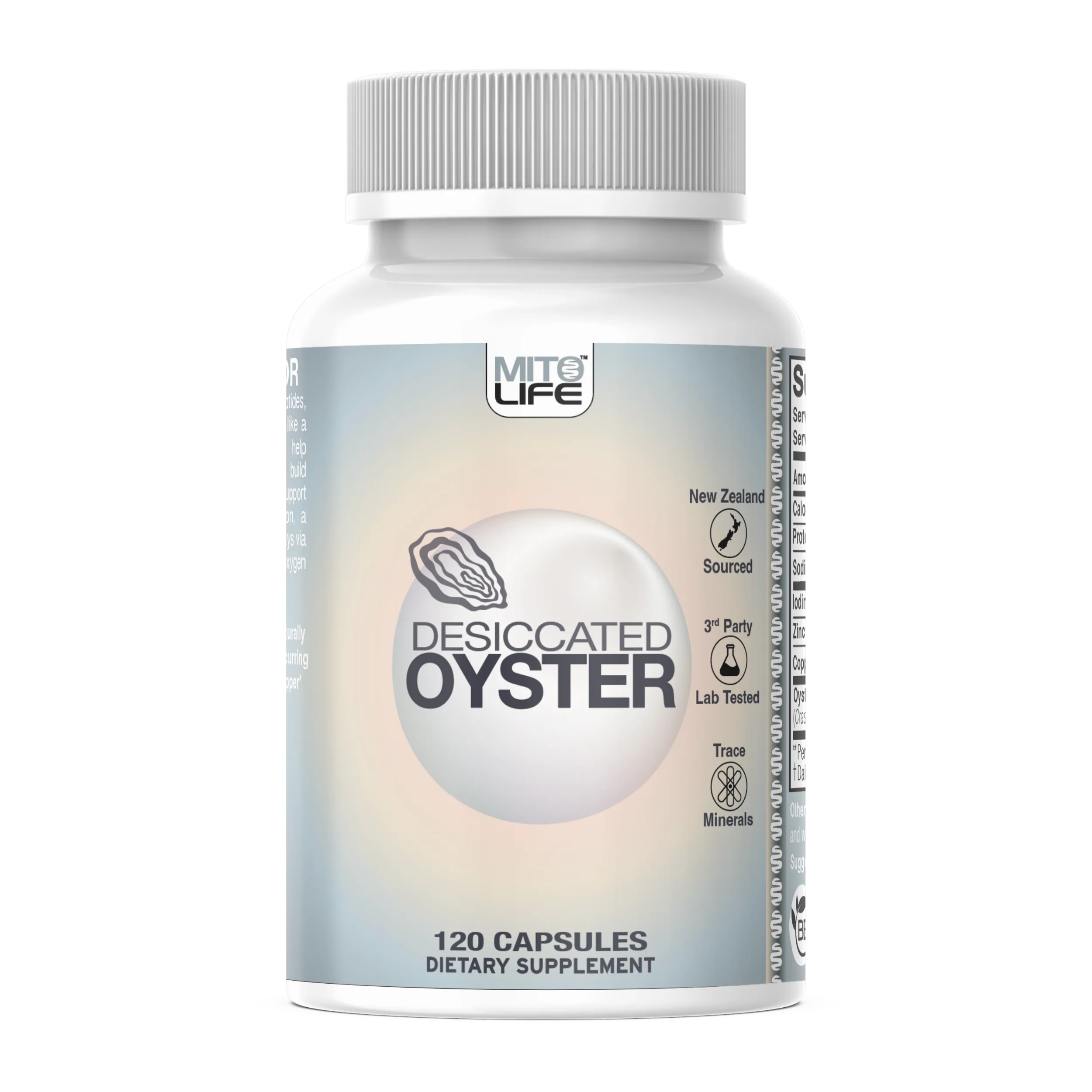
Whole-food desiccated (dried) oyster in capsule form. Oyster is one of the richest natural sources of zinc there is, and carries copper, selenium, and iodine alongside it -- trace minerals many diets run short on, delivered in whole-food ratios.
Why the evidence supports it
Oyster's mineral density is plain nutritional fact, not a marketing claim -- it is among the most zinc-rich foods on earth, and zinc is a cofactor behind hundreds of the cell's everyday enzyme reactions. As concentrated real food it delivers that zinc with the copper, selenium, and iodine that naturally balance it, which is the cell's Build function supplied at the source. Those same minerals serve two connected systems at once -- bone, which is living tissue and the home of the immune-cell-making marrow, and the immune system itself, both of which lean heavily on zinc and copper. An easy, whole-food way to cover zinc and trace minerals for people who do not eat shellfish -- and it pairs naturally with Zinc + Copper.
What it supports
- A whole-food source of highly bioavailable zinc
- Provides copper, selenium, and iodine alongside zinc
- Supports normal immune and everyday mineral status
- An easy option for people who do not eat shellfish
Which function it supports
Ties to the cell's Build function -- supplying the zinc and trace minerals cells use across countless everyday enzyme reactions.
Learn the why behind this pillarHow it relates to your cells and mind
Every product here ties back to a specific job your body does. This one touches the functions below -- follow either link to see the mechanism in full, then dig into the studies.
What it is made of -- and the mechanisms behind it
Each ingredient acts on several of the body's functions. Taken together, this product touches these cell and mind functions -- follow any to see the mechanism in full.
The ingredients
Mechanisms drawn from our ingredient knowledge base (5 profiled ingredients). Structure and function only -- not a treatment claim.
What’s actually in it
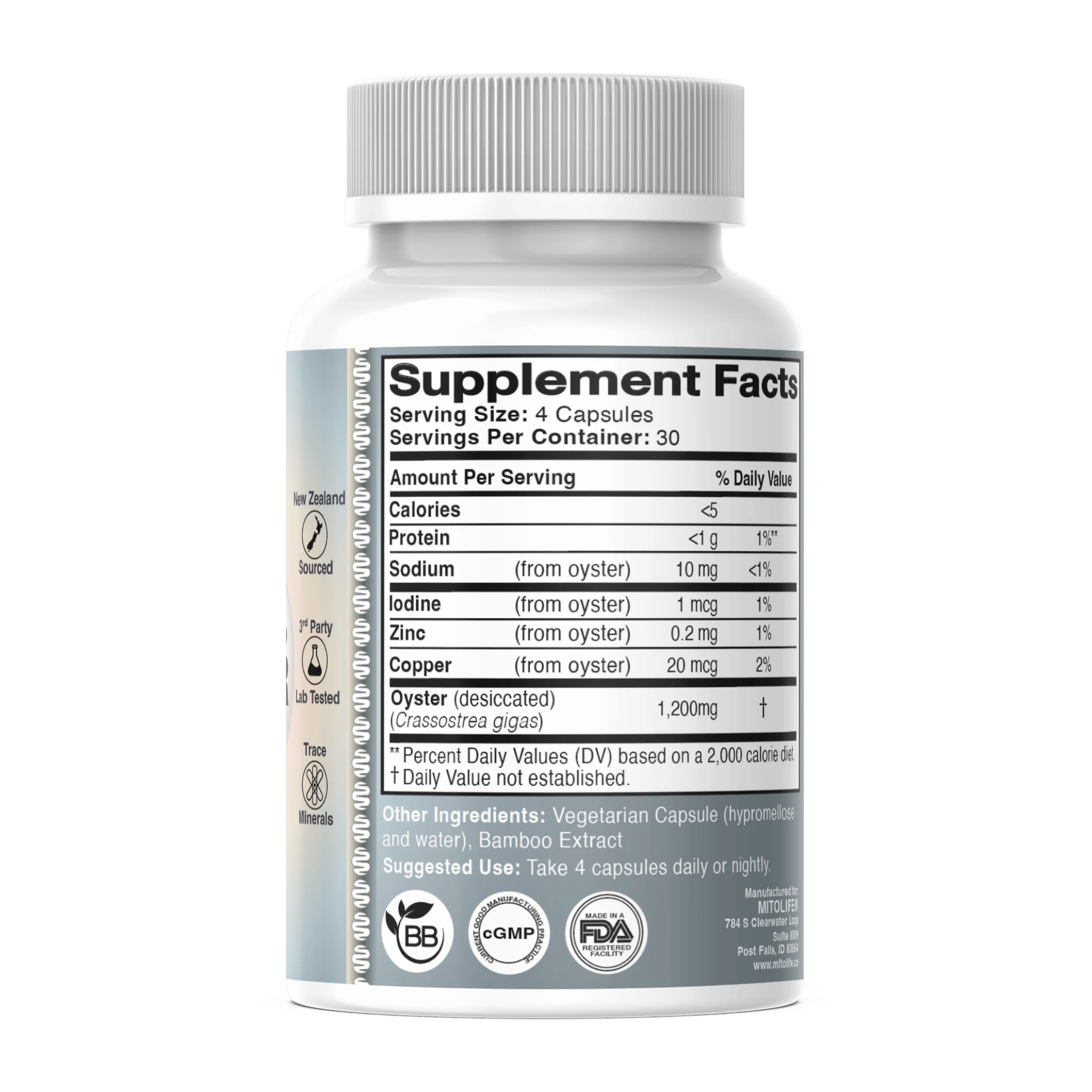
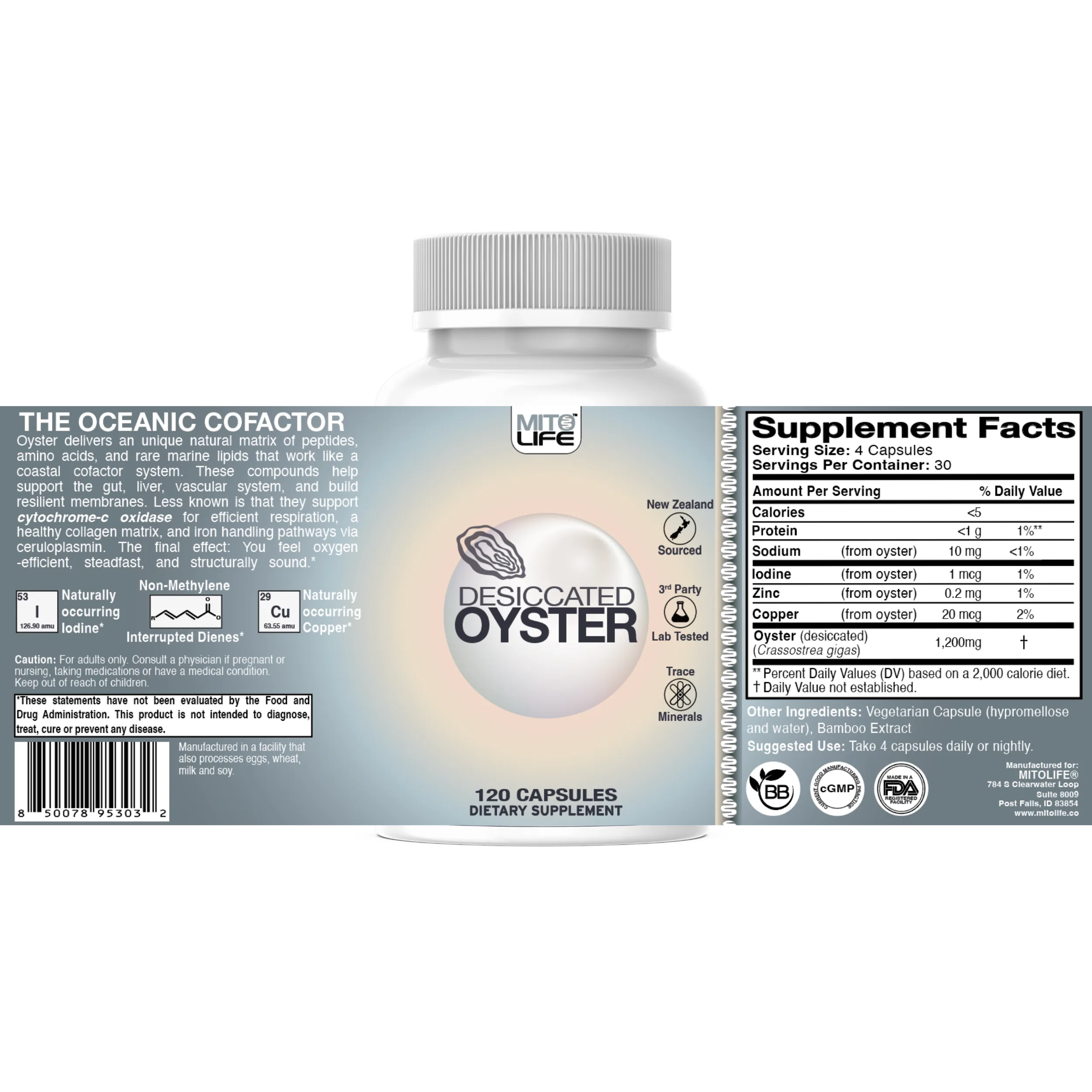
Label revision label image on the product page, read 2026-09-11Transcribed from the manufacturer’s official Product Information Page, exactly as printed. Ingredient names that link open our research page for that ingredient, with the studies behind it.
| Amount per 4 capsules | Amount | % DV |
|---|---|---|
| Calories | <5 | |
| Protein | <1 g | 1% |
| Sodiumfrom oyster | 10 mg | <1% |
| Iodinefrom oyster | 1 mcg | 1% |
| Zincfrom oyster | 0.2 mg | 1% |
| Copperfrom oyster | 20 mcg | 2% |
| Oysterdesiccated, Crassostrea gigas | 1,200 mg | † |
- Servings per container:
- 30
- Other ingredients:
- Vegetarian capsule (hypromellose and water), bamboo extract.
- Allergens:
- Contains shellfish (oyster)
Source: official Product Information Page . Amounts are the manufacturer’s, not ours. Structure and function only -- nothing here is medical advice, and nothing here may be used to diagnose, treat, cure, or prevent any disease.
The science on the ingredients
These studies are research on the ingredients and mechanisms in this product, not on the finished product itself, and they are shown for education. Nothing here is medical advice, and nothing here may be used to diagnose, treat, cure, or prevent any disease. Talk to your own provider about what is right for you.
- Efficacy of topical application of zinc compounds for oral mucosal diseases: A systematic review and meta-analysisPubMed
2026
Topical zinc therapy significantly reduced cancer-induced oral mucositis and showed promise for recurrent aphthous stomatitis and oral lichen planus.
- Zinc status following different bariatric procedures: systematic review and meta-analysisPubMed
2026
A meta-analysis of 12 studies (2,529 participants) found serum zinc fell significantly at 6 and 12 months after gastric bypass and mini-gastric bypass, but not after sleeve gastrectomy.
- Effectiveness of mineral supplements (magnesium, chromium, zinc, selenium, chromium picolinate) in reducing insulin resistance in polycystic ovary syndrome: a meta-analysis of randomized controlled trialsPubMed
2026
This meta-analysis of 11 trials in women with polycystic ovary syndrome found mineral supplementation (magnesium, chromium, zinc, selenium) significantly reduced fasting glucose, insulin, HOMA-IR, total cholesterol, and triglycerides, with mixed lipid effects.
- Dietary factors influencing zinc excretion in pigs: a meta-regression analysisPubMed
Journal of animal science · 2026
A meta-regression of 51 pig studies found that zinc intake was the primary driver of fecal zinc excretion, with 61-82% of ingested zinc excreted depending on intake relative to requirements.
- The Route of Administration Determines the Efficacy of Zinc in Preventing Radiation-Induced Oral Mucositis: A Systematic Review and Meta-AnalysisPubMed
2026
Topical zinc mouthwash significantly reduced severe radiation-induced oral mucositis in head and neck cancer whereas systemic zinc showed inconsistent benefits.
- Effects of Zinc Supplementation on Glycemic Control, Insulin Resistance, Inflammation and Oxidative Stress in Diabetes: A Systematic Review and Meta-Analysis of Randomized Controlled TrialsPubMed
2026
A meta-analysis of 18 randomized trials (1,023 participants) found zinc supplementation increased plasma zinc levels and was associated with reduced insulin resistance, lower CRP and malondialdehyde, and higher antioxidant capacity in people with diabetes or prediabetes.
Obesity and Its Association With Micronutrient Deficiency Among Mexican Children and Adolescents: A Systematic Review and Meta-analysisEstablishedMeta-analysis2026
A meta-analysis of 16 studies and 20,043 Mexican children and adolescents found overweight or obesity was associated with higher odds of vitamin D deficiency (OR 1.84), plus increased zinc, iron and B6 deficiency risk.
Alejandra Herrera-González; Yareni Yunuen Gutierrez-Gómez; Carlos Francisco Moreno-García; Magaly Aceves-Martins
Zinc: An Emerging Axis of Host-Pathogen Interaction in TuberculosisEmergingExpert review2026
This review argues that host proteins such as calprotectin withhold zinc from Mycobacterium tuberculosis, and that zinc limitation inside the host contributes to the bacterium's long-term persistence.
Jordan Holl; Jamie Corro; Bibhuti B Mishra; Anil K Ojha
Overview of the Zinc Functional Interactome Through Health Hallmarks and Medical ConditionsEmergingExpert review2026
Young athletes performing high-volume training show paradoxical performance gains when sleep is extended to 10 hours nightly; benefit plateaus beyond 9 hours in non-overtrained athletes.
Mirela Pavić Vulinović; Vedran Micek; Davorka Breljak; Ivana Vrhovac Madunić; Josip Madunić; Marija Ljubojević
Essential Trace Elements Zinc, Iron, Copper and Attention-Deficit/Hyperactivity Disorder in Children and Adolescents: A Systematic Review and Meta-Analysis of Case-Control StudiesEstablished2026
A meta-analysis of 46 studies with 5,515 children with ADHD and 8,166 controls found significantly lower blood zinc, iron and ferritin levels in children with ADHD, while copper levels did not differ significantly between groups.
Wei Wang; Lei Tian; Huiqiong Xu; Jixing Zhou; Menglong Geng
A hierarchical, pH-responsive nanocomposite hydrogel platform for synergistic microenvironment reprogramming and attenuation of inflammatory periodontal bone lossEmergingPrimary research (design unspecified)2027
A zinc oxide-polypeptide hydrogel preserved alveolar bone in a murine periodontitis model by promoting anti-inflammatory macrophage polarization and ROS scavenging.
Yixin Zhang; Xiaodong Jing; Xu Wang; Zhengchu Zhang; Jiaqi Xin; Zhengyang Chang; Yue Su; Zhimin Yan; Anhuai Lu; Hua Lu
A multifunctional MOF-mineralized conductive hydrogel coating on zinc implants orchestrates neuro-osteogenic coupling for enhanced bone defect repairEmergingPrimary research (design unspecified)2027
Metal-organic framework coating on zinc implants reduced corrosion and promoted neuro-osteogenic coupling, achieving 79% new bone volume in rat defects.
Yujia Wei; Dong Mo; Meng Pan; Tingyu Yang; Xicheng Li; Lin Ye; Jianan Li; Liping Yuan; Zhongwu Bei; Zhiyong Qian
Reversing zinc dyshomeostasis and oxidative stress: A metallothionein 1-activating MXene/Zn2+ triple-action nanotherapeutic strategy for chronic non-bacterial prostatitisEmergingPrimary research (design unspecified)2027
In experimental chronic non-bacterial prostatitis, a zinc-loaded MXene nanoparticle was linked to upregulated metallothionein 1, reduced inflammation and oxidative stress, and alleviated pelvic pain.
Kailai Liu; Yuchen Zhang; Yanyao Gao; Yunhe Zheng; Yu Huang; Jiangchuan He; Ting Wang; Hanchao Zhou; Jinpeng Wen; Zhengye Sun; Keke Wang; Qiang Fu; Bin Song; He Wang; Lei Wang; Geng Zhang; Ke Wang
Iron and its import systems enhance copper accumulation in Streptococcus pneumoniaeEmerging2026
In the bacterium Streptococcus pneumoniae, iron uptake pathways were found to also let in copper, an effect not seen with zinc or manganese, and removing iron transport proteins reduced how much copper the bacteria accumulated.
Yamil Sanchez-Rosario; Meredythe Durckel; Rithy Meas; Mahi Rohilla; Sakshi Parate; S G M S D Senanayaka; Juan Angel Cota Ibarra; Igor H Wierzbicki; David J Gonzalez; Michael D L Johnson
Causal link between folic acid and recurrent aphthous ulcers: A two-sample Mendelian randomization studyEmerging2026
A Mendelian randomization study testing 15 micronutrients found a possible causal link between genetically predicted folic acid levels and recurrent mouth ulcers, but found no significant association for zinc or the other 14 micronutrients tested.
TieXin Gao; TianYang Chen; YuLong Xu; LiuXin He; YanJun Hou; MinYong Gong
The Exchangeable Copper-Zinc Ratio Links Sex Hormones, Tumor Burden, and Epithelial Remodeling in Colorectal CancerEmerging2026
In 152 people with colorectal cancer versus 140 healthy controls, patients had higher copper and lower zinc in blood, and a higher exchangeable copper-to-zinc ratio tracked with tumor size and stage in women and cancer spread in men.
Rosanna Squitti; Anastasia De Luca; Altea Severino; Gianluca Rizzo; Luca Emanuele Amodio; Federica Marzi; Gabriella Vicano; Mauro Cozzolino; Angela Lombardi; Mauro Rongioletti; Vincenzo Tondolo
Value of functional iron parameters in diagnostic re-assessment of MPN: refinement of iron-deficiency markers by zinc protoporphyrin (ZPP)Emerging2026
In 445 patients with blood cancers called myeloproliferative neoplasms, the usual positive link between hemoglobin and ferritin reversed to a negative one, and zinc protoporphyrin levels tracked iron-restricted red blood cell production better than ferritin alone.
Kirsi Manz; Myriam Kobrosly; Carl C Crodel; Haifa Al-Ali; Susanne Isfort; Diana Kleppe; Manuela Neubert; Tina M Schnöder; Ina Rogalski; Stefanie Jilg; Thomas Stauch; Wolfgang Hoffmann; William H Krüger; Jan Krönke; Andreas Hochhaus; Christian Homann; Florian H Heidel
Saliva as a Matrix for Primary Care: Feasibility and Scoping of Its Use for Assessment of Nutrition and InflammationEmerging2026
A scoping review of 76 studies found ferritin, iron, zinc and vitamin A can be measured in saliva, but standardized collection methods and accuracy compared with blood tests are still lacking.
Shah Mohammad Fahim; Mahesa Miah; Mia Marcotte; Nancy Zoria; Mahdia Ahmed; Samantha L Huey; David Erickson; Julia L Finkelstein; Saurabh Mehta
Anemia Prevalence and its Determinants among Adolescent Girls in Gujarat, India: A Cross-Sectional StudyEmerging2026
In 750 adolescent girls in Gujarat, India, 54.5% had latent iron deficiency (low serum ferritin despite normal hemoglobin), and anemia was linked to low zinc and vitamin A levels and limited intake of nuts, seeds, and leafy greens.
Shalu R Chaudhary; Varsha J Gadhavi; Rupali Chauhan; Kripanshu Garasiya; Shreya Shah; Astha Vala; Harsh Bakshi; Somen Saha; Amiruddin M Kadri; Deepak B Saxena
Impact of serum vitamin (Vitamin D, Vitamin B12) and trace element (Fe, Zn, Cu) levels on major adverse cardiovascular events and poor prognosis in STEMI patients undergoing primary PCIEmerging2026
In 202 heart attack patients after stent placement, those with higher blood iron and copper and lower zinc, vitamin D and B12 had significantly greater odds of a major cardiac event, though each marker alone predicted outcomes only modestly.
ChunYan Wang; Dong Liu; MinJie Tang; JinDa Liu; YiJia Ma
A diagnostic pitfall in iron-refractory microcytic hypochromic anemia with acquired ring sideroblasts initially treated as iron deficiency anemia-a case reportEmerging2026
A case report describes a 67-year-old woman with iron-refractory anemia and ring sideroblasts in 14 percent of bone marrow erythroblasts, where iron studies showed iron loading with impaired utilization, and copper or zinc deficiency could not be ruled out.
Xiaoqi Liu; Juning Ma; Anning Song; Sheng Yang; Mingxia Li; Jing Yang
A Perfect MDS Mimic: Zinc-Driven Copper Deficiency After Gastric Bypass in a Patient Using Denture AdhesiveEmerging2026
In a 58-year-old woman after gastric bypass surgery, chronic use of zinc-containing denture adhesive drove copper and the iron-mobilizing enzyme ceruloplasmin far below normal, causing severe anemia and low white blood cell counts that improved with copper repletion.
Farzeen Fatma Syed; Ye Lin Son; Jessica Amos
Combined Effects of Curcumin and Zinc Co-Supplementation on Inflammatory and Oxidative Stress Biomarkers in Prediabetes: A Double-Blind, Randomized, Placebo- Controlled TrialEmergingPreprint2026
In 84 adults with prediabetes randomized for 90 days, curcumin 500 mg plus zinc 30 mg daily raised total antioxidant capacity and superoxide dismutase and lowered IL-1beta and hs-CRP, while malondialdehyde did not change significantly.
Maryam Azhdari; Majid Karandish; Hassan Mozaffari-khosravi; Bahman Cheraghian; Seyed Mohammad Mohammadi
Urinary Trace-Element Profiles and Atherogenic Lipoprotein Remodeling in Young Adults: Associations with Small Dense LDL and LDL Triglyceride ContentEmergingPreprint2026
The dominant PLS-derived covariance pattern, characterized primarily by iron, nickel, zinc, and cadmium, corresponded with coordinated variation across sdLDL, LDL-TG, triglycerides, LDL-C, total cholesterol, and related atherogenic ratios.
Chih-Wei Wei; Lon-Fye Lye; Po-Chin Huang; Zhi-Yu Liu; Ke-Ni Chen; Shun-Fa Yang; Pao-Ling Torng; Ta-Chen Su
Investigating the risk assessment of heavy metal contamination of iron, zinc, lead, cadmium, chromium, arsenic and nickel in the falling dust of Tehran metropolisEmergingPreprint2026
Air pollution study of 88 sites across 22 Tehran districts found highest heavy metal concentrations (iron, zinc, chromium, arsenic) in central and southeast areas.
Akram Karimi; Kaveh Ostad-Ali-Askari; Peiman Kianmehr
Three-dimensional trace element profile reflecting aging, disease, and frailtyEmergingPrimary research (design unspecified)2026
Disease and inflammation, rather than age alone, significantly influenced trace element profiles (lower manganese, iron, zinc, selenium; higher copper, iodine) and contributed to frailty in older adults.
Catrin Herpich; Tom Heinze; Varvara Moskiou; Magdalena Kalymon; Lea Göger; Lea Faust; Kristina Lossow; Ursula Müller-Werdan; Tanja Schwerdtle; Lutz Schomburg; Anna P Kipp; Kristina Norman
DETERMINATION AND EVALUATION OF THE MINERAL COMPOSITION OF LEMON PEEL USING ICP-OESEmergingPrimary research (design unspecified)2026
Lemon peel contains significant quantities of iron, zinc, manganese, and copper, microelements essential for enzymatic activity, immune system function, and red blood cell production.
Askarov Ibrokhimjon Rakhmonovich; Maxmudova Maxliyo Marufjon Kizi; Atakulova Nargiza Baxtiyorjon Kizi; Madrakhimova Mukhiba Kobiljonovna -- Universum: химия и биология
Assessing the degree of damage to birch stands in areas of airborne industrial pollution from copper smelterEmergingPrimary research (design unspecified)2026
Copper smelter emissions deposited multiple heavy metals (copper, lead, zinc, cadmium, nickel) in birch leaves, with peak contamination 1.5 km from the pollution source.
S.L. Menshchikov; V.D. Gorbunova -- Ecosystem Transformation
Distribution interactions of the trace elements zinc, copper, and selenium under conditions of their parallel deficiencyAnimal study2026
In a mouse model, combined zinc, copper, and selenium deficiency produced interacting changes in tissue trace mineral distribution, illustrating how these minerals function as an interdependent cofactor network for cellular enzyme systems.
Lossow K, Maares M, Heinze T, Pellowski D, Richter E, Schröder K, Dahmen L, Schüßler C, Renko K, Schwerdtle T, Haase H, Kipp AP -- Redox Biology
Targeting Ferroptosis and Cuproptosis for Antimicrobial Control in Postharvest PreservationEmergingExpert review2026
This review proposes triggering iron-driven and copper-driven cell death together to kill spoilage microbes on harvested produce, noting that delivery, biosafety and plant toxicity remain unsolved.
Yuan Feng; Jinyue Sun; Rui-Qi Qian; Xiaodong Zheng; Wen-Wen Zhou
Balanced by design -- we show supporting and contradicting findings. Search all studies
If you have had labs done
These are lab markers where this product's ingredients have measured evidence in our citation library. This is not a claim that the product will change your results -- the research attaches to the ingredient, and what a marker means depends on the whole picture. Each one links to its full entry, including what typically moves it and how to read it.
- Zincsolid evidence
via Zinc · 2,123 studies, 444 in people
What people often notice when this marker sits outside the usual range
Higher: Nausea and metallic taste at high oral doses.
Lower: Frequent colds that last longer than everyone else's.
- Zincsolid evidence
via Zinc · 2,123 studies, 444 in people
Studied alongside selenium in subclinical hypothyroidism.
What people often notice when this marker sits outside the usual range
Lower: For the full symptom picture in both directions, read the main zinc entry -- it is the same measurement, and repeating it here would only risk the two drifting apart.
- Zinc and the Zinc:Copper Ratiosolid evidence
via Zinc · 2,123 studies, 444 in people
What people often notice when this marker sits outside the usual range
Higher: ⚠️ THE ZINC:COPPER RATIO'S REAL CONTENT IS A SAFETY WARNING, AND IT IS A GOOD ONE.
Lower: Low zinc: loss or dulling of taste and smell, slow wound healing, acne, white spots on nails, hair thinning, frequent colds, low testosterone, poor night vision.
- Seleniumsolid evidence
via Selenium · 1,083 studies, 259 in people
What people often notice when this marker sits outside the usual range
Higher: A garlic smell on the breath with no garlic eaten -- the classic early sign.
Lower: Frequent infections and slow recovery from them -- selenium is required by the immune system's antioxidant defences.
- Vitamin Asolid evidence
via Zinc · 110 studies, 45 in people
What people often notice when this marker sits outside the usual range
Lower: For the full symptom picture in both directions, read the main vitamin A entry -- it is the same measurement, and repeating it here would only risk the two drifting apart.
- Retinol (Vitamin A)solid evidence
via Zinc · 110 studies, 45 in people
What people often notice when this marker sits outside the usual range
Higher: Headache, bone and joint pain, dry cracked lips, hair loss, liver enzyme elevation.
Lower: Night vision that is worse than it was -- the earliest and most specific sign.
- Ferritin, Iron, Iron Saturation & TIBCsolid evidence
via Copper · 238 studies, 40 in people
What people often notice when this marker sits outside the usual range
Higher: Often SILENT for years, which is what makes iron overload dangerous.
Lower: Fatigue that rest does not fix -- and it appears at LOW FERRITIN, long before haemoglobin falls or anaemia exists.
via Copper · 238 studies, 40 in people
What people often notice when this marker sits outside the usual range
Higher: In the functional mineral model framing, the concern is not iron DEFICIENCY but iron DYSREGULATION -- iron in the wrong place, unbound and oxidative, with a normal or high ferritin.
Lower: Fatigue that rest does not fix -- and it appears at LOW FERRITIN, long before haemoglobin falls.
- Serum Ceruloplasminsolid evidence
via Copper · 238 studies, 40 in people
What people often notice when this marker sits outside the usual range
Higher: Usually inflammation, pregnancy or oral oestrogen rather than a copper problem.
Lower: In the functional mineral model framing, low ceruloplasmin means copper is present but not properly bound and directed -- producing fatigue, poor iron handling, and oxidative stress.
- Hemoglobin, Hematocrit, RBC Count, MCV & RDWsolid evidence
via Zinc · 43 studies, 24 in people
What people often notice when this marker sits outside the usual range
Higher: Commonest causes are dehydration (a false rise), smoking, sleep apnoea, altitude and testosterone therapy -- all worth asking about before anything rarer.
Lower: LOW MCV (small cells) points at iron deficiency, or at thalassaemia trait if iron studies are normal.
via Zinc · 108 studies, 22 in people
What people often notice when this marker sits outside the usual range
Higher: HIGH ALP: bone pain or liver/bile symptoms.
Lower: LOW ALBUMIN: swelling of ankles and feet, puffiness around the eyes, fatigue, poor wound healing, muscle loss.
- Thyroglobulin Antibodies (TgAb)solid evidence
via Selenium · 31 studies, 17 in people
What people often notice when this marker sits outside the usual range
Higher: Often NONE for years. Antibodies commonly precede any change in TSH or in how someone feels by a long time -- which is the argument for measuring them early rather than waiting.
Lower: Negative antibodies are the desired result and carry no symptoms.
- Thyroid Peroxidase Antibodies (TPOAb)solid evidence
via Selenium · 31 studies, 17 in people
What people often notice when this marker sits outside the usual range
Higher: Often NONE for years -- antibodies commonly precede any change in TSH or in how someone feels by a long time.
Lower: Negative antibodies are the desired result.
- Thyroglobulin Antibodies (TgAb)solid evidence
via Selenium · 31 studies, 17 in people
What people often notice when this marker sits outside the usual range
Higher: Same picture as TPO antibodies -- frequently silent for years, then the hypothyroid symptoms appearing while TSH still reads normal.
Lower: Negative is the desired result.
via Selenium · 31 studies, 17 in people
What people often notice when this marker sits outside the usual range
Higher: In an autoimmune panel these are here because THYROID AUTOIMMUNITY IS THE COMMONEST AUTOIMMUNE CONDITION THERE IS, and it clusters with everything else on this panel.
Lower: Negative is the desired result.
- TSH -- Fertility-Specific Interpretationsolid evidence
via Selenium · 31 studies, 17 in people
What people often notice when this marker sits outside the usual range
Higher: The hypothyroid picture -- cold, fatigue, fog, constipation, dry skin, hair thinning -- plus the fertility-specific ones: heavier or longer periods, anovulatory cycles, and reduced fertility.
Lower: Overactive thyroid also disrupts cycles and fertility, and needs treating rather than tolerating.
- Mercurysolid evidence
via Selenium · 114 studies, 15 in people
What people often notice when this marker sits outside the usual range
Higher: Often silent at dietary levels.
Lower: No symptoms. Mercury has no biological function -- there is no deficiency.
- Thyroid-Stimulating Hormone (TSH)solid evidence
via Selenium · 18 studies, 11 in people
What people often notice when this marker sits outside the usual range
Higher: Cold all the time, especially hands and feet, and needing more layers than everyone else in the room.
Lower: Racing or irregular heartbeat, palpitations, waking at night with the heart pounding.
- Thyroid-Stimulating Hormone (TSH)solid evidence
via Selenium · 18 studies, 11 in people
What people often notice when this marker sits outside the usual range
Higher: HIGH TSH = UNDERACTIVE THYROID -- the counterintuitive part people get wrong constantly.
Lower: LOW TSH = OVERACTIVE THYROID, or too much thyroid medication -- the commoner cause in anyone already treated.
- Free T3 : Reverse T3 Ratiosolid evidence
via Selenium · 18 studies, 11 in people
The deiodinases that convert T4 to T3 are selenoproteins; zinc is required for their activity and for receptor binding; thyroid peroxidase is a haem enzyme.
What people often notice when this marker sits outside the usual range
Higher: No recognised significance.
Lower: The claim: a low free T3 to reverse T3 ratio means T4 is being routed to the inactive form, producing hypothyroid symptoms with normal standard labs -- cold, fatigue, fog, weight gain.
- Glucose (Fasting)solid evidence
via Zinc · 18 studies, 9 in people
What people often notice when this marker sits outside the usual range
Higher: Waking at 3am, often with a racing heart -- 'why do i wake up at 3am every night'.
Lower: Shakiness, sweating, sudden anxiety and difficulty concentrating that resolve within minutes of eating.
- White Blood Cell Count & Differentialsolid evidence
via Zinc · 17 studies, 9 in people
What people often notice when this marker sits outside the usual range
Higher: Usually an active infection -- fever, feeling unwell, a specific site that hurts.
Lower: Frequent or lingering infections; mouth ulcers; slow recovery.
- Vitamin Dsolid evidence
via Selenium · 24 studies, 7 in people
What people often notice when this marker sits outside the usual range
Higher: Excess risks hypercalcaemia and kidney stones -- read the main vitamin D entry.
- Zonulin (serum and fecal)solid evidence
via Zinc · 11 studies, 7 in people
What people often notice when this marker sits outside the usual range
Higher: Bloating and abdominal discomfort that does not track neatly with any one food.
Lower: No symptoms; an intact barrier is the desired state.
- Free T3 (Triiodothyronine) & Free T4 (Thyroxine)solid evidence
via Selenium · 17 studies, 6 in people
What people often notice when this marker sits outside the usual range
Higher: Palpitations, tremor, heat intolerance, anxiety, weight loss, loose stools, poor sleep -- the overactive picture.
Lower: The hypothyroid picture even when TSH reads normal -- cold, flat, foggy, constipated, dry-skinned, losing hair.
- Free T4 (Free Thyroxine)solid evidence
via Selenium · 17 studies, 6 in people
What people often notice when this marker sits outside the usual range
Higher: Palpitations, tremor, heat intolerance, anxiety, weight loss, loose stools, poor sleep.
Lower: The hypothyroid picture -- cold, fatigue, fog, constipation, dry skin, hair thinning, heavy periods, low mood.
- Free T3 (Free Triiodothyronine)solid evidence
via Selenium · 17 studies, 6 in people
What people often notice when this marker sits outside the usual range
Higher: Palpitations, tremor, heat intolerance, anxiety, weight loss, loose stools.
Lower: The hypothyroid picture EVEN WHEN TSH READS NORMAL -- cold, flat, foggy, constipated, dry-skinned, losing hair.
- Hemoglobin A1c (HbA1c)solid evidence
via Zinc · 6 studies, 4 in people
Supplementation moved glycaemic biomarkers including HbA1c.
What people often notice when this marker sits outside the usual range
Higher: Everything listed under fasting glucose, but with more time behind it -- HbA1c is a three-month average, so symptoms are usually established rather than new.
- High-Sensitivity C-Reactive Protein (hs-CRP)solid evidence
via Zinc · 5 studies, 4 in people
Meta-analysis of supplementation and immune factors in adults shows movement in inflammatory measures; zinc is also required for the antioxidant enzymes that restrain the response.
What people often notice when this marker sits outside the usual range
Higher: Deep, unrefreshing fatigue -- searched as 'tired all the time blood tests normal' and 'why am i tired even after 8 hours sleep'.
Lower: No symptoms. Low is the desirable direction.
- Fasting Glucoseemerging evidence
via Zinc · 18 studies, 9 in people
What people often notice when this marker sits outside the usual range
Higher: A high fasting glucose is often silent early -- the classic high-sugar symptoms (excess thirst, frequent urination, fatigue, blurred vision) tend to appear later and higher.
Lower: A genuinely low glucose (hypoglycaemia) can cause shakiness, sweating, irritability, hunger and lightheadedness -- but a low-normal fasting value in a healthy person is usually favourable.
- Fasting Insulinemerging evidence
via Zinc · 18 studies, 9 in people
What people often notice when this marker sits outside the usual range
Higher: Must be drawn fasting to be interpretable, and read alongside glucose (as HOMA-IR), never in isolation.
Lower: A low fasting insulin, with a normal glucose, generally reflects good insulin sensitivity -- the favourable direction.
- Fasting Glucoseemerging evidence
via Zinc · 18 studies, 9 in people
What people often notice when this marker sits outside the usual range
Higher: A high fasting glucose is often silent early -- the classic high-sugar symptoms (excess thirst, frequent urination, fatigue, blurred vision) tend to appear later and higher.
Lower: A genuinely low glucose (hypoglycaemia) can cause shakiness, sweating, irritability, hunger and lightheadedness -- but a low-normal fasting value in a healthy person is usually favourable.
- Leademerging evidence
via Zinc · 21 studies, 8 in people
What people often notice when this marker sits outside the usual range
Higher: In adults, usually SILENT at the levels now common.
Lower: No symptoms. Lead has no biological function -- there is no deficiency, and lower is always better.
- Estradiol, FSH, LH, Prolactin, DHEA-S & Testosteroneemerging evidence
via Zinc · 15 studies, 5 in people
What people often notice when this marker sits outside the usual range
Higher: HIGH FSH with low oestradiol is the menopause transition signal.
Lower: Joint aches that appeared with no injury; skin and hair changing texture.
- Total & Free Testosteroneemerging evidence
via Zinc · 15 studies, 5 in people
What people often notice when this marker sits outside the usual range
Higher: Acne, oily skin, unwanted facial or body hair, scalp hair thinning at the crown.
Lower: Low libido, low drive, loss of muscle tone, flat mood.
- Total & Free Testosteroneemerging evidence
via Zinc · 15 studies, 5 in people
What people often notice when this marker sits outside the usual range
Lower: Low libido; reduced spontaneous erections; erectile difficulty.
- HbA1c (Hemoglobin A1c)emerging evidence
via Zinc · 6 studies, 4 in people
What people often notice when this marker sits outside the usual range
Higher: A high HbA1c reflects the same chronic high-glucose state -- silent early, then thirst, frequent urination and fatigue at higher levels.
Lower: A low HbA1c is generally favourable, but an unexpectedly low value can reflect a red-cell condition rather than excellent control -- cross-check against fasting glucose if it surprises you.
- HbA1c (Glycated Hemoglobin)emerging evidence
via Zinc · 6 studies, 4 in people
What people often notice when this marker sits outside the usual range
Higher: A high HbA1c reflects the same chronic high-glucose state as glucose, averaged over roughly three months -- silent early, then thirst, frequent urination and fatigue at higher levels.
Lower: A low HbA1c is generally favourable, but an unexpectedly low value can reflect a red-cell condition rather than excellent control -- cross-check against fasting glucose if it surprises you.
- hs-CRP (High-Sensitivity C-Reactive Protein)emerging evidence
via Zinc · 5 studies, 4 in people
What people often notice when this marker sits outside the usual range
Higher: hs-CRP is non-specific -- read it as a trend and in context, never as a stand-alone verdict.
Lower: A low hs-CRP is favourable and simply reflects little systemic inflammation at the moment of the draw.
- HDL Cholesterolemerging evidence
via Zinc · 5 studies, 3 in people
What people often notice when this marker sits outside the usual range
Higher: A high HDL-C is generally read as favourable, but it is a cargo measure, not the whole story -- and very high HDL from some causes does not carry the protective meaning people assume.
via Selenium · 5 studies, 2 in people
What people often notice when this marker sits outside the usual range
Higher: Eye changes -- gritty, bulging or aching eyes, double vision, lid retraction.
Lower: A negative result is the expected one and carries no symptoms.
- Prolactincontested evidence
via Zinc · 2,298 studies, 1,096 in people
Popular in functional-medicine circles for 'balancing' prolactin, with weak direct human trial evidence for changing serum prolactin specifically.
What people often notice when this marker sits outside the usual range
Higher: Irregular, infrequent or absent periods; cycles that lengthen then stop.
Lower: Rarely clinically significant outside the postpartum period.
Lab results are interpreted by a qualified clinician who knows your history. Nothing here diagnoses anything or replaces that conversation.
No product works in isolation
Every cell function above -- Sense, Exchange, Transform, Build, Maintain, Adapt -- needs the same broad base of optimal micronutrient levels running underneath it, all the time. Desiccated Oyster is not a stand-alone fix; it is one piece that plugs into that larger system. The foundation comes first, and this supports it.
Stacks well with
Pick your goal -- here is what Desiccated Oyster pairs with for each. Nothing works in isolation; these share the same systems.
For Minerals
For Immune
For Foundation Nutrition
For Bone & Cartilage
Foundational, or targeted?
Not everything in the shop is meant to be taken forever. Some products here are foundational -- a daily nutrient base built for long-term, ongoing use. Others are targeted -- shorter-term support for a specific season, not a lifelong habit. If you are not sure which one this is, that is a fair question to ask us before you buy.
Learn more, on your terms
Do not take our word for it -- go read. Each topic below opens a pre-loaded search so you can explore the nutrient, the mechanism, or the device for yourself.
Search the full studies libraryHow to use it
Take the daily capsules with water and a meal. Follow the label, and keep an eye on total zinc if you take other zinc products.
Use code HOLISTICLOVE at checkout.
Where to get it
Ready when you are. This link takes you to the official, verified source for this product.
Get Desiccated OysterThe studies
See the research behind the science we point to.
Explore studiesThe blog
Plain-language reads on how it all fits together.
Read the blogOptimal nutrients are the definition of longevity
Long-term cell function depends on having what it needs, at the level it needs it, for as long as it needs it. That is the whole thesis behind everything we point you to here.
When you buy through our links, we earn a small commission -- and that is what funds all the free education here. It never costs you more. Products are not intended to diagnose, treat, cure, or prevent any disease.
Desiccated Oyster is whole-food dried oyster in capsule form. Oyster is famously one of the richest natural sources of zinc, along with copper, selenium, and iodine -- minerals many people run short on. It fits people who do not eat shellfish but want those minerals from real food.
FAQ
What does Desiccated Oyster support?
It is a whole-food source of highly bioavailable zinc, provides copper, selenium, and iodine alongside zinc, supports normal immune and everyday mineral status, and is an easy option for people who do not eat shellfish.
How do I take it?
Take the daily capsules with water and a meal. Follow the label, and keep an eye on total zinc if you take other zinc products.
What makes it different?
Like beef liver, this is just concentrated real food, and oyster's mineral density is plain nutritional fact rather than a marketing claim.