EVIDENCE-BACKED

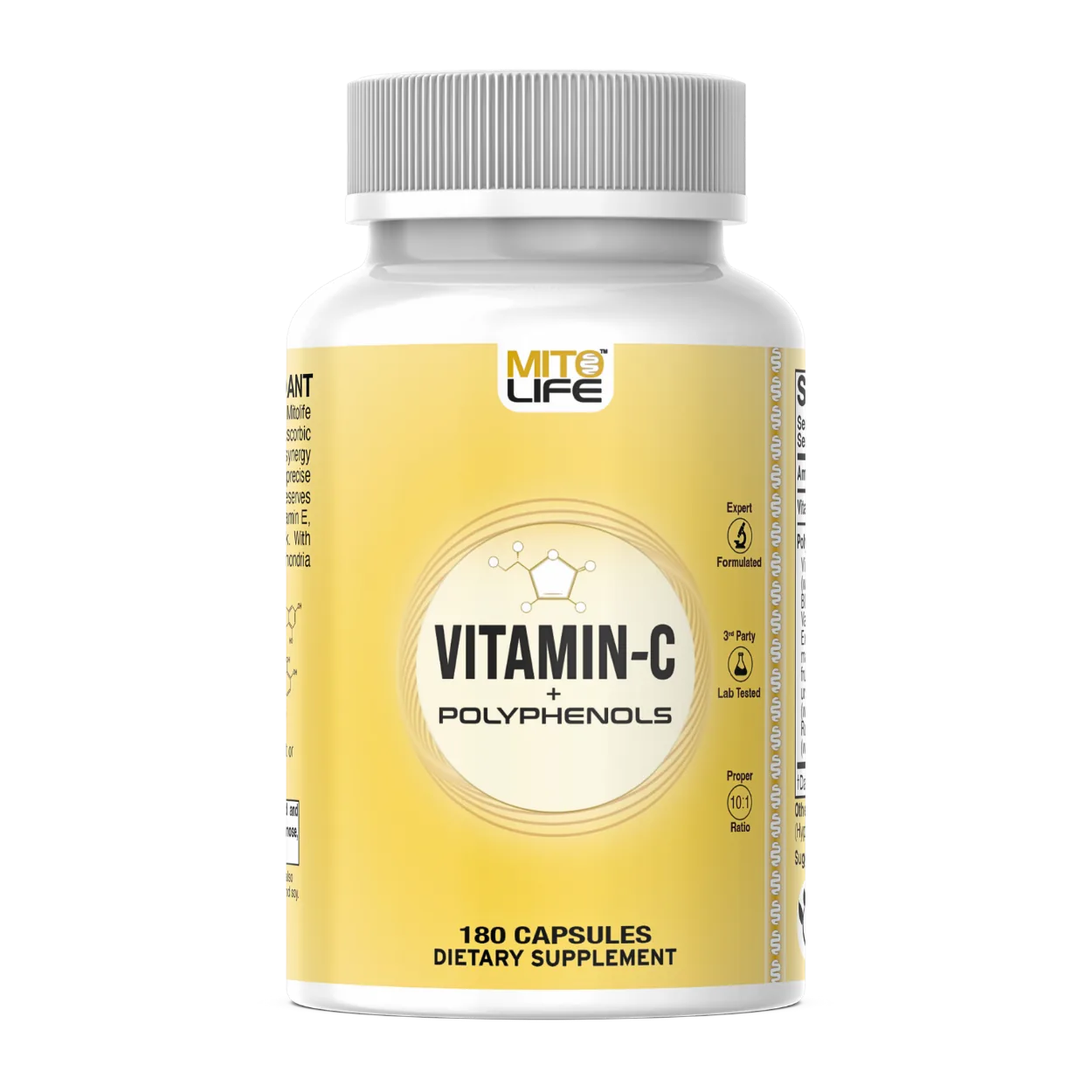
Vitamin C with Polyphenols

Vitamin C the way food delivers it -- with polyphenols.

Immune

MitoLifeCell
Vitamin C with Polyphenols

$30.00

Your discount applies with code HOLISTICLOVE.

When you buy through our links, we earn a small commission -- and that is what funds all the free education here. It never costs you more. Products are not intended to diagnose, treat, cure, or prevent any disease.

What it is

Vitamin C (ascorbic acid) delivered alongside plant polyphenols, closer to the way whole foods package it than an isolated ascorbic-acid tablet. Vitamin C is a water-soluble antioxidant and an essential cofactor the body cannot make, and the added polyphenols contribute their own antioxidant activity.

Why the evidence supports it

Vitamin C is one of the most thoroughly established nutrients there is, and its reach is unusually wide. The evidence firmly ties it to antioxidant defense, normal immune-cell function, and collagen synthesis -- and it is the classic cofactor for iron: it converts plant (non-heme) iron into the form the gut can actually absorb and helps move it into transport, which is why poor vitamin C status sits behind poor iron status, and why the two are paired for healthy iron levels. Beyond iron it is a cofactor across a long list of the body's enzyme reactions, from building connective tissue to making neurotransmitters. As a front-line electron donor it also buffers oxidative stress -- including the oxidative load that environmental stressors like EMF are studied to generate, an emerging but reasonable use for a water-soluble antioxidant the body cannot make itself. Pairing it with polyphenols mirrors how food delivers it. That is the cell's Maintain function in plain terms -- oxidative balance, immune work, iron handling, and connective-tissue upkeep -- kept to everyday-adequacy doses, not the mega-dose or IV-style claims, which are a different conversation.

What it supports

  • Supports the body's normal antioxidant defenses
  • Supports normal everyday immune function
  • Helps the body absorb iron from plant foods
  • Provides vitamin C alongside food-like polyphenols

Which function it supports

CellMaintain
antioxidant defenseimmune-cell signaling

Ties to the cell's Maintain function -- vitamin C and polyphenols help buffer oxidative stress and support the immune cells' everyday work.

Learn the why behind this pillar

How it relates to your cells and mind

Every product here ties back to a specific job your body does. This one touches the functions below -- follow either link to see the mechanism in full, then dig into the studies.

What it is made of -- and the mechanisms behind it

Each ingredient acts on several of the body's functions. Taken together, this product touches these cell and mind functions -- follow any to see the mechanism in full.

The ingredients

Mechanisms drawn from our ingredient knowledge base (2 profiled ingredients). Structure and function only -- not a treatment claim.

What’s actually in it

Label revision label image on the product page, read 2026-09-11

Transcribed from the manufacturer’s official Product Information Page, exactly as printed. Ingredient names that link open our research page for that ingredient, with the studies behind it.

Supplement Facts panel for Vitamin-C with Polyphenols
Amount per 2 capsulesAmount% DV
Vitamin CAscorbic Acid800 mg890%
Polyphenol-CVinCare whole grape extract (Vitis vinifera), blueberry (Vaccinium uliginosum), cranberry (Vaccinium macrocarpon), blackberry (Rubus laciniatus, armeniacus, ursinus & fruticosus), raspberry (Rubus idaeus and/or stringosus), strawberry (Fragaria virginiana)80 mg
Servings per container:
90
Other ingredients:
Vegetarian capsules (hypromellose and water), bamboo extract.

Source: official Product Information Page . Amounts are the manufacturer’s, not ours. Structure and function only -- nothing here is medical advice, and nothing here may be used to diagnose, treat, cure, or prevent any disease.

The science on the ingredients

These studies are research on the ingredients and mechanisms in this product, not on the finished product itself, and they are shown for education. Nothing here is medical advice, and nothing here may be used to diagnose, treat, cure, or prevent any disease. Talk to your own provider about what is right for you.

Powered by CellWell.life
  • Ascorbic acid as an adjunct therapy for anemia in erythropoietin-treated hemodialysis patients: a systematic review and meta-analysisEmergingMeta-analysis2026

    A meta-analysis of 14 trials in hemodialysis patients found vitamin C supplementation modestly raised hemoglobin and iron saturation while reducing required erythropoietin dose, though evidence certainty was rated low.

    Salma Alejandra Beltrán Covarrubias; Angelo Magallanes Bajana; Alejandro Chen Liang; Yeison Cruz Castillo; Montserrat Villa Sánchez; España De la Rosa Valdez; Michelle Sámano Sánchez; Shreya Shambhavi; Vaidarshi Abbagoni; Oscar Yasser Pena Zapata; Camila Sanchez Cruz; José Antonio García-Erce; Ernesto Calderón-Martínez

  • Mn defect enhanced oxidase-mimicking activity of MnO2 for colorimetric detection of total antioxidant capacityEmerging2026

    Introducing manganese vacancies into MnO2 lowered the work function from 5.11 to 4.30 eV and raised substrate affinity 5-fold, detecting ascorbic acid at 0.13 micromolar in vitamin C tablets, beverages and juices.

    Sui C; Wang L; Zheng F; Li F; Li W; Qin C; Fang Y; Yin H -- Analytica chimica acta

  • The role and therapeutic potential of vitamins in fracture healing.2026

    Review describes vitamin C as a cofactor for collagen crosslinking that promotes osteoblast differentiation and mitigates oxidative blockade of callus formation, while vitamin A, E, K, and B vitamins support distinct phases of fracture repair through osteoimmune and metabolic pathways.

    Yu Q; Yu G; Dong H; Wang C; Guan M; Shi B; Li Z -- Nutrition journal

  • Electronic reconfiguration enhanced oxidase-mimicking activity of Cu-Mn3O4 for colorimetric detection of total antioxidant capacityEmerging2026

    A copper-doped Mn3O4 nanozyme showed 4.5-fold higher substrate affinity than pristine Mn3O4 and detected ascorbic acid down to 0.009 micromolar, measuring total antioxidant capacity in beverages and fruit juices.

    Li X; Chen Z; Sui C; Wang L; Zheng F; Li F; Yang X; Jiao Y; Jiang D -- Analytica chimica acta

  • Ascorbic and salicylic acid regulate antioxidant defense and drought stress responses in maize.2026

    Foliar ascorbic and salicylic acid application induced drought stress tolerance in maize, with combined treatment addressing declines in shoot length, leaf area, and photosynthetic pigments caused by water scarcity.

    Abdul Khaliq A; Naeem MS; Din KU; Ahmad M; Zulfiqar U; Sarker MO; Ashraf U; Ali S; El-Shaboury GA; Alasmari A; Shah MA -- Plant signaling & behavior

  • Optimization of the in vitro Model of Cardiac FibrosisEmerging2026

    In neonatal rat cardiac fibroblasts, 72 hours of 500 nM angiotensin II with 100 microM ascorbic acid raised collagen, alpha-smooth muscle actin and vimentin, while dextran sulfate alone did not increase collagen deposition.

    Zeinab Neshati; Zahra Esmaeili; Farrokh Arzi

  • Multi-omics of oxidative stress and particulate matter exposure: a systematic review.2026

    A systematic review found that particulate matter exposure is linked to oxidative-stress-related changes across multiple omics layers in adult human studies, mechanisms associated with respiratory, cardiovascular, and metabolic disease risk.

    Fallahzadeh A; Mahmoodi T; Kwon S; Liu M; Nolan A -- Respiratory research

  • Ascorbic Acid Modulates Collagen Properties in Glucocorticoid-Induced Osteoporotic Bone: Insights into Chemical, Mechanical, and Biological RegulationEmerging2026

    In osteoblast and endothelial models of glucocorticoid-induced osteoporosis, glucocorticoids impaired ascorbic acid metabolism and collagen synthesis, while adding ascorbic acid restored collagen production and improved endothelial barrier function.

    Micaila DE Curtis; Yoontae Kim; Rahul Patil; Xinran Zhang; Meth Jayatilake; Orelle Bulgin; Peter Lialios; Sana Surrency; Soraya Tarrah; Argyris K Lazaris; Alison Grafton; James Williams; Seyedeh Boshra Nouraie; Maria Bizaki; Penelope Xeron; Edward Van Keuren; Jonathan E Seppala; Evagelia C Laiakis; Joanna B Kitlinska; Stella Alimperti

  • Plasma membrane mediated GLUT10 mitochondrial targeting regulates intracellular ascorbic acid homeostasis.2026

    Oxidative stress triggers GLUT10 transporter relocation from the endoplasmic reticulum to the plasma membrane and mitochondria, enhancing dehydroascorbic acid uptake to sustain intracellular ascorbic acid levels needed for connective tissue homeostasis.

    Chirackal Jose A; Syu YW; Lai HW; Tsai MY; Jiang YF; Hsu SC; Lin PY; Huang WC; Chu WC; Fu CY; Lee YC -- iScience

  • Gold Nanoparticle Complexes with PAMAM Dendrimers for In Vitro Cancer Cytotoxicity Assessment: Synthesis via Ascorbic Acid ReductionEmerging2026

    This materials-science study used ascorbic acid to chemically reduce gold ions into nanoparticles tested against human breast and bone cancer cell lines, finding particle size, not the reducing agent used, mainly determined how toxic the particles were to cells.

    Kołodziejczyk AM; Karwowski BT; Grala M -- Molecules (Basel, Switzerland)

  • Coordinated N metabolism and NO signaling underlie allantoin-citrulline synergy in salt-stressed cucumber.2026

    In salt-stressed cucumber, foliar allantoin improved nitrogen metabolism and potassium-to-sodium balance while citrulline boosted nitric oxide signaling; combining both produced the largest gains in growth, photosynthesis, and yield.

    Amerian M; Gohari G; Panahirad S; Ntatsi G -- BMC plant biology

  • Dual-mechanism vitamin C delivery by polyethylene glycol-23 glyceryl distearate-based niosomes via SVCT2 induction and enhanced transdermal penetrationEmerging2026

    In normal human keratinocytes, the surfactant GDS-23 upregulated xCT and SVCT2 messenger RNA via Nrf2, and its niosomes carrying ascorbic acid attenuated hydroquinone-induced damage in a reconstructed epidermis model.

    Tatsuro Miyoshi; Brian C Keller; Sui Nakagawa; Takashi Ashino; Asuka Kaizaki-Mitsumoto; Satoshi Numazawa

  • Nutritional immunology in lifespan.2026

    A review proposed that early-life vitamin C intake, along with vitamin E and D, may support immune function and reduce oxidative-stress-related aging through antioxidant defense and cellular signaling pathways.

    Fallah M; Naeini F; Fahimzad FS; Nouri A; Manesh SMR; Haghighi A; Ebrahimpour-Koujan S -- Experimental gerontology

  • Electrochemical Gating of d-Band Engineering in Hierarchically Bridged Dual-Site Nanozymes for Synergistic Cascade Catalysis and Wearable BiosensingEmerging2026

    A copper nanocluster and iron polymer dual-site nanozyme with electrochemical d-band gating showed improved Michaelis-Menten kinetics and enabled dual-mode colorimetric and electrochemical monitoring of ascorbic acid in human sweat.

    Chai H; Sun X; Tan X; Yuan Z; Guan J; Zhang X; Xie J; Zhang G -- Analytical chemistry

  • Targeting oxidative stress pathways in epilepsy: mechanistic insights into the role of ascorbic acid.2026

    Review describes ascorbic acid crossing the blood-brain barrier to reduce ROS accumulation and modulate Nrf2, NF-kB, and MAPK signaling implicated in seizure-related oxidative stress and antiseizure medication toxicity.

    Desai M; Malik S; Singh A; Kukreti R; Kukreti S; Grewal GK -- Molecular biology reports

  • LC-MS/MS profiling and cytotoxic and antioxidant evaluation of sandarac gum resin extractsEmerging2026

    Methanolic sandarac resin extract contained caffeic acid at 1,222 mg/kg but showed very limited antioxidant activity (4.32% DPPH scavenging at 25 microgram/mL versus 67.28% for ascorbic acid) and dose-dependent Artemia salina lethality.

    Çelik TA -- Natural product research

  • A Thorough Analysis of Ascorbic Acid's Therapeutic Benefits and Potential Toxicological Effects.2026

    Ascorbic acid acts as a principal antioxidant, supports collagen formation and enzyme cofactor activity, and reduces reactive oxygen species and inflammation, with effects and safety varying by dose.

    Tiwari A; Mandal S; Samal PK -- Journal of biochemical and molecular toxicology

  • Redox-driven speciation and colloid formation contribute the in vivo chemistry and organ deposition of Astatine-211Emerging2026

    Free astatine-211 accumulated in stomach, lungs, liver and spleen unlike iodine-131, as At- rapidly oxidised, hydrolysed and formed colloids, and co-administered ascorbic acid partially suppressed the abnormal organ uptake.

    Xiaoxu Dong; Jiaojiao Li; Mumei Chen; Kaiqi Zhang; Xiaozheng Zhang; Fengling Shan; Shuai Xue; Xiao Li; Lan Zhang; Huawei Cai; Jiajun Liu; Qingnuan Li

  • Salivary and GCF Vitamin C Levels: Implications for Local and Systemic Periodontal Defense.2025

    In a study of 43 people, salivary vitamin C levels were significantly higher in periodontally healthy individuals and progressively decreased with worsening periodontitis severity, suggesting salivary vitamin C could serve as a biomarker for disease progression.

    Hashim NT; Rahman MM; Islam MS; Padmanabhan V; Chaitanya NCSK; Mohammed R; Shivappa P; Farghal NS; Nayef HK; Talib MS; Fathima S; Hisham NM; Chaik A -- International journal of dentistry

  • In Vitro Assessment of Stimulation of Collagen Biosynthesis via Collagenprash and Collagen BuilderEmerging2026

    In cell assays, two collagen-blend formulations containing ascorbic acid and botanical extracts increased expression of prolyl 4-hydroxylase and lysyl hydroxylase, enzymes required for collagen triple helix stabilisation and cross-linking.

    Bharat R; Kumar A; Kumar G; Pv S; Bhadauria S; Bhende N; Gupta R -- Journal of agricultural and food chemistry

  • Harnessing Vitamin C: Unveiling Its Potential in Cancer Prevention and Treatment.2025

    A review describes how high-dose vitamin C can act as a pro-oxidant that selectively generates hydrogen peroxide in the tumor microenvironment while modulating angiogenesis, inflammation, and immune response, though it remains an investigational adjunct rather than standard cancer therapy.

    Roy A; Maiti DK; Banik BK -- Current medicinal chemistry

  • Exogenous ascorbic acid enhances drought tolerance in Hypericum perforatum L. by modulating antioxidant defense and osmotic adjustmentEmerging2026

    In St John's wort under deficit irrigation, foliar ascorbic acid at 400 mg/L increased ascorbate peroxidase, catalase and superoxide dismutase activity and reduced malondialdehyde and electrolyte leakage.

    Fatemeh Asadi; Nematollah Etemadi; Rahim Amirikhah; Mohammad Reza Mosaddeghi; Hamed Aalipour

  • Antioxidant and membrane-protective effects of the 3-O-ethyl ascorbic acid-cannabigerol system on UVB-irradiated human keratinocytes.2025

    Combining ethyl ascorbic acid with cannabigerol protected UVB-irradiated skin keratinocytes by preserving membrane structure, maintaining redox balance, and modulating NFkB-related inflammatory signaling proteins in cell culture.

    Jarocka-Karpowicz I; Stasiewicz A; Olchowik-Grabarek E; Sękowski S; Kacprowska A; Skrzydlewska E -- Free radical biology & medicine

  • TRP-Dependent Calcium Regulation in HCEC-12 Cells: Involvement of Ascorbic Acid and Cannabinoid Receptor SignalingEmergingPrimary research (design unspecified)2026

    In humans, Cannabinoid CB1 agonists and TRP channel activity interact additively to regulate calcium dynamics in corneal endothelial cells.

    Louay Homsi; Anisha Atul Bhamare; Uwe Pleyer; Stefan Mergler

Balanced by design -- we show supporting and contradicting findings. Search all studies

If you have had labs done

These are lab markers where this product's ingredients have measured evidence in our citation library. This is not a claim that the product will change your results -- the research attaches to the ingredient, and what a marker means depends on the whole picture. Each one links to its full entry, including what typically moves it and how to read it.

  • via Polyphenols (general) · 81 studies, 19 in people

    Largely unabsorbed in the small intestine and metabolised by colonic bacteria -- which is why polyphenol supplementation shows up in microbiota-composition studies at all.

    What people often notice when this marker sits outside the usual range

    Higher: Generally favourable, and not a target to maximise for its own sake.

    Lower: Bloating, irregular bowel habit, and food tolerance that narrows over time.

  • via Polyphenols (general) · 81 studies, 19 in people

    What people often notice when this marker sits outside the usual range

    Higher: Very high fecal SCFAs may reflect malabsorption or rapid transit rather than a thriving microbiome.

    Lower: Constipation or sluggish transit.

  • Zonulin (serum and fecal)emerging evidence

    via Polyphenols (general) · 13 studies, 4 in people

    What people often notice when this marker sits outside the usual range

    Higher: Bloating and abdominal discomfort that does not track neatly with any one food.

    Lower: No symptoms; an intact barrier is the desired state.

Lab results are interpreted by a qualified clinician who knows your history. Nothing here diagnoses anything or replaces that conversation.

No product works in isolation

Every cell function above -- Sense, Exchange, Transform, Build, Maintain, Adapt -- needs the same broad base of optimal micronutrient levels running underneath it, all the time. Vitamin C with Polyphenols is not a stand-alone fix; it is one piece that plugs into that larger system. The foundation comes first, and this supports it.

Stacks well with

Pick your goal -- here is what Vitamin C with Polyphenols pairs with for each. Nothing works in isolation; these share the same systems.

Foundational, or targeted?

Not everything in the shop is meant to be taken forever. Some products here are foundational -- a daily nutrient base built for long-term, ongoing use. Others are targeted -- shorter-term support for a specific season, not a lifelong habit. If you are not sure which one this is, that is a fair question to ask us before you buy.

Learn more, on your terms

Do not take our word for it -- go read. Each topic below opens a pre-loaded search so you can explore the nutrient, the mechanism, or the device for yourself.

Search the full studies library

How to use it

Take with water, with or without food, once daily. Splitting the dose across the day can be gentler on the stomach if you take a larger amount. Follow the label.

Use code HOLISTICLOVE at checkout.

Where to get it

Ready when you are. This link takes you to the official, verified source for this product.

Get Vitamin C with Polyphenols

Optimal nutrients are the definition of longevity

Long-term cell function depends on having what it needs, at the level it needs it, for as long as it needs it. That is the whole thesis behind everything we point you to here.

When you buy through our links, we earn a small commission -- and that is what funds all the free education here. It never costs you more. Products are not intended to diagnose, treat, cure, or prevent any disease.

Vitamin C with Polyphenols pairs vitamin C with plant polyphenols, the way whole foods tend to package it, rather than ascorbic acid on its own. It supports antioxidant defense and the normal, everyday work of the immune system. It fits people who want vitamin C closer to how food delivers it.

FAQ

What does Vitamin C with Polyphenols support?

It supports the body's normal antioxidant defenses and normal everyday immune function, helps the body absorb iron from plant foods, and provides vitamin C alongside food-like polyphenols.

How do I take it?

Take with water, with or without food, once daily. Splitting the dose across the day can be gentler on the stomach if you take a larger amount. Follow the label.

What makes it different?

Delivering vitamin C alongside polyphenols is closer to how you would get it from real food. It stays grounded at everyday doses rather than reaching for mega-dose or IV-style claims.