$75.00
Your discount applies with code HOLISTICLOVE.
When you buy through our links, we earn a small commission -- and that is what funds all the free education here. It never costs you more. Products are not intended to diagnose, treat, cure, or prevent any disease.
What it is
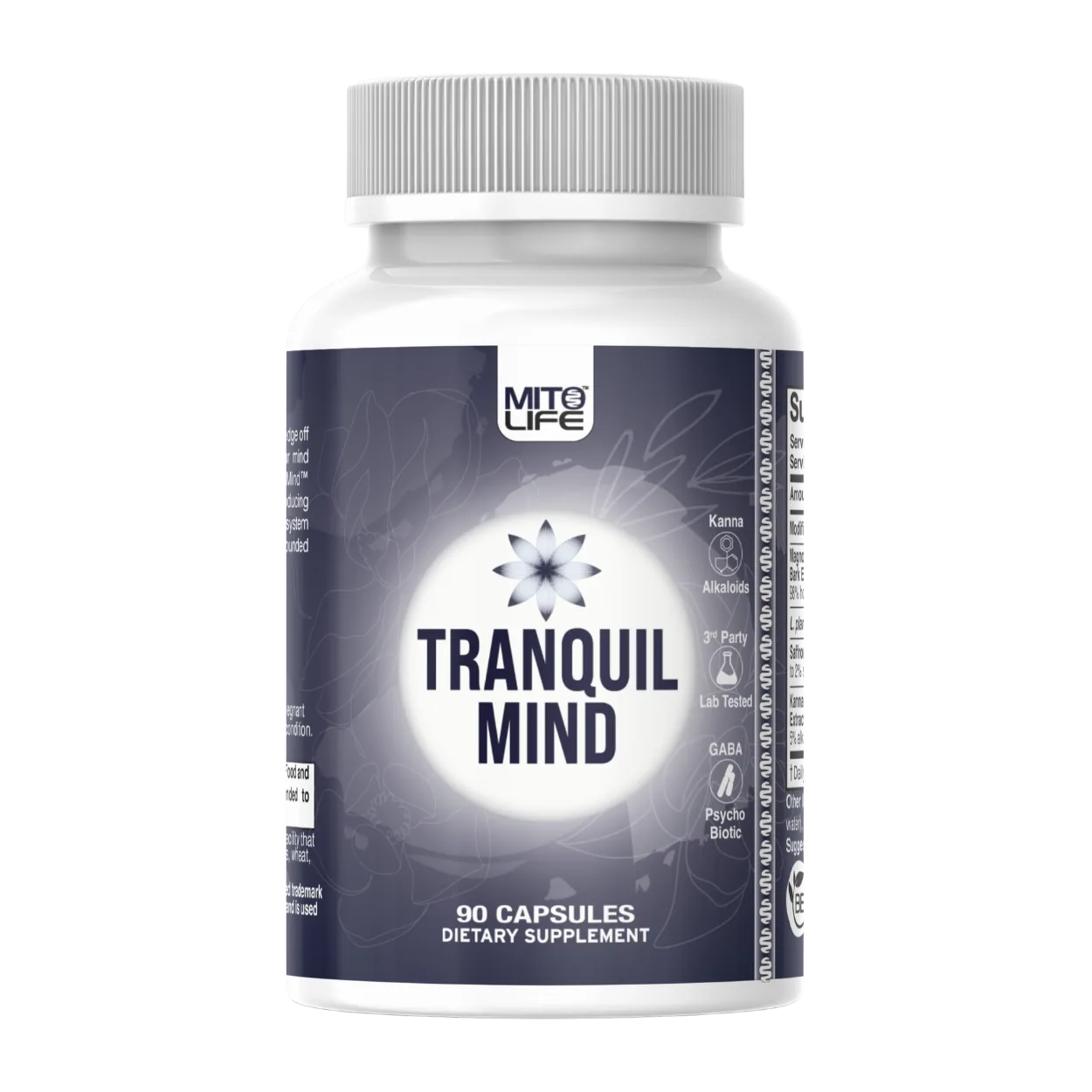
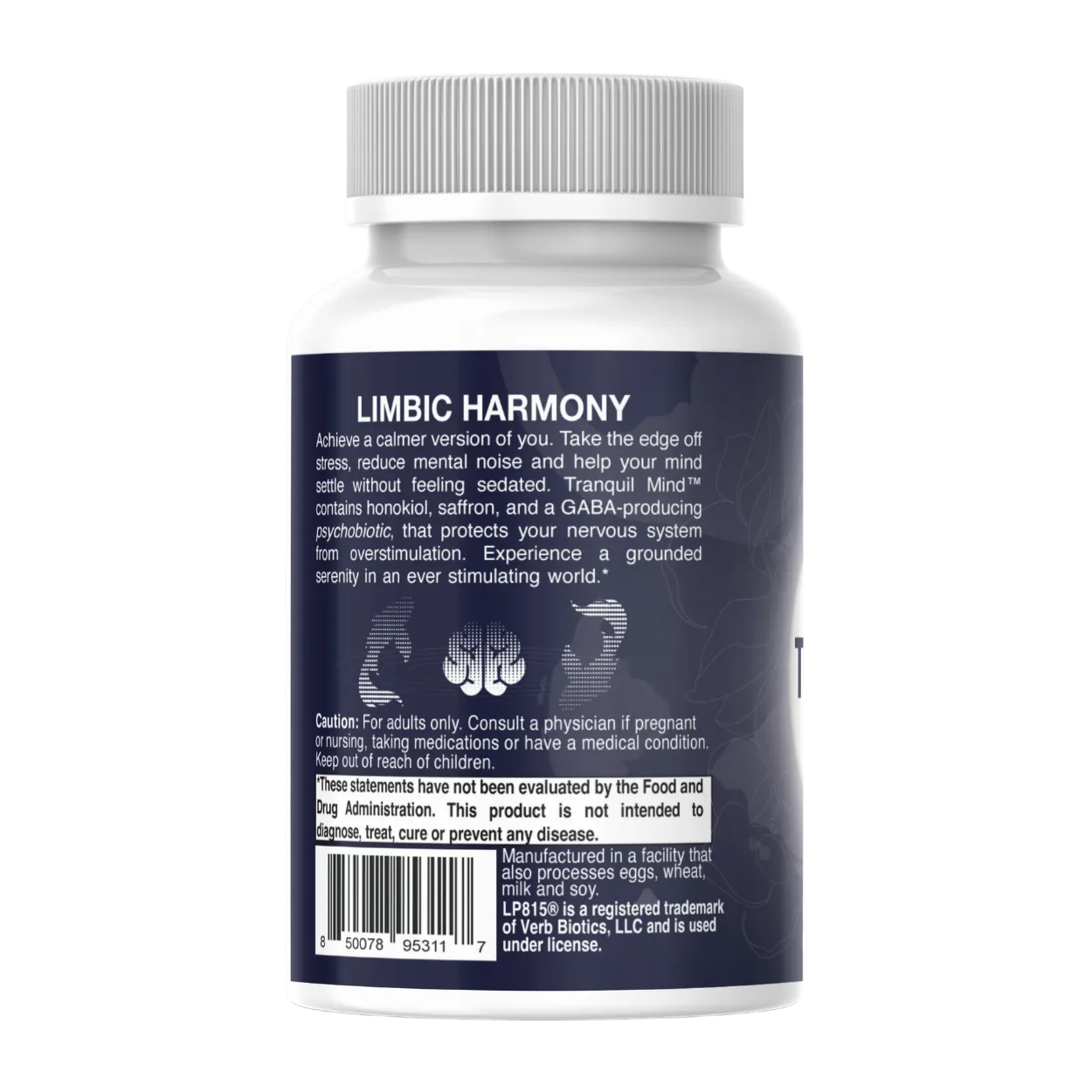
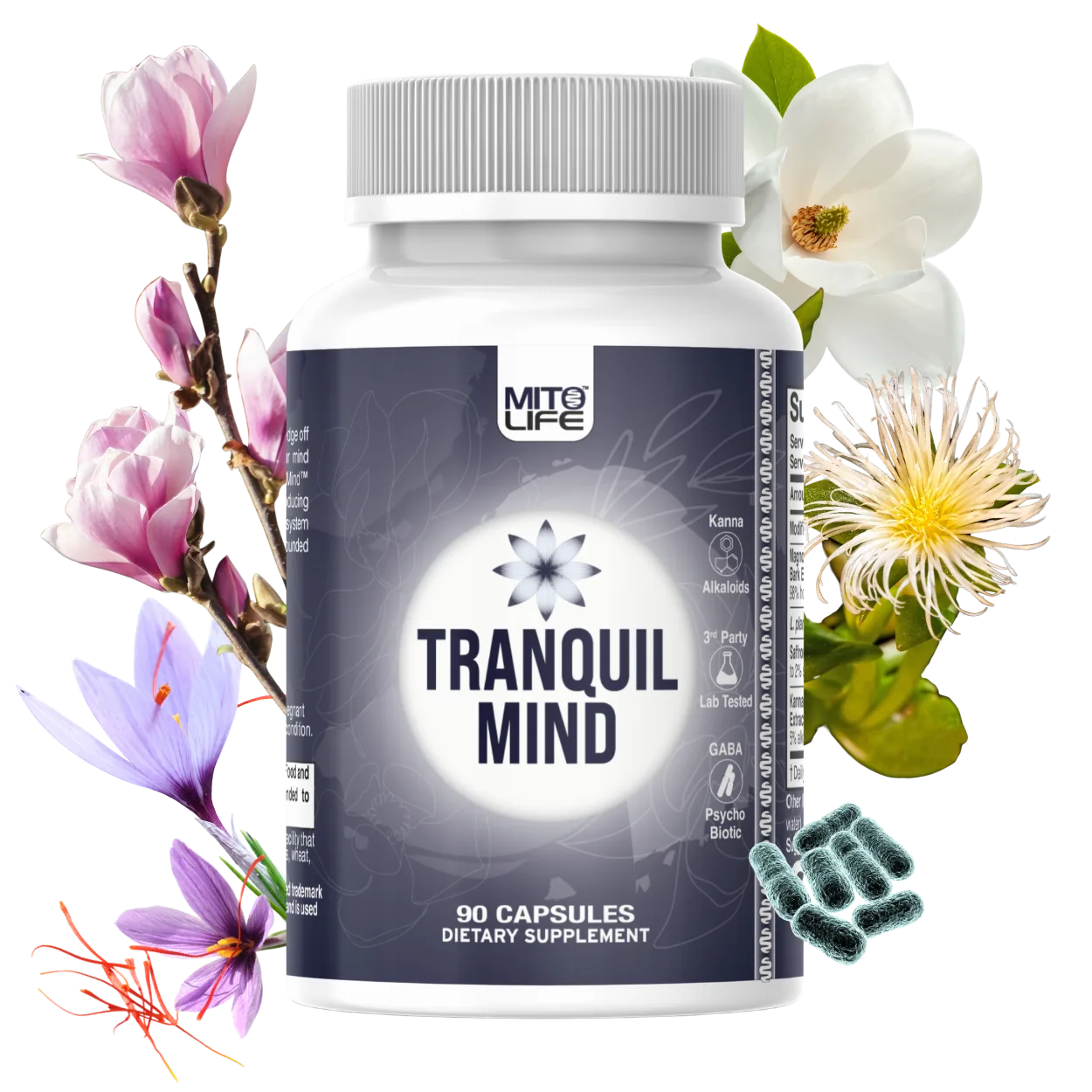
A calm-support blend of saffron (Crocus sativus), honokiol from magnolia bark, and a GABA-producing probiotic strain. Saffron and its carotenoids act on mood pathways, honokiol interacts with the GABA system for calm, and the probiotic reflects the newer gut-brain angle on GABA. It is built to take the edge off overstimulation while keeping you clear-headed rather than sedated.
Why the evidence supports it
Saffron is the strongest card in this blend -- systematic reviews of randomized trials find it shows real promise for mood and calm, which is more than most stress formulas can claim. Honokiol adds a mechanism-plausible calming action on the GABA system, though much of its data is still pre-clinical, and the GABA-producing probiotic reflects a newer gut-brain idea held more loosely. Together they serve the Mind world's Regulate function -- nudging the nervous system toward a settled state. Framed as everyday calm support, not a treatment for anxiety.
What it supports
- Supports a calm, settled nervous system
- Supports steady mood during busy, overstimulating days
- Aims for calm without heavy sedation
- Combines saffron, honokiol, and a calming probiotic strain
Which function it supports
Ties to the Mind world's Regulate function -- supporting the nervous system's shift toward a calmer, more settled state.
Learn the why behind this pillarHow it relates to your cells and mind
Every product here ties back to a specific job your body does. This one touches the functions below -- follow either link to see the mechanism in full, then dig into the studies.
What it is made of -- and the mechanisms behind it
Each ingredient acts on several of the body's functions. Taken together, this product touches these cell and mind functions -- follow any to see the mechanism in full.
The ingredients
Mechanisms drawn from our ingredient knowledge base (3 profiled ingredients). Structure and function only -- not a treatment claim.
What’s actually in it
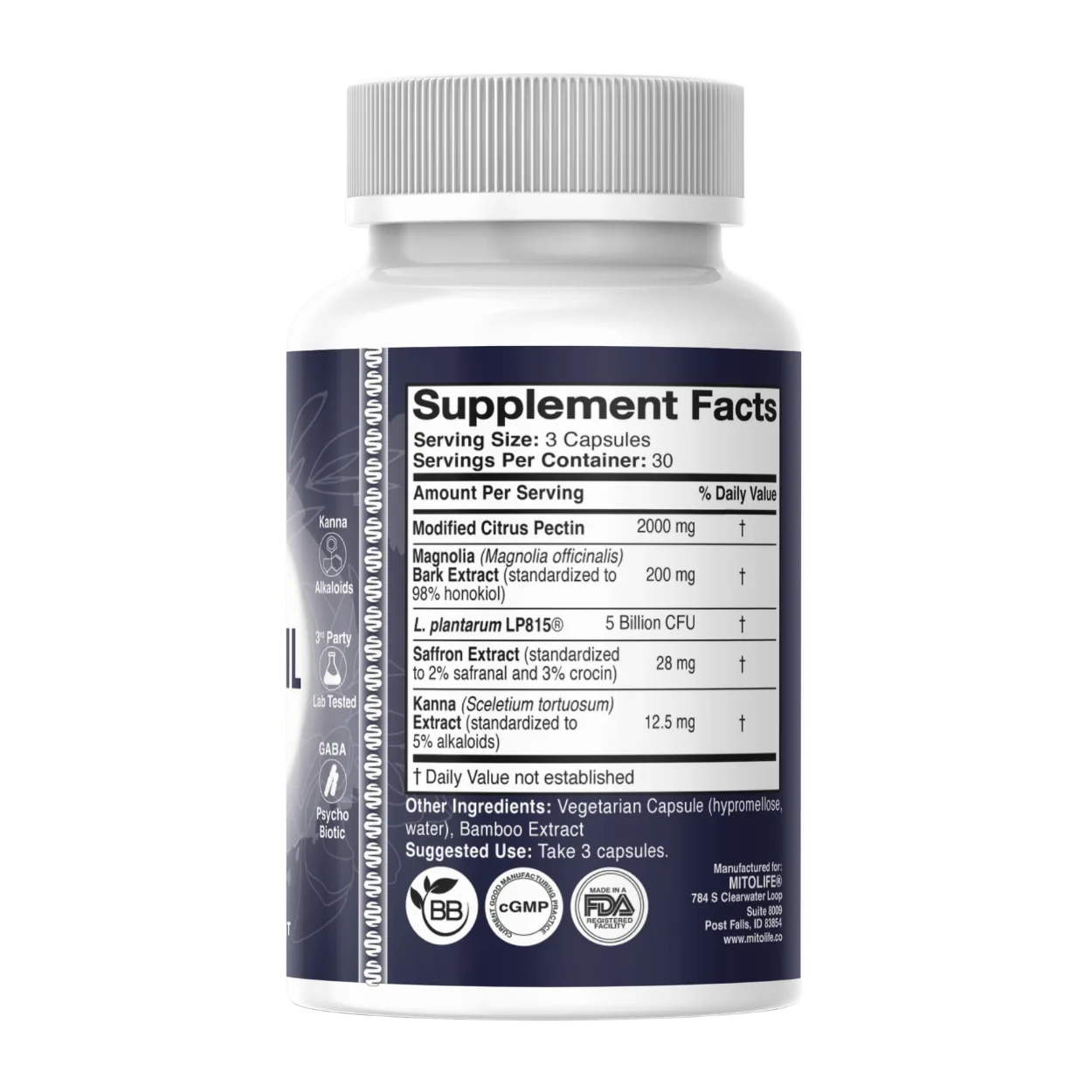
Label revision label image on the product page, read 2026-09-11Transcribed from the manufacturer’s official Product Information Page, exactly as printed. Ingredient names that link open our research page for that ingredient, with the studies behind it.
| Amount per 3 capsules | Amount | % DV |
|---|---|---|
| Modified Citrus Pectin | 2000 mg | † |
| Magnolia Bark ExtractMagnolia officinalis, standardized to 98% honokiol | 200 mg | † |
| L. plantarum LP815 | 5 Billion CFU | † |
| Saffron Extractstandardized to 2% safranal and 3% crocin | 28 mg | † |
| Kanna ExtractSceletium tortuosum, standardized to 5% alkaloids | 12.5 mg | † |
- Servings per container:
- 30
- Other ingredients:
- Vegetarian capsule (hypromellose, water), bamboo extract.
Source: official Product Information Page . Amounts are the manufacturer’s, not ours. Structure and function only -- nothing here is medical advice, and nothing here may be used to diagnose, treat, cure, or prevent any disease.
The science on the ingredients
If you have had labs done
These are lab markers where this product's ingredients have measured evidence in our citation library. This is not a claim that the product will change your results -- the research attaches to the ingredient, and what a marker means depends on the whole picture. Each one links to its full entry, including what typically moves it and how to read it.
via Saffron · 10 studies, 8 in people
What people often notice when this marker sits outside the usual range
Higher: The symptoms that actually travel with raised triglycerides belong to the metabolic pattern behind them -- the post-meal crash, central weight, rising blood pressure, fatty liver.
Lower: Very low total cholesterol alongside low albumin and unintended weight loss points at absorption or liver capacity, not at good health.
- Glucose (Fasting)solid evidence
via Saffron · 8 studies, 7 in people
What people often notice when this marker sits outside the usual range
Higher: Waking at 3am, often with a racing heart -- 'why do i wake up at 3am every night'.
Lower: Shakiness, sweating, sudden anxiety and difficulty concentrating that resolve within minutes of eating.
- Hemoglobin A1c (HbA1c)solid evidence
via Saffron · 7 studies, 6 in people
What people often notice when this marker sits outside the usual range
Higher: Everything listed under fasting glucose, but with more time behind it -- HbA1c is a three-month average, so symptoms are usually established rather than new.
- High-Sensitivity C-Reactive Protein (hs-CRP)solid evidence
via Saffron · 5 studies, 4 in people
Systematic review and meta-analysis on inflammation and oxidative stress specifically -- reduced inflammatory markers.
What people often notice when this marker sits outside the usual range
Higher: Deep, unrefreshing fatigue -- searched as 'tired all the time blood tests normal' and 'why am i tired even after 8 hours sleep'.
Lower: No symptoms. Low is the desirable direction.
- Fasting Glucoseemerging evidence
via Saffron · 8 studies, 7 in people
What people often notice when this marker sits outside the usual range
Higher: A high fasting glucose is often silent early -- the classic high-sugar symptoms (excess thirst, frequent urination, fatigue, blurred vision) tend to appear later and higher.
Lower: A genuinely low glucose (hypoglycaemia) can cause shakiness, sweating, irritability, hunger and lightheadedness -- but a low-normal fasting value in a healthy person is usually favourable.
- HbA1c (Hemoglobin A1c)emerging evidence
via Saffron · 7 studies, 6 in people
What people often notice when this marker sits outside the usual range
Higher: A high HbA1c reflects the same chronic high-glucose state -- silent early, then thirst, frequent urination and fatigue at higher levels.
Lower: A low HbA1c is generally favourable, but an unexpectedly low value can reflect a red-cell condition rather than excellent control -- cross-check against fasting glucose if it surprises you.
- HbA1c (Glycated Hemoglobin)emerging evidence
via Saffron · 7 studies, 6 in people
What people often notice when this marker sits outside the usual range
Higher: A high HbA1c reflects the same chronic high-glucose state as glucose, averaged over roughly three months -- silent early, then thirst, frequent urination and fatigue at higher levels.
Lower: A low HbA1c is generally favourable, but an unexpectedly low value can reflect a red-cell condition rather than excellent control -- cross-check against fasting glucose if it surprises you.
- hs-CRP (High-Sensitivity C-Reactive Protein)emerging evidence
via Saffron · 5 studies, 4 in people
What people often notice when this marker sits outside the usual range
Higher: A high hs-CRP reflects low-grade inflammation SOMEWHERE -- you tend to feel the underlying cause (a cold, a flare, a sore joint, poor sleep, extra weight) rather than the CRP itself.
Lower: A low hs-CRP is favourable and simply reflects little systemic inflammation at the moment of the draw.
- hs-CRP (High-Sensitivity C-Reactive Protein)emerging evidence
via Saffron · 5 studies, 4 in people
What people often notice when this marker sits outside the usual range
Higher: hs-CRP is non-specific -- read it as a trend and in context, never as a stand-alone verdict.
Lower: A low hs-CRP is favourable and simply reflects little systemic inflammation at the moment of the draw.
- Cortisolemerging evidence
via GABA (+ psychobiotic) · 11 studies, 3 in people
What people often notice when this marker sits outside the usual range
Higher: "Wired but tired" -- exhausted all day, then alert the moment the head hits the pillow.
Lower: Profound fatigue that is worst in the morning, and improves slightly through the day -- the reverse of the usual pattern.
- HDL Cholesterolemerging evidence
via Saffron · 3 studies, 3 in people
What people often notice when this marker sits outside the usual range
Higher: Silent, and NOT automatically good news.
Lower: Silent. HDL produces no sensation at any level.
Lab results are interpreted by a qualified clinician who knows your history. Nothing here diagnoses anything or replaces that conversation.
No product works in isolation
Every cell function above -- Sense, Exchange, Transform, Build, Maintain, Adapt -- needs the same broad base of optimal micronutrient levels running underneath it, all the time. Tranquil Mind is not a stand-alone fix; it is one piece that plugs into that larger system. The foundation comes first, and this supports it.
Stacks well with
Pick your goal -- here is what Tranquil Mind pairs with for each. Nothing works in isolation; these share the same systems.
For Brain & Sleep
For Mood & Hormones
For Women's Health
For Gut Health
Foundational, or targeted?
Not everything in the shop is meant to be taken forever. Some products here are foundational -- a daily nutrient base built for long-term, ongoing use. Others are targeted -- shorter-term support for a specific season, not a lifelong habit. If you are not sure which one this is, that is a fair question to ask us before you buy.
Learn more, on your terms
Do not take our word for it -- go read. Each topic below opens a pre-loaded search so you can explore the nutrient, the mechanism, or the device for yourself.
Search the full studies libraryHow to use it
Take with water, either during a demanding stretch of the day or in the evening to wind down, depending on how it sits with you. Follow the brand's serving size.
Use code HOLISTICLOVE at checkout.
Where to get it
Ready when you are. This link takes you to the official, verified source for this product.
Get Tranquil MindThe studies
See the research behind the science we point to.
Explore studiesThe blog
Plain-language reads on how it all fits together.
Read the blogOptimal nutrients are the definition of longevity
Long-term cell function depends on having what it needs, at the level it needs it, for as long as it needs it. That is the whole thesis behind everything we point you to here.
When you buy through our links, we earn a small commission -- and that is what funds all the free education here. It never costs you more. Products are not intended to diagnose, treat, cure, or prevent any disease.
Tranquil Mind is a calm-support blend of honokiol (from magnolia bark), saffron, and a GABA-producing probiotic strain. It is built to help take the edge off overstimulation while keeping you clear-headed rather than sedated. It fits people who want to feel settled without the fog.
FAQ
What does Tranquil Mind support?
It supports a calm, settled nervous system and steady mood during busy, overstimulating days, aims for calm without heavy sedation, and combines saffron, honokiol, and a calming probiotic strain.
How do I take it?
Take with water, either during a demanding stretch of the day or in the evening to wind down, depending on how it sits with you. Follow the brand's serving size.
What makes it different?
Saffron and magnolia bark both have real, if modest, human calm-and-mood research behind them. It is framed as everyday nervous-system support for feeling settled, not a treatment for anxiety.