
$22.00
$26.00 save $4.00 -- applied automatically through this link
When you buy through our links, we earn a small commission -- and that is what funds all the free education here. It never costs you more. Products are not intended to diagnose, treat, cure, or prevent any disease.
What it is
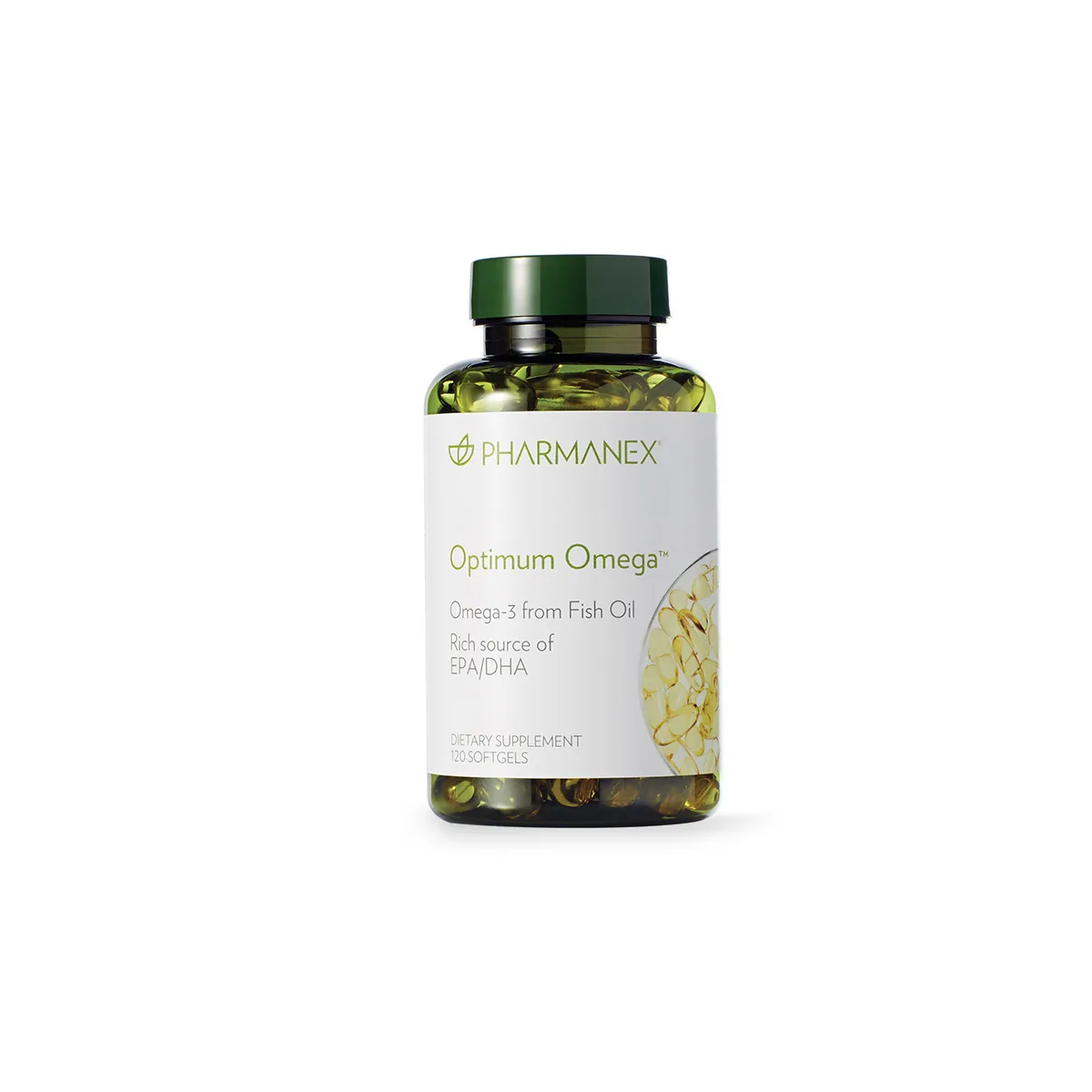
A marine-sourced omega-3 softgel delivering EPA and DHA from ultra-pure fish oil, with added vitamin E to keep the oil fresh. The fish oil is screened under Pharmanex's quality process to be free of harmful levels of toxins, contaminants, and heavy metals. EPA and DHA are the fatty acids built directly into your cell membranes, where cells sense their surroundings and pass signals.
Why the evidence supports it
Omega-3 status is one of the most consistently studied nutrition markers there is, and most modern diets run measurably low on EPA and DHA. Because these are the fats built directly into every cell membrane, their reach is genuinely system-wide: the research ties adequate EPA and DHA to a healthy inflammation response and to normal heart, brain, and mood function, and -- less talked about -- to the gut lining and to the hormone-carrying membranes of both men and women, since all of those tissues run on the same membrane chemistry. The one hard requirement is freshness: these fats oxidize easily, which is why the added vitamin E, an antioxidant partner that protects the oil, and the toxin screening are mechanism, not marketing. A tested, protected marine oil is the evidence-based way to support the cell's Build function at the membrane -- with the honest note that omega-3's clearest, best-established signal is the inflammation and membrane story, while the hormone and gut links are real but supporting rather than headline.
What it supports
- Supports healthy cell membrane structure
- Supports a healthy inflammation response already within normal range
- Supports normal heart and brain function as part of a balanced diet
- Provides EPA and DHA that diets often lack
Which function it supports
Ties to the cell's Build function via the cell membrane -- EPA and DHA become part of the membrane itself, where signaling and exchange play out.
Learn the why behind this pillarHow it relates to your cells and mind
Every product here ties back to a specific job your body does. This one touches the functions below -- follow either link to see the mechanism in full, then dig into the studies.
What it is made of -- and the mechanisms behind it
Each ingredient acts on several of the body's functions. Taken together, this product touches these cell and mind functions -- follow any to see the mechanism in full.
The ingredients
Mechanisms drawn from our ingredient knowledge base (3 profiled ingredients). Structure and function only -- not a treatment claim.
What’s actually in it
Transcribed from the manufacturer’s official Product Information Page, exactly as printed. Ingredient names that link open our research page for that ingredient, with the studies behind it.
| Amount per 2 softgels | Amount | % DV |
|---|---|---|
| Total Calories | 25 | |
| Total Fat | 2.5 g | 3% |
| Saturated Fat | 0.5 g | 2% |
| Cholesterol | 10 mg | 3% |
| Marine Lipid ConcentrateEPA 300 mg; DHA 200 mg; Other Omega-3 Fatty Acids 100 mg | 2,200 mg | ** |
| Deodorized Garlic Oil | 2 mg | ** |
- Servings per container:
- 30
- Other ingredients:
- Gelatin, Glycerine, Purified Water, D-Alpha Tocopherol (as antioxidant).
- Allergens:
- Contains fish (anchovies, mackerel)
Label's own distinction from MarineOmega: MarineOmega adds krill oil and has double the fish oil softgels per bottle.
Source: official Product Information Page . Amounts are the manufacturer’s, not ours. Structure and function only -- nothing here is medical advice, and nothing here may be used to diagnose, treat, cure, or prevent any disease.
The science on the ingredients
These studies are research on the ingredients and mechanisms in this product, not on the finished product itself, and they are shown for education. Nothing here is medical advice, and nothing here may be used to diagnose, treat, cure, or prevent any disease. Talk to your own provider about what is right for you.
- Fish consumption, fish oil, omega-3 fatty acids, and cardiovascular disease (AHA Scientific Statement)
Circulation · 2002
- Plasma lipids and lipoproteins in Greenlandic west coast Eskimos
Acta Med Scand · 1971
- Marine n-3 Fatty Acids and Prevention of Cardiovascular Disease and Cancer
New England Journal of Medicine (VITAL) · 2018
- Omega-3 supplementation and cardiovascular disease, meta-analysis
JAMA (meta-analysis) · 2012
If you have had labs done
These are lab markers where this product's ingredients have measured evidence in our citation library. This is not a claim that the product will change your results -- the research attaches to the ingredient, and what a marker means depends on the whole picture. Each one links to its full entry, including what typically moves it and how to read it.
- Omega-3/Omega-6 Fatty Acid Panel (EPA, DHA, DPA, Arachidonic Acid, Linoleic Acid, Ratios)solid evidence
via EPA (Omega-3) · 102 studies, 42 in people
The only thing that reliably raises the omega-3 index, because the index measures them.
What people often notice when this marker sits outside the usual range
Higher: Very high intakes: easier bruising, longer bleeding from small cuts, and a fishy aftertaste or reflux.
Lower: Dry, rough or bumpy skin on the backs of the arms; dry eyes; dry, brittle hair.
- Triglyceridessolid evidence
via EPA (Omega-3) · 24 studies, 19 in people
What people often notice when this marker sits outside the usual range
Higher: High triglycerides are usually silent and travel with the insulin-resistant pattern -- central weight gain, energy crashes after carb-heavy meals, a low HDL.
Lower: Low triglycerides are generally not a concern and often reflect good metabolic health.
- Triglyceridessolid evidence
via EPA (Omega-3) · 24 studies, 19 in people
What people often notice when this marker sits outside the usual range
Higher: A non-fasting draw or recent alcohol inflates the number -- confirm a true fasting sample before acting on a borderline value.
Lower: Low triglycerides are generally not a concern and often reflect good metabolic health and insulin sensitivity.
- Triglyceride : HDL Ratio (calculated -- a derived value)solid evidence
via EPA (Omega-3) · 24 studies, 19 in people
What people often notice when this marker sits outside the usual range
Lower: A low ratio suggests good insulin sensitivity -- the favourable direction.
via EPA (Omega-3) · 24 studies, 19 in people
What people often notice when this marker sits outside the usual range
Higher: The TyG index is a calculated insulin-resistance marker built from fasting triglycerides and fasting glucose -- a derived number, not a felt symptom.
Lower: A lower TyG index (within a population) is the favourable direction -- the validating studies read it as higher-versus-lower, not against a fixed line.
- Seleniumsolid evidence
via Vitamin E · 66 studies, 13 in people
What people often notice when this marker sits outside the usual range
Higher: A garlic smell on the breath with no garlic eaten -- the classic early sign.
Lower: Frequent infections and slow recovery from them -- selenium is required by the immune system's antioxidant defences.
- Sperm Motility (Total & Progressive)emerging evidence
via DHA (Omega-3) · 355 studies, 205 in people
What people often notice when this marker sits outside the usual range
Lower: Silent. Found only on semen analysis.
- Omega-3 Fatty Acids (Gut/Microbiome)emerging evidence
via EPA (Omega-3) · 223 studies, 86 in people
What people often notice when this marker sits outside the usual range
Lower: An intervention entry. In the gut context the claim is that omega-3s support barrier function and shift the microbiome toward SCFA-producing genera.
- High-Sensitivity C-Reactive Protein (hs-CRP)emerging evidence
via Vitamin E · 5 studies, 5 in people
Improved biomarkers of intestinal inflammation alongside lipid changes -- again the gut-barrier route rather than a direct antioxidant effect on the marker.
What people often notice when this marker sits outside the usual range
Higher: Deep, unrefreshing fatigue -- searched as 'tired all the time blood tests normal' and 'why am i tired even after 8 hours sleep'.
Lower: No symptoms. Low is the desirable direction.
- hs-CRP (High-Sensitivity C-Reactive Protein)emerging evidence
via Vitamin E · 5 studies, 5 in people
What people often notice when this marker sits outside the usual range
Higher: A high hs-CRP reflects low-grade inflammation SOMEWHERE -- you tend to feel the underlying cause (a cold, a flare, a sore joint, poor sleep, extra weight) rather than the CRP itself.
Lower: A low hs-CRP is favourable and simply reflects little systemic inflammation at the moment of the draw.
- hs-CRP (High-Sensitivity C-Reactive Protein)emerging evidence
via Vitamin E · 5 studies, 5 in people
What people often notice when this marker sits outside the usual range
Higher: hs-CRP is non-specific -- read it as a trend and in context, never as a stand-alone verdict.
Lower: A low hs-CRP is favourable and simply reflects little systemic inflammation at the moment of the draw.
- LDL-C (LDL Cholesterol)mixed evidence
via EPA (Omega-3) · 24 studies, 19 in people
What people often notice when this marker sits outside the usual range
Higher: A high LDL-C is an ESTIMATE that a lot of cholesterol cargo is riding in your LDL particles.
Lower: A low LDL-C is generally favourable, but on its own it is a start, not an answer -- pair it with ApoB to know the real particle burden.
- Non-HDL Cholesterolmixed evidence
via EPA (Omega-3) · 24 studies, 19 in people
What people often notice when this marker sits outside the usual range
Lower: A low non-HDL is favourable and, unlike calculated LDL-C, stays reliable even when triglycerides are high.
- ALT & AST (Liver Enzymes)mixed evidence
via Vitamin E · 7 studies, 5 in people
What people often notice when this marker sits outside the usual range
Higher: Fatigue disproportionate to activity is the commonest complaint that turns out to have a raised ALT behind it.
Lab results are interpreted by a qualified clinician who knows your history. Nothing here diagnoses anything or replaces that conversation.
No product works in isolation
Every cell function above -- Sense, Exchange, Transform, Build, Maintain, Adapt -- needs the same broad base of optimal micronutrient levels running underneath it, all the time. Optimum Omega is not a stand-alone fix; it is one piece that plugs into that larger system. The foundation comes first, and this supports it.
Stacks well with
Pick your goal -- here is what Optimum Omega pairs with for each. Nothing works in isolation; these share the same systems.
For Foundation Nutrition
For Brain & Sleep
For Women's Health
For Mood & Hormones
Foundational, or targeted?
Not everything in the shop is meant to be taken forever. Some products here are foundational -- a daily nutrient base built for long-term, ongoing use. Others are targeted -- shorter-term support for a specific season, not a lifelong habit. If you are not sure which one this is, that is a fair question to ask us before you buy.
Learn more, on your terms
Do not take our word for it -- go read. Each topic below opens a pre-loaded search so you can explore the nutrient, the mechanism, or the device for yourself.
Search the full studies libraryHow to use it
Take the daily serving of two softgels with a meal that has some fat. Confirm on the current label whether the intended routine is once or twice daily.
Where to get it
Ready when you are. This link takes you to the official, verified source for this product.
Get Optimum OmegaThe studies
See the research behind the science we point to.
Explore studiesThe blog
Plain-language reads on how it all fits together.
Read the blogOptimal nutrients are the definition of longevity
Long-term cell function depends on having what it needs, at the level it needs it, for as long as it needs it. That is the whole thesis behind everything we point you to here.
When you buy through our links, we earn a small commission -- and that is what funds all the free education here. It never costs you more. Products are not intended to diagnose, treat, cure, or prevent any disease.
Optimum Omega is a marine-sourced omega-3 softgel providing EPA and DHA, with added vitamin E. These are the fatty acids built directly into your cell membranes, where cells sense their surroundings and pass signals. It fits anyone who wants a clean, no-narrative fish oil, since most people run low on omega-3s.
FAQ
What does Optimum Omega support?
It supports healthy cell membrane structure, a healthy inflammation response already within normal range, and normal heart and brain function as part of a balanced diet, while providing EPA and DHA that diets often lack.
How do I take it?
Take the daily serving of two softgels with a meal that has some fat. Confirm on the current label whether the intended routine is once or twice daily.
What makes it different?
It is a tested marine source with vitamin E to keep it stable -- a simple, solid upgrade with no marketing story attached.